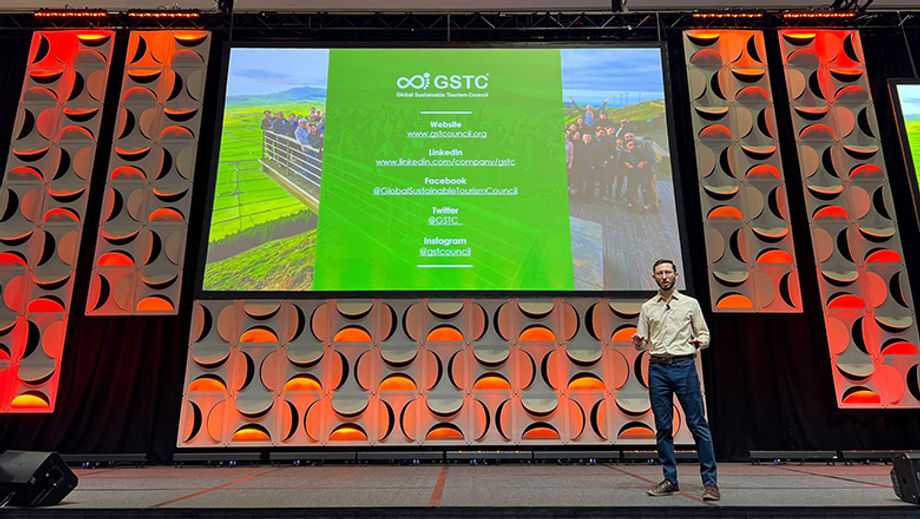
 Roi Ariel: strong demand for certification in a particular location causes the certification price for hotels to decrease.
An increasing number of certification bodies have entered the MICE
industry to certify hotels as sustainable. These include Bureau Veritas,
Vireo Srl and Control Union. The latter, for example, has more than 200
certification programmes.
Such certification bodies have in turn, been accredited for
compliance with the requirements of GSTC accreditation. The GSTC (Global
Sustainable Tourism Council), a non-governmental organisation
established in 2007 with the support of UNEP – United Nations
Environment Programme – and UNWTO – United Nations World Tourism
Organization, has Criteria and Suggested Indicators for Hotels to
provide a common understanding of sustainable tourism, and the minimum
that a hotel should aspire to reach.
The Hotel Criteria are organised around four main themes: effective
sustainability planning, maximising social and economic benefits for the
local community, enhancing cultural heritage, and reducing negative
impacts to the environment.
In this Q&A with GSTC’s GM, Roi Ariel, M&C Asia finds out how the sustainable venue certification landscape is evolving.
What trends do you observe among the increasing number of certification bodies?
Quite a few professional certification bodies that already certify to
other sustainability standards are seeing the increasing demand in
certification of sustainable tourism, especially in the hospitality
sector, which translates to a business potential for certification
bodies. Those certification bodies then apply for GSTC Accreditation to
be able to certify hotels as sustainable - a process that may take up to
two years, pending the quality and preparedness.
When there's a strong demand for certification in a particular
location, the certification price for hotels goes down. That is due to
economies of scale, where the certification bodies don't need to spend
much resources to convince hotels that they should seek certification,
because that's already what is happening.
Examples of strong demand in a particular location would be Turkey
where it is regulated that all accommodations must be certified as
sustainable by 2030, or Singapore where in 2022, the Singapore Tourism
Board and the Singapore Hotel Association launched the Singapore Hotel
Sustainability Roadmap with a clear target of certified hotels by 2025.
How is this changing the way sustainability is being benchmarked?
When speaking about certification, it's crucial first to note its
definition: a voluntary, third-party assessment, through an audit, of a
tourism enterprise for conformity to a standard.
As such, as long as certification bodies use the same standard, and
the certification bodies are accredited as being competent in
certifying, then not much is changing.
However, the more (certification bodies) use the same standard and
same framework, the easier it is for hotels to measure and report.
What are the challenges when more certification players enter the market?
Increase of certification bodies can cause dilution of quality for
businesses that don't know which one to choose. This is why
accreditation is so important. Accreditation is a mark of quality that a
certification body has been verified through a rigorous external review
and deemed they operate in a professional process according to
international norms of transparency, impartiality, and competence. GSTC
looks very hard at the process of how certification bodies certify to
assure that they issue certifications based on merit and neutrality.
If a certification body is not accredited properly, you don't have an
assurance that they certify with transparency, impartiality, and
competence. This creates liability issues. And we are familiar with
so-called certification bodies that do not act in an impartial manner.
What are the ways meeting planners can approach this new landscape?
Meeting planners can, and should, review where events take place. If
the venue is a hotel, then check if it is certified as sustainable by an
accredited certification body. If not, ask the hotel why, and show them
it's important for you. If you don't mention it's important, then how
would they know?
The Global Sustainable Tourism Council (GSTC) is now developing a new
GSTC MICE Criteria that will be published in 2024, and will be of a
great help to meeting planners who want to plan more sustainable
meetings using similar standards to what hotels are looking at when they
approach sustainability.