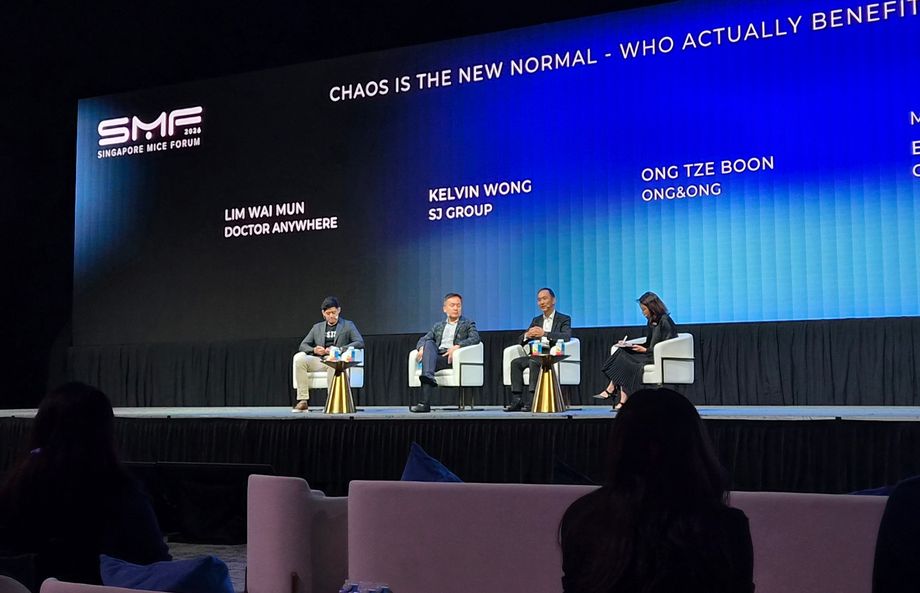
 The Singapore MICE Forum panel on ‘Chaos Is The New Normal - Who Actually Benefits?’ featured successful business owners and executives.
For meeting experts aiming to lead change in uncertain times, disruption can be more than a challenge to manage – it can be a catalyst for transformation.
At the Singapore MICE Forum 2026 last week, business leaders from the design, healthcare and built-environment sectors shared how crises and uncertainty can drive reinvention, resilience and stronger leadership.
Good problems
When Ong Tze Boon, group executive chairman, ONG&ON, took over the firm during the 2003 SARS outbreak, the company had about 60 employees and a sharp drop in projects. To sustain the workforce, he diversified beyond architecture into landscape and interior design, an unconventional move at the time that eventually became a defining feature of the business.
He later applied the same thinking to sustainability. Frustrated by the bespoke and labour-intensive nature of architectural design, Ong sought a more productised approach, leading him to launch EV charging company Charge+ in 2019, where he is founder and chairman. He described the venture as “less exhausting” than architecture.
“Problems are the beginning of all opportunities,” he said, adding that he is constantly looking out for “good problems” that can become opportunities.
Preparing well
Meanwhile, Kelvin Wong, group chief commercial officer & region head, Asia, SJ Group, said effective crisis leadership begins well before a crisis.
Drawing on experiences including the Asian financial crisis and 9/11, he highlighted scenario planning to identify “known unknowns” such as geopolitical tensions, as well as longer-term structural challenges such as Singapore’s ageing population and shrinking workforce.
While scenario planning can help organisations stress-test strategies and prepare the right tools and partnerships, crises such as COVID-19 are “unknown unknowns” that cannot be anticipated. In such situations, the ability to respond depends on the culture and resilience built over the long term.
Authenticity builds trust
Lim Wai Mun, founder & CEO, Doctor Anywhere, said authenticity is particularly important when leading diverse teams across Southeast Asia. He found his most effective all-hands sessions were those where he put aside prepared scripts and spoke candidly about what mattered to employees.
With new challenges emerging constantly, he said authenticity is critical to maintaining trust. Rather than relying on prepared messaging or projecting certainty, leaders should be open about challenges to help employees understand the situation and strengthen their confidence in leadership.
Organised by the Singapore Association of Convention & Exhibition Organisers & Suppliers (SACEOS), the Singapore MICE Forum took place at Resorts World Convention Centre from 29 to 31 July 2026.