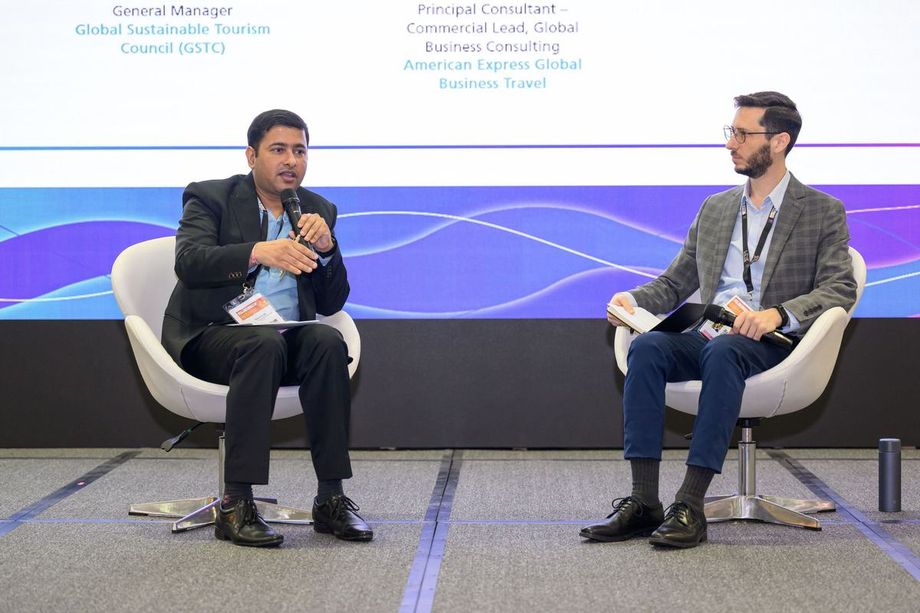
 (from left) AMEX GBT’s Vibhav Singh and GSTC’s Roi Ariel. Photo Credit: ITB Asia
The value of embracing the Global Sustainable Tourism Council (GSTC)
framework is becoming increasingly evident as meeting planners witness a
rising demand for accredited venue certification from their clients.
Roi Ariel, general manager of GSTC, and Vibhav Singh, principal
consultant – commercial lead at Global Business Consulting, American
Express Global Business Travel (AMEX GBT), shared insights into this
growing trend.
AMEX GBT, which first joined GSTC around three years ago, was one of
the pioneering travel management companies in this domain. Managing
hotels for individual clients and those procured globally on behalf of
customers, AMEX GBT has already secured GSTC certification for 22% of
its total global programme cache of approximately 35,000 hotels. The TMC
aims to achieve 25% certification by 2025 and is on track to surpass
this goal soon.
When conducting hotel RFPs for clients, AMEX GBT assesses factors
such as average carbon footprint, water consumption, and other criteria
aligned with the GSTC framework. Singh explained that hotels meeting
GSTC-recognised standards receive a score of 5, while those with
GSTC-accredited standards earn a score of 6.
AMEX GBT employs an Environmental, Social, and Governance (ESG) index
ranging from 1 to 6, with higher scores indicating greater
sustainability. The index covers various aspects, including
sustainability planning, societal impact, ecosystem conservation, waste
and water management, energy conservation, carbon emissions, responsible
purchasing, and diversity and inclusion.
Low scores don't automatically disqualify hotels, as AMEX GBT
identifies gaps and highlights a hotel's strengths to clients. Singh
emphasised that these scores are context-dependent; for example, a
French hotel might naturally have a lower carbon footprint due to
reliance on nuclear energy compared to hotels in India that use fossil
fuels.
“My client asked recently why a particular property has a low score
and then we were able to dig deeper to give them advice,” said Singh.
Icons on booking tools help clients to identify preferred hotels
which meet GSTC sustainability standard. In conversations with hotels
and chains, AMEX GBT communicates its goals in sustainability and how
this is going to benefit the hotel and chain partners.
“So far, we have received a lot of queries from hotels and chains.
Many of them have gone back to GSTC asking for their guidance for which
is the right certification for them. It takes time if a hotel decides to
get certified, as there could be changes needed in their premises and
supply chain and businesses, which today, do not meet the GSTC framework
of criteria. But with these changes, maybe one or two years down the
line, they will be eligible for certification. This is a gradual process
that we are aware of.”
It takes time if a hotel decides to get certified, as there could be changes needed in their premises and supply chain and businesses, which today, do not meet the GSTC framework of criteria. But with these changes, maybe one or two years down the line, they will be eligible for certification. This is a gradual process that we are aware of.
Vibhav Singh, principal consultant – commercial lead, Global Business Consulting, AMEX GBT
Growing number of certification bodies
When it comes to certification, GSTC will only accredit professional
certification bodies. Hence, with an increasing demand for such
services, these third-party certification bodies are also increasing in
number globally.
Said Ariel: “This is where a lot of certification bodies are opening
themselves to external review for organisations to see how they
certify.” Among the well-known players are Control Union and Bureau
Veritas.
GSTC’s relationship with Singapore hotels
Singapore, as the first destination to apply the GSTC certification process on a country level,
is a unique case because there are already a significant number of
stakeholders engaged with GSTC, said Ariel. Singapore Tourism Board,
being a member of GSTC, has the benefit of engagement with the
association for guidance. Other members include Sentosa Development
Corporation, Resorts World Sentosa, and other consultancies.
Besides the two sets of criteria available as a framework (Industry and Destinations), GSTC is now developing two other sets: Attractions and MICE.
Singapore is at the forefront of supporting the establishment and
creation of these sustainability standards to help the industry to use a
similar language and to be the early adopter of these standards.
Encouraging steps with Turkey
Another destination, Turkey, is aggressively revamping its standards
of sustainability. Turkey has issued a mandatory national programme
whereby all hotels have to achieve a certification by a GSTC-accredited
certification body by 2030.
By end-2023, 30% of hotels in the country are expected to fulfil 14
criteria verified by Cappadocia University; by end-2025, 70% of all
hotels must fulfil 29 criteria verified by the same university; and by
end 2030, 100% must fulfil 42 criteria and obtain full certification by a
GSTC-accredited certification body.