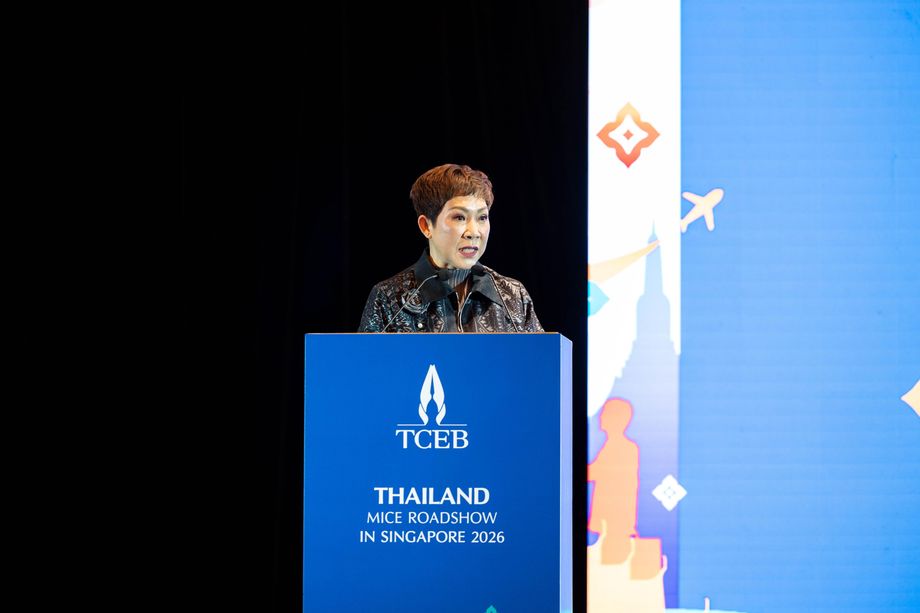
 Oil disruption prompts new energy-saving guidelines for events and venues: TCEB president Supawan Teerarat Photo Credit: TCEB
There is – for now – a sense of cautious optimism running through Thailand’s meetings and events sector. After a challenging 2025 that saw MICE arrivals decline on the back of border conflict and floods, momentum has returned to the destination, buoyed by a packed calendar of major international gatherings.
Yet, this hard-fought rebound may be short-lived as greater challenges loom. Along with the rest of the world, the destination is bracing for the escalating effects of geopolitical tensions in the Iran-US war and an unprecedented disruption to oil supply.
Heavyweights carry into 3Q
In the near term, Thailand’s MICE industry is riding a wave of high-profile events. A survey by TCEB shows no cancellations so far, said president Supawan Teerarat, who noted a possible shift in interest towards key event platforms in Asia.
In Singapore recently for a MICE roadshow, Supawan confirmed that Gastech (14-17 September), Money 20/20 (21-23 April) and the 2026 Annual Meetings of the International Monetary Fund (IMF) and the World Bank Group (12-18 October) will take place as planned.
Related: Asia’s biggest events are happening here - discover why
“Organisers see more interest from speakers and attendees because of the challenging environment in key Middle East cities. Business has to go on, so they have to find an alternative platform where their profile fits,” she said.
For Money20/20, taking place next month, organisers are still fielding enquiries from prospective speakers keen to participate and share insights on finance and technology, according to Supawan.
The shift in interest to Asian events, said the bureau chief, is “the other side” of the doom and gloom.
Against a backdrop of mounting uncertainty around oil and gas, Gastech – the world’s largest exhibition and conference for natural gas, LNG, hydrogen and low-carbon solutions – takes on added relevance when it opens at BITEC in September.
Gastech alone is expected to bring in 50,000 overseas visitors to Bangkok, with accommodation in the Bangkok International Trade & Exhibition Centre (BITEC) area approaching capacity.
An industry adapting in real time
Even as business continues, the industry is making necessary adjustments to buffer unprecedented shocks in the oil industry.
With crude oil prices pushed above US$100 per barrel – and diesel, jet fuel and LPG even higher – Thailand’s MICE stakeholders are rolling out energy-saving guidelines for venues and events.
TCEB – together with the Thailand Hotel Association and Thailand Incentive and Convention Association, Thailand Exhibition Association and the Event Management Association – has responded with a new set of guidelines recommending measures ranging from reducing air-conditioning, LED and lighting use, to encouraging rail-based transport to event venues.
With fuel constraints already affecting coach services, particularly for large buses that carry 80 to 100 passengers now facing gas caps, TCEB is working with business events stakeholders to nudge delegates towards rail-based options.
Bangkok’s three major convention centre – BITEC, IMPACT and the Queen Sirikit National Convention Center – are all accessible by rail transport, TCEB stressed.
Meanwhile, to cushion the immediate impact of rising oil prices, the Thai government has stepped in with price controls – both on fuel and across roughly 200 consumer goods and services.
Supawan estimates that these price controls may last approximately three months, but rising prices beyond this window would pose immense challenges to the MICE industry.
Greater uncertainties ahead
If geopolitical tensions persist – and with them, sustained disruption to oil supply – the implications could be “very, very challenging”, according to Supawan. Unlike Covid-19, where domestic consumption and localised events offered a fallback, an energy crisis strikes at the very ability to move.
“With oil and gas scarcity, we cannot travel,” Supawan said plainly
But for an industry no stranger to crises, players believe that the sector’s resilience and adaptability will keep business moving.