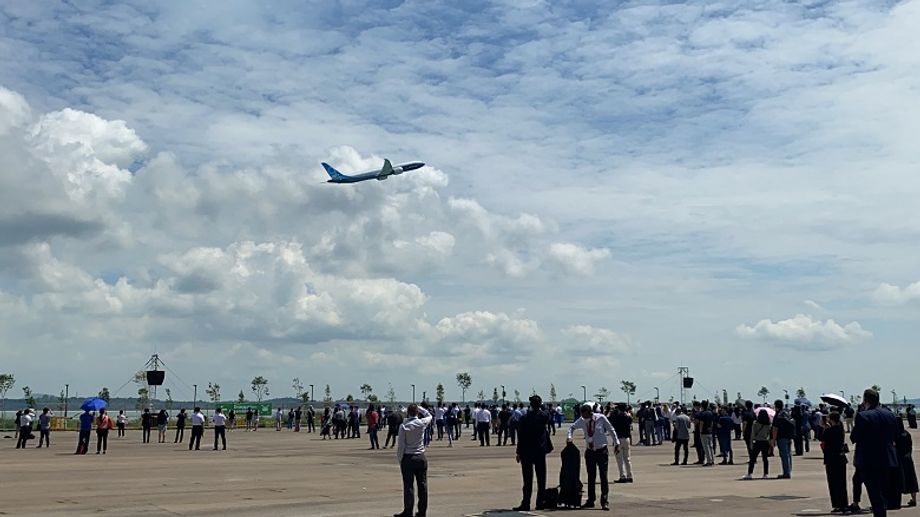
 The Singapore Airshow 2022 takes flight as Singapore's first large-scale, in-person international MICE event since the pandemic, with some 13,000 trade in attendance. Photo Credit: Natalie Joy Lee
Not only did the four-day Singapore Airshow 2022 serve as a hotbed for
collaborations, conversations and creativity, the event was also an
affirmation from the global business community that the Lion City's
restart of the MICE sector is well and truly underway.
Event
organiser Experia indicated more than 13,000 trade attendees and some
600 participating companies from more than 39 countries/regions at the
international show — setting the stage for "strategic conversations,
exchange of ideas and significant partnerships that will catalyse the
recovery of the industry in Asia," said Leck Chet Lam, Managing
Director, Experia.
Such blooming buds of recovery in the aerospace sector included
Singapore Airlines' (SIA) order for seven Airbus A350F freighter
aircraft, Etihad’s seven Airbus A350F freighters, and JetBlue’s 30
additional Airbus A220-300.
eVTOLs – electric vertical take-off and landing craft – are also
quickly gaining traction, as a means of convenient, emissions-free air
travel option for everyone. Buyers at the Airshow included Australia’s
Microflite and HeliSpirit's order of 90 eVTOLs, and AirAsia's plan to
lease a minimum of 100 VX3 eVTOL aircraft from Avolon.
And they all point to a unified direction the industry is moving towards: leaving a sustainable footprint.
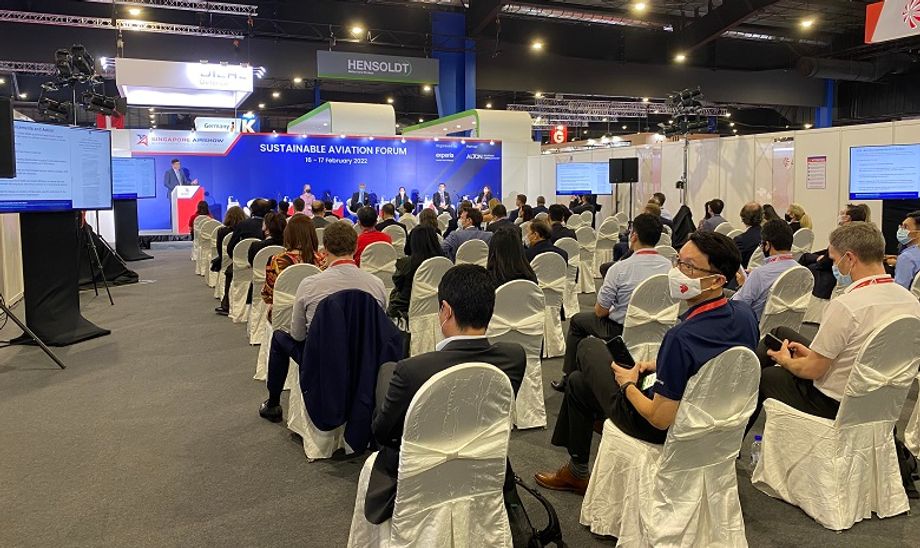 Some 70 delegates attended the second of two sustainability forums, joined by representatives from The Boeing Company, ST Engineering, Pratt & Whitney, and Shell among others. Photo Credit: Natalie Joy Lee
The Singapore Airshow 2022 hosted two sessions of Sustainable
Aviation Forums, touching on the future of technology air mobility, as
well as working sustainability into aviation operations.
In terms of partnerships, Singapore Airlines, Airbus, Rolls-Royce and
Safran signed a Global Sustainable Aviation Fuel (SAF) Declaration to
promote the acceleration of the development, production, and consumption
of SAF as an important decarbonisation ramp up.
There was also the Civil Aviation Authority of Singapore’s
collaboration with Changi Airport Group, Airbus and Linde to study the
development of hydrogen supply as an alternative for aviation — which
could mean hydrogen-powered aircraft, or the electrification of airport
operations using hydrogen fuel cells.
And perhaps the most obvious support to sustainability was to simply
look up — at the 15,000 panels installed on the roof of the Changi
Exhibition Centre, powering the event by solar energy.
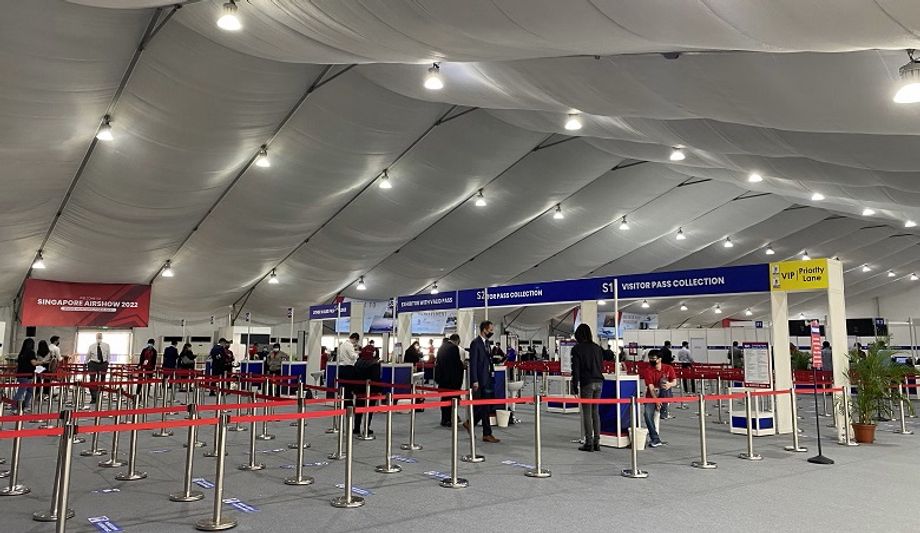 Several added Covid-safe checkpoints in a post-pandemic era, before reaching the typical security checks point. Photo Credit: Natalie Joy Lee
Covid-safe rules yay or nay?
Helping make this first large-scale, in-person international MICE
event held in Singapore since the start of the pandemic a success, was a
combination of hardware and software setups, based off Singapore's
ongoing trial of new hybrid event models.
At
the Changi Exhibition Centre, post-pandemic event protocols included
pre-registration and approval, daily supervised testing for foreign
delegates, self-administered antigen rapid tests for local attendees who
must also upload the negative results online, self collection of
passes, before finally reaching security checks.
A quick poll saw a consensus: while such Covid-safe rules can be
cumbersome, eight of 10 agreed these measures helped them feel safer,
whether at the Airshow, or touring Singapore.
For Thomas Imke, Regional Sales Director at Ruag AG, this year's
event marks his 10th time to the show. Although he missed 2020's event
due to the uncertainties that came with the start of the pandemic, the
German exhibitor says Singapore's safe management measures such as daily
checks "at least for the time being are an absolute must".
It's a sentiment echoed by another Australian attendee, who said that
"once we're here, Singapore's very good at handling the check-ins,
everyone's wearing masks, I feel safer".
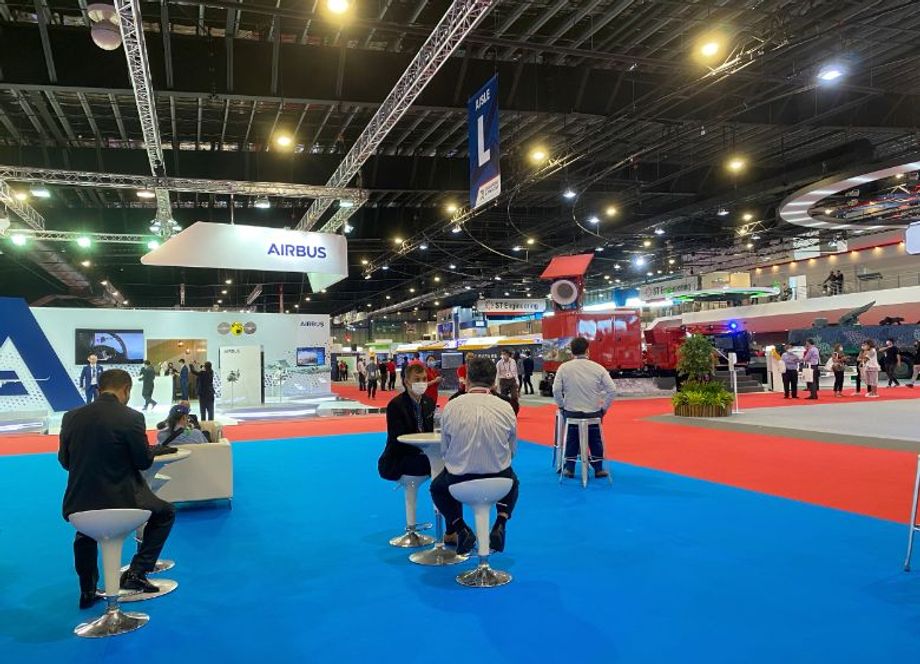 A total of nine, well-spaced meeting zones were set up for the show this year. Photo Credit: Natalie Joy Lee
New creative rules of engagement
Attendees this year represented more than 70% of the top 20 global aerospace companies. With zoning requirements removed since end 2021, everyone mingled freely on the show floor, which consisted of indoor exhibitor booths, multiple dining areas and meeting zones, as well as exclusive hospitality chalet areas and a static display zone.
Unlike the recent Industrial Transformation Asia-Pacific 2021 in
November, which did not allow dining or drinking, delegates at the
Singapore Airshow could sit at tables of not more than five each, and
pick from vendors the likes of Goodwood Park Hotel, Orchard Hotel
Singapore, Starbucks, and catering company Creative Eateries.
The nine, well-spaced meeting zones were also often filled with
delegates either catching up over drinks, or resting in between
appointments.
Muhammed Fikri and Ismail Hakim, both from R.I.S.E Aerospace pte ltd,
said these networking points were a welcome change from the last
Airshow in 2020 which did not have any, but noted that there were lesser
exhibitors and content this year. "Companies that we normally see are
not here, such as Satair Group," said Fikri.
New creative rules of engagement also went towards VIP hosting design.
While major aviation players such as Lockheed Martin, Rolls Royce and
Airbus took up sea-fronting chalets for its VIPs, main exhibitor
Singapore Technologies Engineering (STE) built its suites directly above
its exhibiting area — a smaller one with an open top concept on the
ground level overlooking the showfloor, and another row of suites on the
mezzanine level for privacy.
As a further sign of the aviation industry's comeback post pandemic,
Hanoi will be hosting the upcoming Vietnam International Aviation Expo
from 10-12 May, while Thailand is expected to host its first ever
international airshow in 2027 over six days to both business and public
attendees.