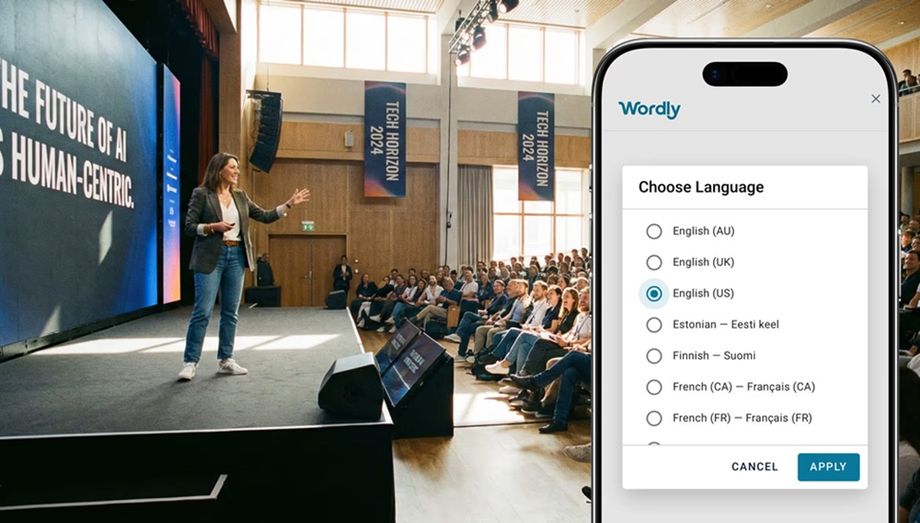
 One billion minutes of translation and captions signal growing AI adoption in the wider industry. Photo Credit: Wordly
Live AI translation provider Wordly has crossed one billion minutes of AI-generated live translation and captions since the launch of its platform in 2019.
According to Wordly, it has helped deliver more than US$200 million in savings since 2019, presumably derived from the one billion minutes of AI-generated live translation and captions delivered across 300,000 sessions in 120 countries.
The company claims that customers “consistently report savings of 50% or more” compared with equivalent human interpreter fees.
The savings estimate appears to be based largely on a comparison between Wordly’s flat-rate pricing model and the projected cost of hiring human interpreters, rather than independently audited reductions in overall event expenditure.
“Hiring human interpreters requires a minimum of two interpreters per language – and costs compound fast. For an event supporting six languages, that's 12 interpreters before a single word is spoken. According to a recent survey, 40% of meeting and event planners report attendees speaking six or more non-English languages – making multilingual support a widespread and costly challenge,” Wordly said in a statement.
While the one billion live translation minutes milestone (and additional hours by similar services such as Interprefy) signal growing AI adoption across the events industry, the reported US$200 million savings may warrant some, well, interpretation.
Wordly promotes a savings calculator that estimates cost reductions based on variables such as annual translation hours, average Wordly hourly fees and interpreter hourly rates.
It should be noted that regular interpretation is still far from universal in the meetings and events industry. While interpretation may be common in large international congresses, government meetings, association summits and regulated sectors like healthcare or finance, until AI tools came about, many events still operated largely in English only, especially regional corporate meetings.
Moreover, in high-stakes settings such as executive summits, negotiations, medical congresses or policy forums, where nuance, accuracy and cultural interpretation remain critical, AI tools may fail to replace human interpreters.
Related: Can the new AirPods make meetings multilingual? | Meetings & Conventions Asia
Nevertheless, the broader interpretation market, which Wordly cites as being worth US$15.8 billion in 2026, is facing unmistakable pressure from AI-driven alternatives. The intersection of AI solutions with hybrid and large-scale international events have also created demand for multilingual support at a scale that many organisers previously could not afford.