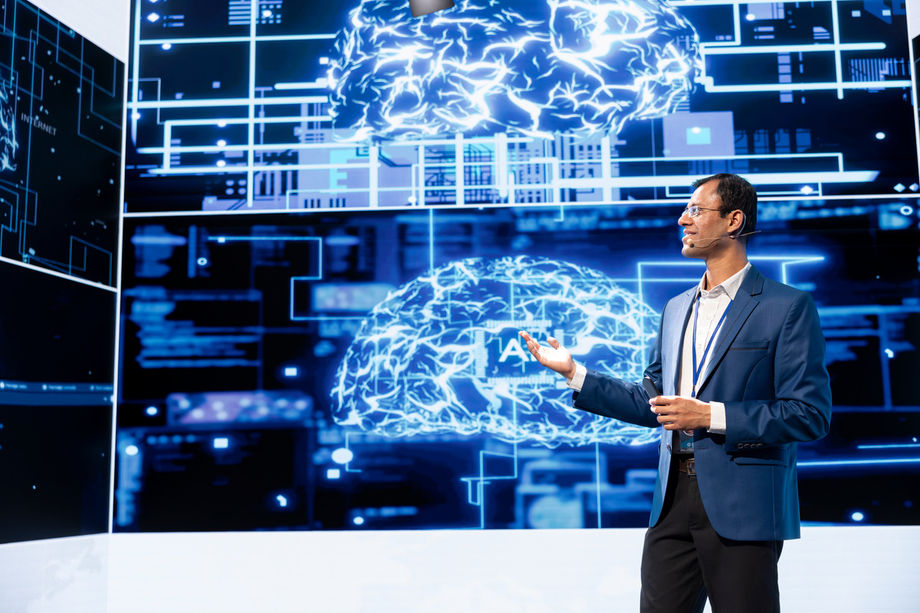
 While artificial intelligence usage is on the rise, potential pitfalls lie ahead - and it’s up to event planners to navigate them. Photo Credit: Adobe Stock/DC Studio
AI is “the gift that keeps on giving”, according to Kim Hyde, conferences and events professional at CPA Australia.
“It’s been that way for the past 18 months,” she said. “If you
include [AI] in your programme and your agenda, people will definitely
be there, they want to hear about the latest technologies and how to use
them.”
Hyde was speaking with fellow events professionals at the recent
“What’s AI doing in events?” webinar organised by the Professional
Convention Management Association (PCMA). Moderated by Florence Chua,
managing director of PCMA APAC, the hour-long session sought to address
how organisers could most effectively make use of the tools at hand.
Examples of such solutions include Gevme’s snapsight AI technology,
which listens in on the content being discussed at conferences and then
creates a real-time summary of the event’s key points.
“This way, attendees don’t have to sit at a conference frantically
typing away trying to catch up with the latest thing that’s just been
said by the speakers – it takes that stress away from you.” Hyde said,
adding that in this manner, attendees are free to fully engage with the
speaker and their presentation.
Getting it right: AI’s role in enhancing events
Over the past year, AI has penetrated into many events and conferences, with positive effects.
“At Asia Tech x Singapore this year, we had five conference stages
across three days,” shared Patricia Cheong, event director at Informa.
“For attendees, the biggest challenge would be to choose which session
they should be attending, and snapsight gave us the opportunity to allow
our attendees to sit in on one session yet avoid missing out on the
others because the key takeaways were captured and we were able to share
it with them.”
Another way that AI can be managed across multiple usage fronts
presents itself in live captioning, which is a popular feature commonly
requested by non-English-speaking attendees.
“Live captioning provided attendees with the option of reading off
their screens, whatever the speaker was saying… It really did help with
enhancing the experience for them,” said Cheong.
The next frontier: Navigating AI’s challenges
AI and its applications have come a long way since its rudimentary
beginnings, but challenges remain. According to Dr Oliver Lock, AI
studio director at Deloitte, there is still a large hurdle to overcome.
“Falsely generated content is a big challenge… As AI tools get easier
and easier to use, the temptation to create things faster can lead to a
huge influx of fake events, avatars, AI-generated content,” he said.
“The challenge then will be in legitimising this information and
creating and keeping the things that make events special, like personal
connections, authentic content, and creativity in engagement.”
Organisers have to be mindful of potential cybersecurity concerns.
“Protecting our members, privacy and their data and things is very,
very important,” stressed Hyde. “And even AI isn’t 100% accurate –
there’s a reason it’s called ChatGPT, because you chat to it. It’s all
about the prompting and talking; AI won’t get it right the first time.”
In other words, human intervention and refinement is still a key
component to effective AI implementation – especially when it needs to
be utilised across various fronts and sectors.