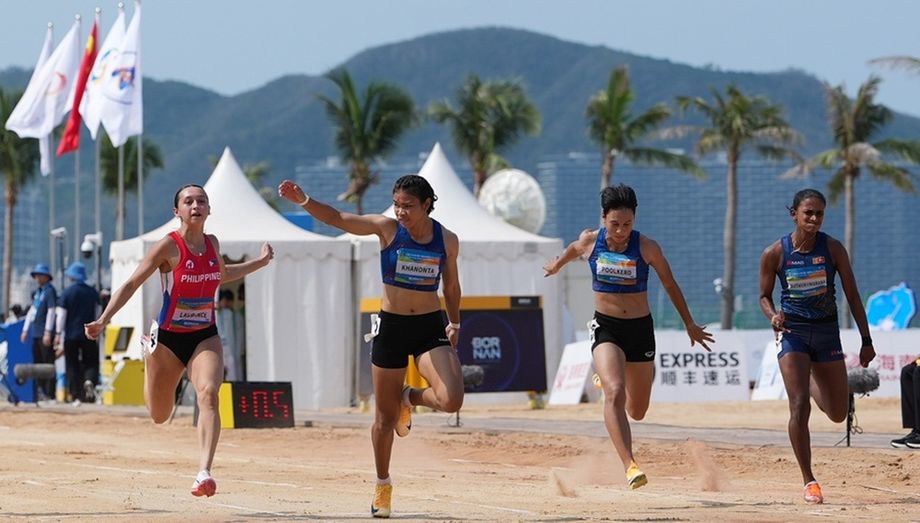
 Thailand’s Jirapat Khanonta (second from left) clinched gold in 60-metre sprints at the 6th Asian Beach Games. Photo Credit: Olympic Council of Asia
After two postponements, the 6th Asian Beach Games - which was originally scheduled for 2020 – has powered through the latest wave of global uncertainties, at a time when resilience and solidarity matter more than ever.
At the ongoing Games in Sanya, China, the participation of all 45 National Olympic Committees is a strong show of unity across Asia’s sporting community, said Husain Al Musallamm, Director General of the Olympic Council of Asia (OCA), during a press conference last week.
Despite challenges faced by several countries due to conflict in the Middle East, all delegations made it to Sanya for the Games, he observed.
Originally slated for 2020, the 6th Asian Beach Games was postponed twice due to pandemic-related disruptions.
Proof of concept
While beach sports have often sat outside the commercial profile of large-scale sporting events, the relatively young Asian Beach Games is becoming persuasive proof that compact coastal zones can serve as continental stages for both sport and tourism.
Sanya’s host narrative, for instance, brought together beach venues, a high-production opening ceremony and destination branding.
Modelling compact venue planning
The Asian Beach Games could also serve as case studies in compact and sustainable venue planning, shaped in part by the nature of coastal terrains.
Unlike traditional mega sporting events, which have historically relied on purpose-built stadium clusters, the Beach Games are staged in nature – shifting the focus towards lighter-footprint competition infrastructure.
And with many beach sport arenas temporary by design, questions around “single-use” infrastructure and equipment have become unavoidable.
According to local media reports, organisers of the Sanya Games have prioritised zero-waste goals, focusing on converting existing venues and minimising single-use equipment where possible.
Sustainability measures extend across infrastructure and operations, with eight venue clusters combining renovated facilities, prefabricated structures and rainwater collection systems. Recycled and low-impact materials such as aluminium and bamboo have been widely used, while transport is supported by a fleet of 970 new energy vehicles deployed through intelligent scheduling systems to optimise routes and reduce energy use and emissions.
Cebu takes the baton
The case for scaled-up beach games – and the unifying power of sport – is set to continue in March 2028, when Cebu City hosts the next Asian Beach Games.
The host city agreement was signed in Sanya on 26 April by OCA President Sheikh Joaan bin Hamad Al Thani and Philippine Olympic Committee President Abraham Tolentino.
The last time the Philippines hosted a continental multi-sport event was more than 70 years ago, when the 1954 Asian Games took place in Manila.
With the Asian Beach Games offering a lighter-footprint model, without the heavy infrastructural demands of traditional mega-events, the event is looking set to level the playing field for emerging sports hosts such as Cebu.