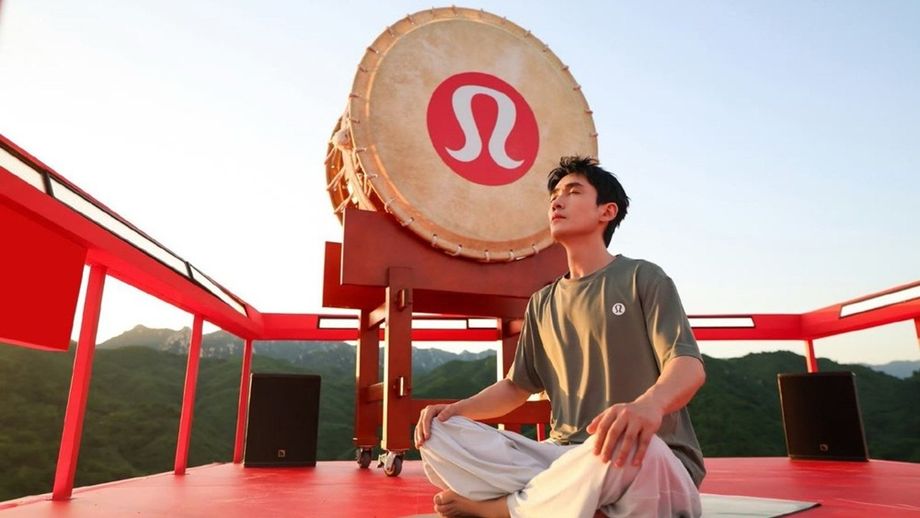
 Brand ambassador Zhu Yilong poses for the campaign.
When a global yoga-wear brand brought a wellness event to one of China's most iconic landmarks, it probably was not expecting the highlight to be the type of drums used in a performance that featured popular Chinese actor and brand ambassador, Zhu Yilong.
Held at China’s most historically significant landmark, The Great Wall, to mark the company's 10th anniversary in the mainland, Lululemon’s event attracted more than 2,000 participants and featured yoga and taichi, among other Chinese elements.
Yet, it was the drum display that ended up dominating headlines and social media. Videos and photos from the event circulated on social media and drew massive backlash from Chinese netizens – who pointed out that a drum used was a Japanese taiko drum rather than a traditional Chinese drum.
What went wrong
Lululemon issued a public apology on Weibo, explaining that the faux pas was not intentional.
The Canadian company explained that its original intention of incorporating elements such as the drumming performance was to show respect for Chinese culture.
It added that there were limitations in its knowledge that prevented it from identifying the potential controversy.
Where global brands look to local partners as experts with deeper insight on cultural intricacies, the drum detail also went undetected by the Chinese event agency responsible for the event coordination, Beijing Aodewang.
In statements to the media, the agency explained it went off trust when selecting the drum troupe as it was considered as a traditional Chinese cultural group, with added credibility from having made state media appearances.
The faux pas was certainly unfortunate, especially considering that companies make big investments in events precisely for their ability to build brand affinity and trust. For a well-intended event component to backfire to this extent also speaks to the implications of holding events in a social media era, which places the smallest of details under a large magnifying glass. If the year must deliver a reality check for global brands to prioritise the evaluation and selection of deeply knowledgeable and discerning local partners, this is it.