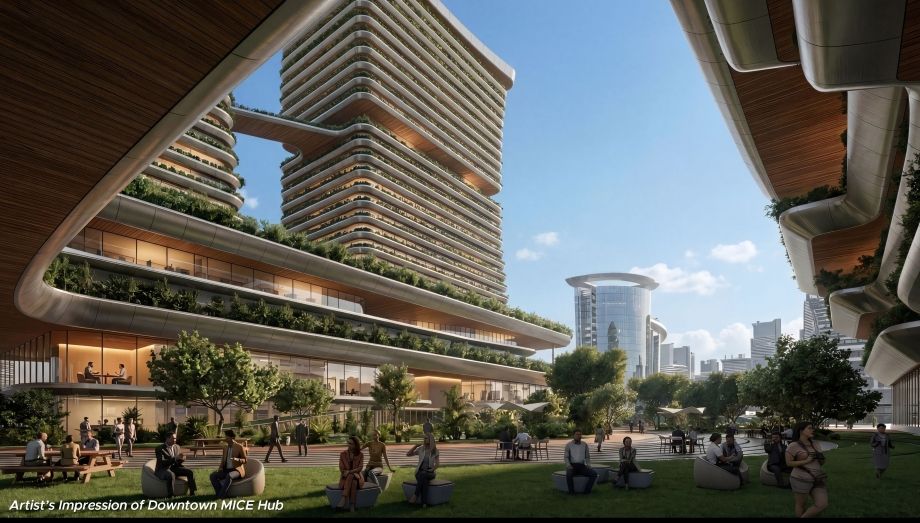
With MICE tourism receipts soaring 35% year-on-year to S$2.3 billion (US$1.8 billion) in 2025, the Singapore Tourism Board (STB) says it is on track in its Tourism 2040 vision to cross S$4.7 billion in 2040, with developments such as a new Downtown MICE Hub signalling ambitions to attract larger groups.
At STB’s recent Tourism Industry Conference, the message for the MICE industry was clear: more than sheer square footage, networks are what will power future-ready growth in the city.
Hub within hubs
The expected location of an anticipated Downton MICE Hub reveals one such an interplay of space and interconnectedness.
Planned for development in the Straits View area near Marina Bay, the integrated project – scheduled for completion in mid 2030s – would be within a three-kilometre radius of other major MICE venues such as Suntec City and Marina Bay Sands.
This would place it in vicinity of visitor-friendly precincts combining commercial, dining, leisure and offerings.
Moreover, there is a chance a new Integrated Cruise and Ferry Terminal, expected to support passenger capacity approximately 1.5 times that of the existing Marina Bay Cruise Centre Singapore, would rise near the Downtown MICE Hub, Singapore’s Minister for Sustainability and the Environment and Minister-in-charge of Trade Relations Grace Fu announced at TIC 2026.
Building for future events
Speaking at the STB conference, Fu expressed confidence that the new hub will help the city in its Tourism 2040 vision to triple MICE tourism receipts from S$1.5 billion in 2019.
“The hub will allow us to host more and bigger events downtown, and to run complementary ones concurrently at other city centre venues,” Fu said.
Elaborating, Huey Hong Ong, STB’s assistant chief executive assistant (industry development), said that the location of the Downtown MICE Hub responds to a new trend of “festivalisation”.
Today, business event boundaries are expanding well beyond convention and exhibition halls, and with that, the opportunities to design experiences and build communities have grown.
Ong said: “Events are no longer confined within the MICE venue. Brands can host smaller conferences in nearby hotels or restaurants. This opens up possibilities to reimagine how events can take place.”
Larger than the sum of its parts
Singapore is also leveraging the network effect for hosting capacity when it comes to accommodation.
Expected to enhance the city’s competitiveness for large bids, more than 22 hotels – covering 25% of total room stock in the destination – have come together to launch the Singapore Hotels Incentives for Business Events (SHINE) programme.
Growth beyond resilience
As conflict in the Middle East continue to destabilise travel, STB announced it is setting aside S$5 million of its Tourism Development Fund to support business event organisers with events confirmed for 2026.
“To ensure that we stand a good chance of continuing to attract quality attendance for MICE events, we are helping organisers shore up and defend their attendance building, said Melissa Ow, chief executive of STB.
Support for businesses pursuing additional marketing outreach will be disbursed as part of the existing Business Events in Singapore Grant.
In the few months since the onset of war, key MICE events in Singapore have generally not taken a major hit, STB stated. Ong cited examples including the Asia Pacific Maritime event in March, which drew a record 20,000 visitors in March; and Milipol TechX 2026 this month, attended by more than 20,000 participants, up from around 15,000 last year.
International partnerships are key to fortifying growth across MICE segments. Assistant chief executive of international group, Olivier Chong, shared that STB’s MoU with the Korea MICE Association has already helped secure eight international conferences on internet-related industries scheduled for later this year.
When it comes to building the meetings and incentives pipeline, the direct-selling industry has been identified as a priority area, with incentives being an integral part of the business model.