 At the Singapore Tourism Industry Conference, STB chief executive Keith Tan (right) said: “We don’t expect tourism to return at scale anytime soon but it will return and we must be ready to capture growth when it returns.” Photo Credit: Singapore Tourism Board
Slow and steady wins the race when it comes to border reopening for Singapore, but the country's top leaders are urging swifter transformation of the tourism and MICE landscape in order to capture the opportunities moving forward.
This message was conveyed loud and clear at the Singapore Tourism Industry Conference (TIC) on 7 April, when minister for trade and industry Chan Chun Sing said, “We are not waiting for a full reopening. Singapore is prepared to disrupt the status quo, transform our products and services, and harness our capabilities to capture the next lap of growth."
Singapore is indeed taking a practical and progressive approach towards reopening, evident in how the hybrid TIC event was managed, with physical delegates having to take Antigen Rapid Tests before entry, while virtual delegates watched on the GEVME platform. On-site arrangements were in line with the “Safe Business Events Framework” developed to restart events.
“As we push forward in 2021, the challenge that lies ahead is not recovery within this year or even next year, but how Singapore will prepare for long-term success and reinvent global travel,” he added.
Keith Tan, chief executive of Singapore Tourism Board (STB), encouraged the industry to answer the minister’s challenge. “We don’t expect tourism to return at scale anytime soon but it will return and we must be ready to capture growth when it returns.”
And the same goes for MICE as the island nation continues to reinvent business events through its hybrid pilot programme. To date, a total of 60 pilot events have been held, attended by close to 9,000 attendees.
While safe management measures surrounding on-site delegate cohorts and Covid-19 testing continue to be refined, industry stakeholders are now trying to tackle the issue of cost — especially as capacity limits are set to increase from 250 to 750 pax from 24 April, and any event with more than 250 attendees must include on-site testing.
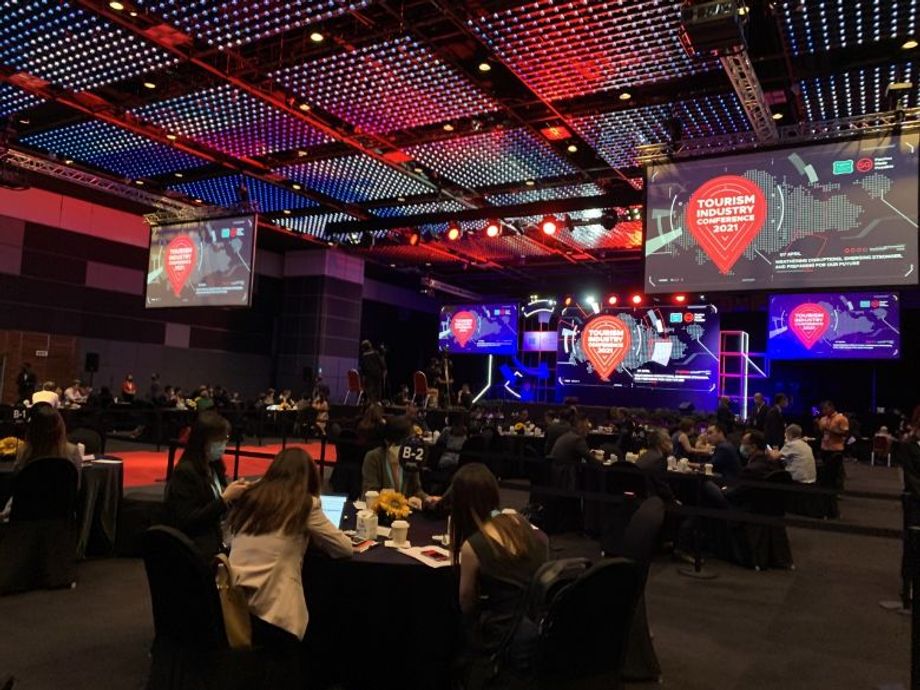 At the hybrid TIC event, physical delegates had to take Antigen Rapid Tests before entry, while virtual delegates watched on the GEVME platform.
The biggest test (ahead of hosting the World Economic Forum in August) will be the upcoming Architecture & Building Services (ABS) 2021, which is set to take place at Marina Bay Sands from 30 June to 2 July. The event will comprise seven concurrent tradeshows and 12 conferences occupying some 11,600 sqm of exhibition space. ABS organiser Conference & Exhibition Management Services (CEMS) expects to attract 2,500 delegates — making this Singapore's largest hybrid pilot event.
CEMS managing director, Edward Liu, said: "We are grateful that our company is able to collaborate closely with the Singapore Tourism Board (STB) and other agencies in establishing a safety framework of operations and measures so as to allow attendees, exhibitors and conference delegates to confidently conduct their business meetings and activities within a Covid-safe venue.
“The physical and on-site aspects of the show are critical in terms of acquiring and forging business agreements, and for cementing important business decisions. At the same time, our virtual event would help our Singapore companies to globalise and reach new markets throughout the world.”
Prior to Covid-19, the MICE industry has supported more than 34,000 jobs with an economic value-add of S$3.8 billion, or nearly one per cent of Singapore’s GDP.
“Through pilots such as ABS 2021, Singapore is challenging the assumption that larger MICE events cannot be held safely," Andrew Phua, STB executive director of exhibitions & conferences, said.
"We are progressively resuming such events, with rigorous protocols and innovative solutions for the end-to-end visitor journey. We will continue to guide and support the industry to build new capabilities, and reimagine the future of MICE events so that the industry will emerge stronger from Covid-19.”
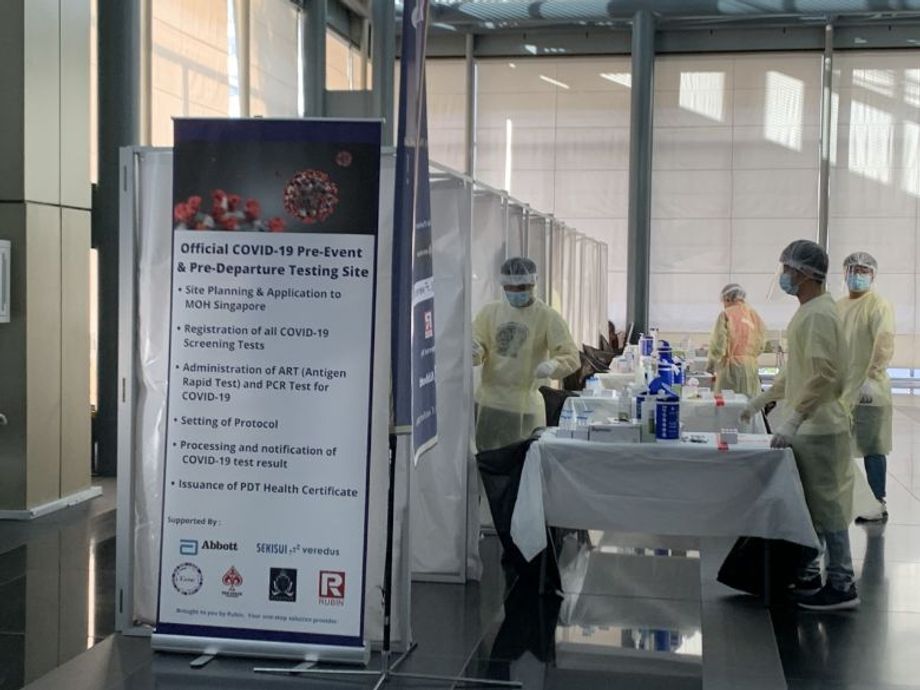 On-site testing at last week's TIC event, which will soon be compulsory for all events with more than 250 delegates.
SG SafeEvents Certification
To bolster this further, the Singapore Association of Convention and Exhibition Organisers and Suppliers (SACEOS) launched a new certification programme, known as SG SafeEvents, at last week's conference.
The certification programme is based on best practices for conducting events in a safe and responsible manner beyond what is covered under the government-mandated safe management measures and complements STB’s Safe Business Events Framework.
SACEOS president, Aloysius Arlando, said the introduction of the SG SafeEvents Certification will "help provide a competitive edge for Singapore as a MICE destination and our MICE enterprises".
He added: "Adherence to the national standards provides a mark of assurance to the industry and the global community that events organised by certified organisers, suppliers and held at certified venues are recognised under the programme to be safe; and the health and wellbeing of all involved are managed with the utmost care and consideration.”
Further details on the certification process and panel of certification bodies will be available in May 2021. In the meantime, SACEOS has been working with NTUC Learning Hub to provide training for a team of SG SafeEvent Ambassadors, whose role is specific to the requirements of the SG SafeEvent Standards. To date, 700 ambassadors have undergone training, and SACEOS hopes to increase the pool to 1,000 by June/July in anticipation of increased demand.
Area of opportunity: wellness and tech
During the event, both minister Chan and STB's Tan highlighted two long-term opportunities for Singapore: sustainability and technological transformation.
The government's vision is to position Singapore “as a top sustainable and innovative urban destination” and it wants to be the “best place to test-bed sustainable tourism products and experiences”.
Tan also questioned whether Singapore could build up its position as a leading urban wellness haven, where wellness offerings and experiences are integrated into the daily life.
“This is a serious challenge as “wellness” is not a top of mind association with Singapore yet,” said Tan. Other cities are stepping up, he said, mentioning The Living Room by the Octave Institute in Shanghai and Bellecel in London.
In the area of technology, Tan challenged the industry: “Can Singapore become a thriving marketplace that brings together the most innovative and promising technology solution providers on the one hand and the most forward looking, tech-savvy tourism companies on the other hand?”
Learn, test, build
To prepare the broader tourism industry for digital transformation, Tcube was also launched at the conference. It will help businesses in a three-step Learn-Test-Build framework. Companies can do self-assessment with the Tourism Transformation Index (TXI) and get recommendations on how to transform.
The Singapore Tourism Accelerator programme, launched in 2019, helps test solutions and to date, it has supported 21 startups to develop 35 industry solutions. It will extend the Accelerator to September 2023. Under “Build”, STB has developed a suite of smart services such as Tourism Information and Services Hub (TIH) and Stan.
To help the industry survive “this long winter”, more financial support schemes are being rolled out and extended. It will top up the Tourism Development Fund (TDF) by S$68.5 million and enhanced support levels until the end of March 2022.
This will include the Business Improvement Fund (BIF) and the Training Industry Professionals in Tourism (TIP-IT) grant.
Additional reporting from Siew Hoon Yeoh, WebinTravel.