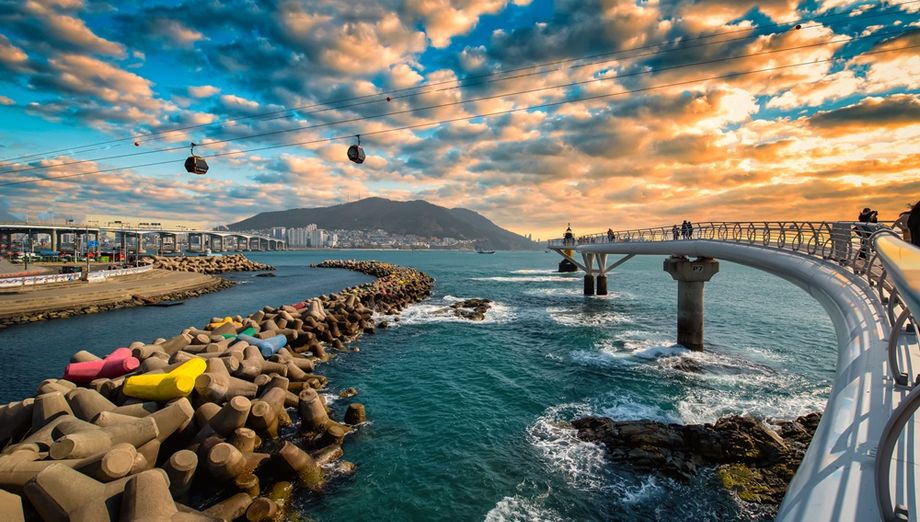
 South Korea courts incentive groups of more than 1,000 delegates from China with diverse regional mix. Busan pictured. Photo Credit: AdobeStock/nuttawutnuy
Stronger air and sea connectivity, coupled with a broadening regional playbook, is fuelling Asian incentive demand into South Korea, with China driving fastest growth.
“When it comes to our main [Asian incentive] markets of Chinese Mainland and Taiwan, our focus is on attracting groups of more than 1,000 participants – with an emphasis on promoting Korea’s regional MICE destinations,” In Sook Lee, executive director, MICE Division, Korea Tourism Organization (KTO), told M&C Asia on the sidelines of The Meetings Show Asia Pacific (TMS APAC).
China incentives roll in on cruise wave
Based on KTO data derived from incentive groups that received destination support, Chinese Mainland (37%) was the top source market in 2025, while Taiwan came in third with a 15% share. Year on year, China was also the fastest growing, with a 10 percentage-point increase over 2024, followed by Taiwan with 3 percentage points.
For now Chinese Mainland groups frequently include Jeju on their itineraries, while Taiwan groups favour Busan.
Chinese Mainland incentive delegates tend to arrive at the island through cruise-linked itineraries, Lee shared, with the resort destination enjoying connections from key Chinese ports in Shanghai, Tianjin and Guangzhou.
Jeju is expected to become more popular with new direct connections from Incheon International Airport benefiting groups combining meetings in Seoul with extended programmes in Jeju – but also travellers from key markets such as Taiwan that did not previously have international flights to Jeju.
Marking the revival of the Incheon-Jeju route after a decade, Jeju Air will launch twice weekly flights from May 12 to August 7, 2026, “significantly reducing the need for transfers via Gimpo Airport” for delegates visiting Seoul.
Go big, go regional
While Jeju and Busan are obvious incentive drawcards. the visitor-readiness of secondary destinations across South Korea is promising to open up new opportunities as KTO trains its sights on attracting larger groups from its key markets.
Signalling its regional diversification strategy, South Korea made its first joint destination participation at TMS APAC this year. KTO led a bloc of 21 tourism companies – including Seoul Tourism Organization (STO), Gyeonggi Tourism Organization (GTO), and Busan Tourism Organization (BTO).
Beyond the primary incentive destination of Seoul, Gyeonggi, Busan, and Jeju, Lee shared that Gangwon, Jeolla, and Gyeongsang provinces and regions are gaining traction.
The diversity of visitor-ready secondary destinations is giving KTO a strategic edge when it comes to attracting repeat incentive groups, or even first-time visitors seeking greater cultural exposure and depth in their itineraries.
Easy accessibility from the Incheon gateway is integral to KTO’s strategy of promoting multi-regional, and perhaps more extended, incentive itineraries for larger Asian groups. Besides the Incheon-Jeju flights, Lee expects other domestic route expansion, such as Incheon-Gimhae (Busan) and Incheon-Daegu, will strengthen the appeal of mixed-region itineraries.
Besides China and Taiwan, KTO’s data shows Vietnam (15%), Thailand (8%) and Japan (8%) among the top five incentive feeders.