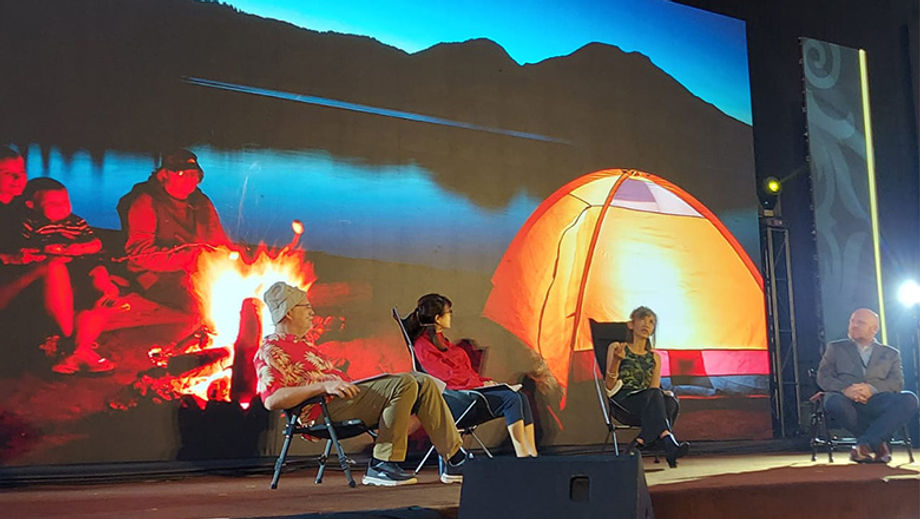
 Discussion between panelists during a "campfire" of The Legacy Impact of Business Events at the 3rd Business Events Tribal Meet (TriBE Assembly) Sarawak. Photo Credit: Anis Ramli
In the global conference and meetings industry, the concept of legacy is
gaining traction. Planners are being encouraged to think past the set
dates of a meeting, and to focus instead on how events can leave a
lasting impression, long after the event has taken place.
Executed
correctly, events legacy can be a value-added differentiator for both
event organisers and host destinations, particularly for those who want
to make a sustainable impact.
Speaking at the 3rd Business Events Tribal Meet (TriBE Assembly)
Sarawak, Waikin Wong, regional director – Asia Pacific of the
International Congress and Conventions Association (ICCA) said: “In the
past, organisers often looked for immediate outcomes. The conversation
now has turned to what are the key impacts, or long-term benefits,
events can bring to society.”
Take the 2021 congress of ESTRO (European Society for Radiotherapy
and Oncology), for example, which was held in August 2021 in Madrid,
Spain. Delegates came together to respond to the lack of information on
radiotherapy by creating a website to make information accessible to
all: specialists, medical students and the public. Further, working with
Madrid Convention Bureau, the impact of the congress ultimately led to a
€700 million investment by the Spanish government in radiotherapy
machines, which were in short supply, equipping hospitals across Spain.
“The point is not to be intimidated by such examples, but to start
somewhere no matter how small,” said fellow speaker Nigel Francis Brown,
director of marketing & partnerships at Best Cities Global
Alliance.
With interest in the concept of legacy gathering pace, here are some
considerations for event professionals looking to deliver a lasting
legacy for their events.
Prioritise the long-term positive impact in the early planning stages of your event.
“Look at what you want to achieve – your mission and vision,” says
Wong. “What kinds of activities and outcomes can it lead to? Then tailor
the legacy of your events to these values for authenticity.”
Work with stakeholders at all levels. “It’s easy to
say the responsibility and accountability of planning legacy strategies
sits with the association,” says Andreas Zins, Dean, Faculty of Business
at Curtin University Malaysia. “But every stakeholder needs to get
involved: from event organisers to the host country’s convention bureau
and the local community,”
Measure the impact post-event. The notion of leaving
something good is attractive, but how do we measure the value of the
legacy? Brown recommends using the Best Cities Global Alliance toolkit, a
framework of measurement indicators to help organisations quantify the
legacy impact of their events and meetings.