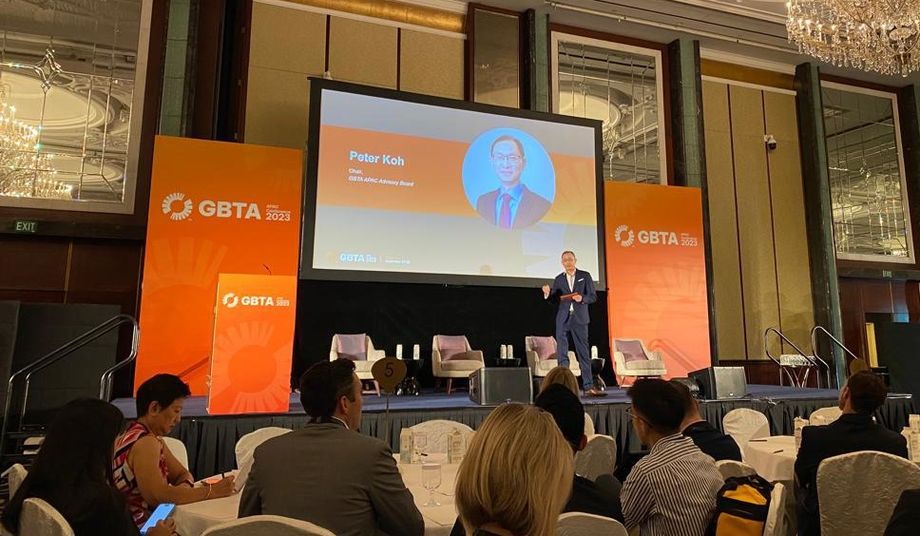
 GBTA’s Peter Koh: welcoming delegates and buyers to the event. Photo Credit: Patricia Wee
The GBTA APAC Conference 2023 was launched in Singapore at Shangri-La
Singapore from 19-20 September 2023, showcasing the strong return of
business travel to the region. Delegates from 17 countries comprising
over 400 delegates and 120 buyers were present. Peter Koh, chair, GBTA
APAC Advisory Board, along with Mark Cuschieri, president, GBTA board of
directors, opened the ceremony after a colourful lion dance
performance. The event was run concurrently with Worldwide ERC Global
Mobility Summit.
Cuschieri announced the launch of the new GBTA Global Equity Program
and called for sponsors to support this initiative that will attract and
empower new and diverse voices from the global business travel
industry. These voices will include qualifying travel professionals in
the OECD low to upper-middle income countries and offer them one-year,
free GBTA membership with tailored programme benefits. With the kickoff
for sponsorships, the association is preparing for applicants, and in
2024, application details will be available and the process will open
for APAC travel planners, before rolling this out to other regions.
Besides a slew of networking sessions, roundtables and speaker
sessions, the event also saw the announcement of a new award for the
association, The Business Travel Service Award 2023 which went to Carl
Jones, VP and head of Strategy for Asia Pacific, SAP Concur.
Singapore Tourism Board’s executive director, Exhibitions &
Conferences, Poh Chi Chuan, was the guest speaker at the opening
ceremony, and was pleased to announce that Singapore achieved, as of
August 2023, 9 million visitors for the year. Tourism is expected to
recover to pre-pandemic levels by early next year.
Suzanne Neufang, CEO, GBTA, presented the 15th GBTA Business Travel
Index Outlook, an annual study of business travel spending and growth in
72 countries, 44 industries and 4,700 business travellers across five
global regions.
 A panel discussion at the GBTA APAC Conference 2023. Photo Credit: Patricia Wee
Some highlights of the Index Outlook:
· Dynamic changes and workforce transformation are influencing
business travel, with increased focus on sustainability, where
sustainably managed business travel is a force for good, where it drives
progress for businesses, governments, economies and people.
· Major changes also include advances in tech and automation.
· In 2022, spending rose 47% to US$1.03 trillion and in 2023,
strong gains continue and 32% growth in global expenditure is expected.
· In 2024, business travel spending will return to pre-pandemic
level of US$1.4 trillion, faster than earlier projected. In 2027,
spending forecast will grow to nearly US$1.8 trillion.
· The drivers of stabilisation - return to in-person meetings and events, and some international business travel.
· The most resilient industry sectors are construction, education, professional, scientific and technical.
· The least resilient industry sectors are wholesale trade, retail trade, information and communication.
· The potential impact of longer-term factors includes the
widespread adoption of virtual meeting technologies, growth in remote
work, rise of new forms of blended travel, and increased focus on
sustainability.
· In 2024, average air ticket price is forecast to be US$780, up from US$766 in the 2023 forecast.
· Hotel average daily rate will be US$174, up from US$168 over the same period.
· Meetings and events – average attendee cost per day will be US$174, up from US$169 over the same period.
· In 2019, US$1 was spent on business travel for US$177 of
sales; in 2022, this figure was US$198 (during COVID-19); in 2023, it
was US$153, highlighting the importance of tracking business travel and
its effectiveness.
· 62% blend business travel and personal travel more than they
did in 2019; 42% add leisure days; 79% stay at the same accommodation
for business and leisure.
· Significant rebound is expected in APAC – 41% gain to US$567
billion in 2023. The region is back to 92% of 2019 business spend of
US$616 billion.