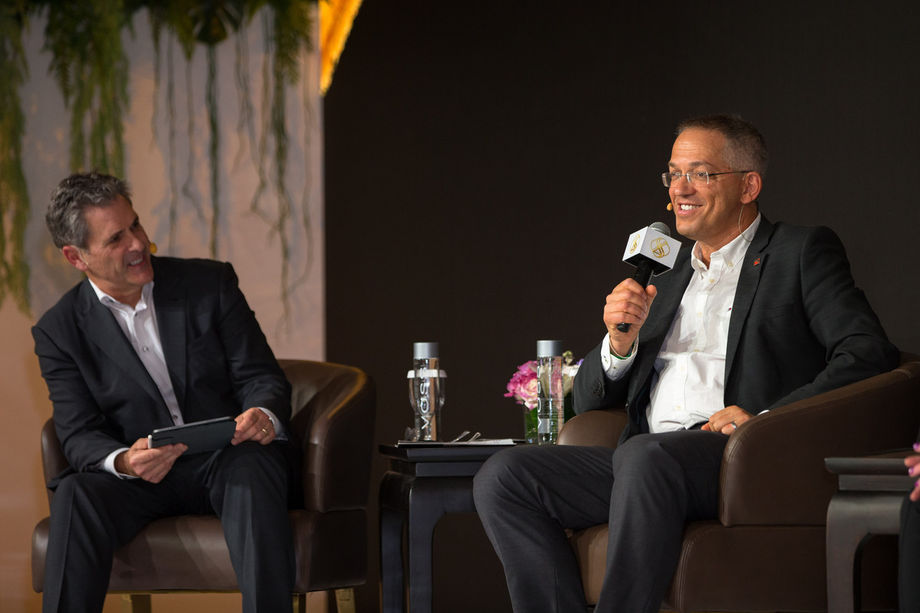
 Discussing trends (from left): Northstar Travel Group’s David Blansfield and The Kenes Group’s Dan Rivlin. Photo Credit: Sands China
Leading meetings and events specialists recently shared how the post
pandemic world is changing the values of attendees and what must be done
to help them.
The session, Meetings & Events in a Post Pandemic World: Status
Quo or A New Game?, took place on June 8, 2023 at the recent MICE &
Luxury Forum hosted by Sands China at Sands Expo & Convention
Centre. Panel speakers for this session were Dan Rivlin, executive chair
and chief vision officer, The Kenes Group; Maureen Rogers, director,
Global Meetings and Events, Baker & McKenzie; and Sherrif Karamat,
president and CEO, PCMA and CEMA. Moderating the talk was Northstar
Travel Group’s executive VP and group publisher, David Blansfield.
M&C Asia condenses the highlights:
Understanding the changing values of buyers
The Kenes Group’s Dan Rivlin said that last year, 80% of participants
came back. His company organises mainly medical and scientific events.
Japan and China were out of the game, but this year the company is
seeing “incoherence of results” – whilst most meetings are back to 100%
or even more than pre-covid, some of the giant European and US brands
have dropped 50%. Some meetings are hovering at 50-60% of pre-Covid
level.
The challenge is having to understand if clients have changed during
the pandemic and re-evaluated their preferences, or whether this is just
a temporary pattern. The demand for the virtual part of hybrid meetings
has dropped and people are simply voting with their feet. Virtual
meetings are considered an extra expense that will be reduced more and
more as people prefer in-person meetings, he said.
PCMA and CEMA’s Sherrif Karamat further affirmed Ravlin’s point about
the need to understand how values have changed. He said: “We are only
starting to realise that, and as we see the euphoria of going back to
face-to-face, it is going to be interesting to see how this materialises
in the future.
“What I’m seeing is that we are not prepared to change. We are not
changing our events, we are not changing based on how people’s values
are changing and I think we have a problem.” He stressed that by
understanding values, it would make all the difference as to how an
event is delivered since delivery channels are completely different from
each other.
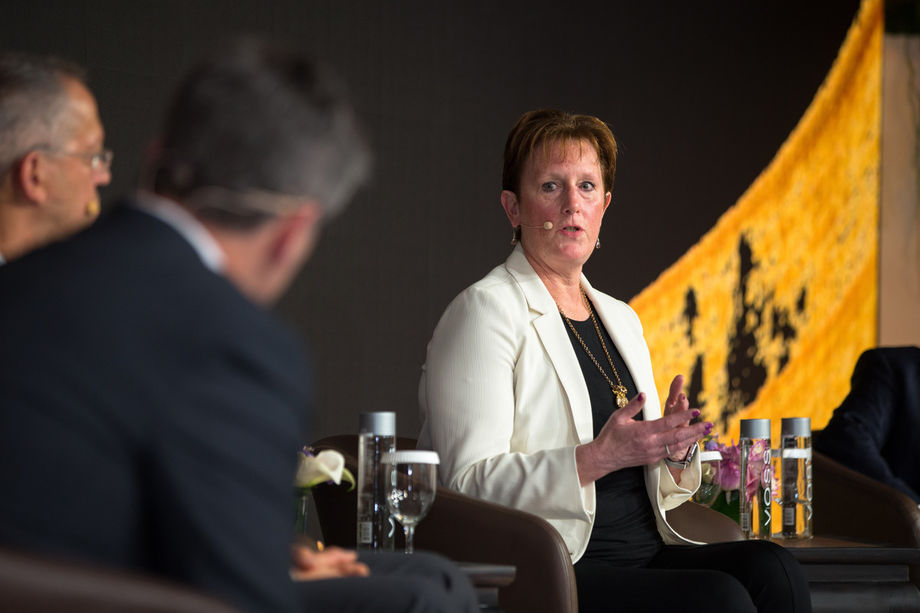 Baker & McKenzie’s Maureen Rogers: executives are evaluating new event strategies with carbon offsetting as a priority.
From the buyer side, Baker & McKenzie’s Maureen Rogers said that
when in-person events returned, the uptick started with North America,
India and this year, in the Asia Pacific, with executives looking at
sustainability as a priority. Decisions consider carbon offsetting. She
added that getting the right mix was crucial. “We need to change for
sustainability, for wellness and for financials.” One of the goals of
in-person meetings is collaboration and strengthening the culture of the
firm.
Sustainability in the whole value chain
Rivlin pointed out that whilst clients are happy to go to a venue
where there is recycling and sustainability, “nobody is going to pay an
extra US$50,000 because this venue has a better recycling or social
responsibility that is done here more than in another venue. It is nice
to have, but it needs to have a common action and created as a standard
so it’s not a matter that it costs extra, but that everybody is doing
it, and that’s the cost.”
Karamat shared that in a survey done by his company, almost 92% of
European event organisers had sustainability elements in their contract.
In North America, especially in America, there was 52% awareness, but
only 7% of such elements were included in their contracts.
“What we are finding though, is that the younger consumers of events
are very purposeful and purpose-driven, and they are demanding much more
sustainable practices. Our industry is focused on things that are not
sustainable. We are talking about 10% that has very limited impact on
the environment. What we are doing, while it may make you feel good but
the impact on purpose is really not good at all, so we have a lot of
work to do. I do think there’s opportunity here. The fact is, maybe it
is not registering, but morally and ethically, it’s something we all
have to come to terms with.”
As for Asia, sustainability is lagging behind, but there are CVBs
such as the Singapore Tourism Board (STB) that have taken on a major
initiative. “This cannot be handled by just the STB. It needs all the
supply chain, the entire value chain to get involved in this. Any step
is a step forward…we have to start somewhere,” he said.