 With new Covid-19 variants prolonging recovery, international business travel will continue to be tricky to navigate. Photo Credit: Getty Images/Peshkova
While hopes for a speedy recovery may be dimming, global medical and
security services firm International SOS says companies can start
planning for the resumption of business travel — by ensuring they have
robust risk assessment frameworks and monitoring capabilities in place.
While vaccines are being rolled out, there are questions as to
whether these would have the same efficacy on new virus variants. “If we
get a variant that’s immune from [existing vaccines], we would have to
start again... It will be a while to get a new vaccine into people’s
arms,” Doug Quarry, International SOS' group medical director, medical
intelligence, said during an webinar by the Singapore-headquartered
firm.
“I am way less happy [about pandemic recovery] now than I was six
weeks ago, partly due to the new variants. The UK variant has been shown
in various studies to be somewhere around 50-70 per cent more
infectious,” he said.
Quarry explained that incidence of transmission compounds with every
infected person, leading to an exponential increase in cases. Given that
some international travel activity has already resumed (and some
countries still lack the genomic testing to detect the new variant),
this could have knock-on effects for the rest of the world.
As of 17 January, the UK variant has emerged in 60 countries,
according to the World Health Organization's weekly update. And
according to Quarry, there is a “fair possibility” that these countries
are 10 weeks behind the UK curve, where severe strains on medical and
healthcare systems are imminent.
Against this backdrop, it would appear that international business travel will continue to be tricky to navigate.
“Apart from the vaccine rollout, [we are facing the continued
challenge of] government restrictions on mobility, and the probability
of them being reimposed on short notice,” said Jame Robertson,
International SOS’ regional security director.
Other destination-specific events and issues may also contribute to
the closing of borders. “If you are cynical, you look at local
considerations like upcoming state elections. In Western Australia [for
example], state elections [can be said to be] affecting decisions about
travel opportunities,” Robertson added.
Whether business travel will resume also depends on organisations’
own risk tolerance, how robust their risk mitigation procedures are, and
how important travel is to their business.
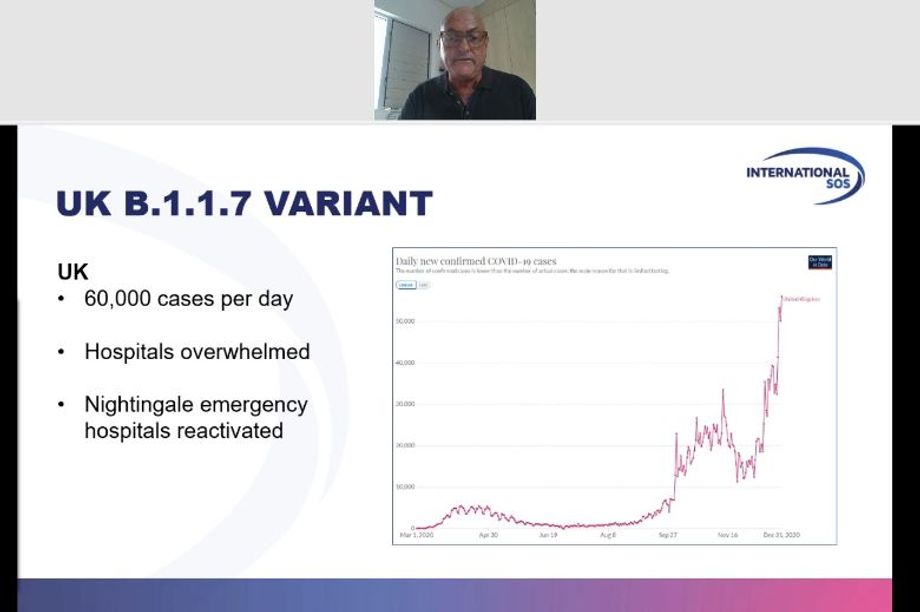 Reality check: As of 17 January, the UK variant has emerged in 60 countries, according to the World Health Organization.
At the same time, Robertson pointed out that “even organisations with
low risk tolerance can plan for resumption” given the necessary risk
assessment plans, as well as travel policies and capabilities. This
entails having pre-travel assessments of threats in destination,
communication procedures and outreach, as well as tracking and
monitoring in support of employees in the field, should they end up
quarantine-stranded.
“Many airlines have gone to the wall around servicing various routes,
which reduces mobility options. Employers should plan for significant
national- and international-level disruptions, as well as for disruption
of extended quarantine or curfew for employees on the road.”
Robertson, who has been advising organisations on business travel,
shared that “a lot of organisations are starting to map out most-likely
destinations” for the resumption of business travel. “They are looking
at staggering and staging them throughout 2021, potentially domestic
first, then to neighbouring countries. Business travel between New
Zealand and Australia, for example, can be relatively low risk, and
itineraries are relatively easier to control.”
Elaborating on what employers can do in the area of risk assessment,
he said: “Organisations should look at the risk level of each
destination and assign possible travellers to them… They should also
consider the risk profile of travellers. A low-risk country for me might
be a higher-risk country for somebody else depending on nationality,
risk tolerance and travel history. Now, you also need to look at
subnational-, state- and provincial-level risk differences.
“We’re seeing pandemic-bourne risk management teams that
characterised 2020 persisting into this year. You might have risk
management, security professionals still being involved in issues around
determining vulnerable persons, mental health and general resilience.”