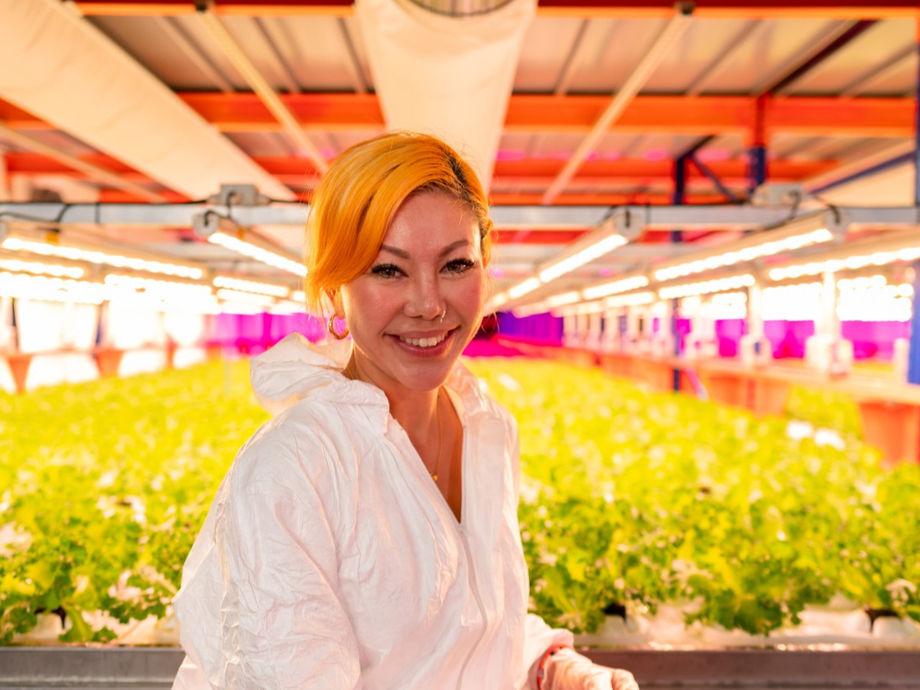
 Urban Farming Partners Singapore’s Grace Lim.
Meeting planners and corporate travellers are increasingly seeking hotels and venues that include sustainability practices. It has become important to emphasise how a guest’s stay directly contributes to worldwide sustainability practices as this educates guests and enhances their ability to make choices.
In land-scarce Singapore, many indoor urban farms have sprouted in the last decade and the struggle to survive and thrive has not been an easy road. Understanding some of their struggles and victories are key to supporting this industry as they are now part of the MICE ecosystem. The farms are also evolving to offer different business models for clients which now include hotels and venues.
Urban Farming Partners Singapore (UFPSG) is an initiative that opened in 2022 with its first operational indoor farm, GroGrace, in an industrial building in Penjuru, Jurong. The 720-sqm cultivation area facility is a partnership that includes the Netherlands Enterprise Agency, a government agency, Singapore Food Agency, and private Dutch agri-tech leaders such as Priva, Orange Climate, GrowAir Signify and Dry Hydroponics.
Grown within an enclosed environment, with optimal use of space, the farm is monitored to ensure high yield, higher nutrient values and longer shelf life of pesticide-free produce. The scalable modular design also provides flexibility and versatility.
M&C Asia met with the startup’s co-founder and CEO, Grace Lim, for a Q&A exclusive.
What’s behind GroGrace?
My Dutch partners and I believe the future of farming is indoor. We decided to conceptualise, design and build this proof-of-concept project to tackle the global challenge of food security. It is the first facility under Urban Farming Partners. We bring proven and patented Dutch horticulture, greenhouse technologies to Singapore and integrate them using local engineering and construction expertise into an indoor, vertical environment. These technologies have been proven to be very successful all over Europe and America in greenhouses.
We are a system integrator, and we offer comprehensive end-to-end solution from design and engineering, construction, to training a team of competent growers for our clients. More importantly, our value-add to our clients is in transferring the knowledge and expertise of how to use this integrated solution to grow high quality crops in the most efficient way.
We are building a library of growing recipes. Every few months, we learn how to perfect the growing parameters of new crops so when we sell our farm systems as an agritech company, we can pass on these recipes to our clients. Our agritech client list includes governments, conglomerates, supermarket chains, and people who see the value in having an indoor farm to themselves.
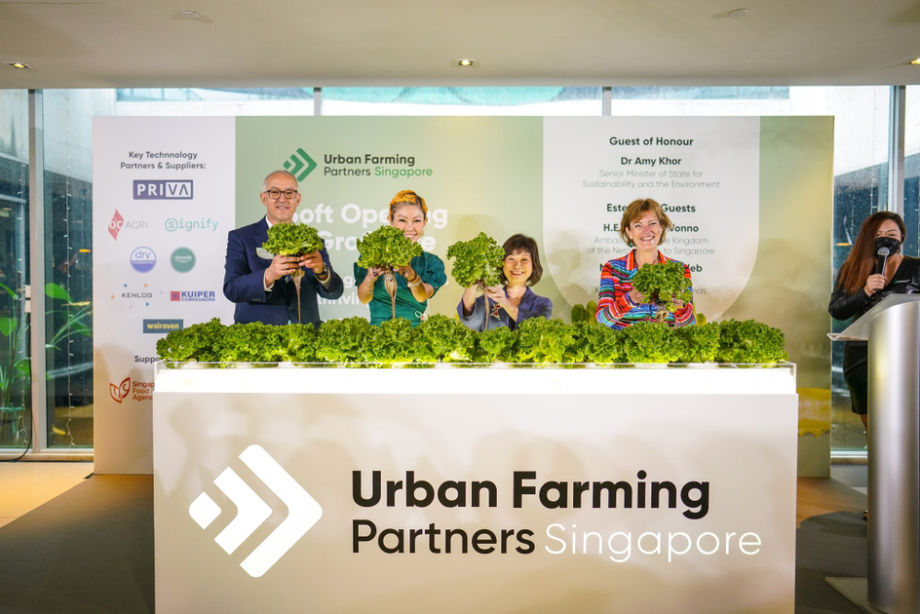 (from left) The 2022 soft opening event graced by Ahmed Aboutaleb, mayor of Rotterdam, the Netherlands; UFPSG’s Grace Lim; Amy Khor, senior minister of state for sustainability and the environment; and Margriet Vonno, ambassador of the Netherlands to Singapore.
How do you hope to work with hotels and venues?
By June this year, we are aiming to raise money to build a much bigger farm next door which will be five to six times the space. One way is to sell plots to companies and this includes hotel chains, and if big hotels such as Resorts World Sentosa are keen, we can allot a plot and grow what they want and supply back to them. We provide the facilities – design, build and own/operate. We also aim to work with other governments around the world with this model.
The Singapore government has provided a S$60-million Agri-Food Cluster Transformation (ACT) Fund which replaced the Agriculture Productivity Fund (APF) to help farms modernise. How has this helped your farm?
GroGrace used the APF which had a sub-category - the productivity enhancement scheme - we built the proof of concept and tapped on that scheme. So we have benefited from that funding. This includes all the capital expenditure – hardware, technology etc. If I were to build the next farm, we will be able to tap on the ACT Fund. This funding is indeed very helpful to agriculture entrepreneurs.
We are probably one of the more productive indoor farms in the world. Our yield per sqm per year is much higher than average based on the statistics that we have gathered. We are able to achieve this because of our total integrated solution using best-in-class Dutch technologies.
What vegetables do you produce and who do you supply to?
The right combination of crops for us is crucial to be economically viable. I can grow many types but we are focusing on the green and red crystal lettuce, curly kale and cultivated rocket using Dutch premium seeds.
The fresh food industry is very brutal with stiff competition from neighbouring countries that have gigantic farms which grow a lot and can sell cheaply. We have to sell our vegetables as a premium crop at the moment because energy prices are high, making our cost of production very high. Having said that, if we can sell directly to consumers, our produce is price competitive to what you get from the supermarkets. We are only expensive when we include third-party logistics and retailers’ costs.
What are some of your challenges?
One of the challenges we face is convincing large buyers like hotel groups to buy directly from us. We may be slightly more expensive in the food services industry but our produce has very low wastage. Wastage tests on imported lettuce shows about 30-35% wastage is caused by food miles and farming methods. Our lettuce only has 6% wastage, which is essentially the core of the lettuce, so all the other parts of our lettuce are almost perfect. So, you may be paying a low price for imported lettuce but if you consider the wastage, you actually have to buy more. This makes the price difference inconsequential.
Moreover, our lettuce is pesticide-free and because of the firm and crispy structure of the leaves, it holds dressings very well, keeping the substantial look presented on a plate. With our lettuce, you will never get limp, sloppy looking salads. One big salad company made this point when they studied our crops. The awareness in Singapore is still lacking among many buyers who are not able to evaluate based on these factors.
Singapore doesn’t have a weekly farmer’s market because we have wet markets. We can’t compete with wet markets as the prices are very low there. We are a startup, we don’t have deep pockets to buy a truck for logistics, and approaching the supermarkets is tough as we can’t hire our own merchandiser and do our own stocking on a consignment basis where stale vegetables are removed and replaced for free. This is not a viable solution for us. We are currently selling to specialty grocery stores via a wholesaler.
I’m starting to collaborate in the last quarter, with three other indoor farms which is a very unique development. Usually, local urban farms consider each other as competitors but now things are changing. These farms have been in Singapore for many years and have established for themselves respectable brand names and stable clientele (such as hotels) so for them to sell is not a problem. Why would other local farms want to purchase our produce rather than grow the crops themselves? I believe we all have areas of expertise. Some farms specialise in herbs and microgreens, others in baby leaf greens or local varieties. It is logical for us to join forces and combine our offerings in order to remain competitive with farms in neighbouring regions.
What could be done to help Singapore consumers and businesses such as hotels and event venues buy more local vegetables?
It’s quite challenging. They are usually price sensitive. They need to go directly to the farms if they are not willing to pay a premium when they buy local through a wholesaler. Would they consider the greater wastage that comes from imported vegetables? Would they consider the poorer quality of vegetables from imported sources? What about pesticide concern and food miles?
I understand that one significant reason why the big hotel chains won’t buy from local farms is because there is just too much admin work involved in dealing with many different local farms. If they work with wholesalers who represent many products, they can buy more items from a single source. If local farms can address this productivity issue, we may be able to penetrate hotels and event venues more effectively.
How is the pricing of local indoor farms vegetables expected to change over time?
When we conceptualised this business, energy was priced at S$0.17 per kWh. Today it is S$0.33 per kWh. We are constantly focused on how to reduce our energy bills and one of them is exploring virtual power purchase agreements with solar investors.
I’m also working with a company that has the ability to reduce energy consumption by 30% using their patented hybrid energy management technology. Once that happens, we can sell the produce at a lower cost, pay for third party logistics and penetrate the supermarkets.
I believe energy costs are a major challenge for indoor farms. If we can find ways to better manage these expenses over time, produce from indoor farms can definitely become more affordable. As energy accounts for a significant portion of indoor farming operations, reducing these costs is key to making this form of agriculture economically viable and to provide competitively priced vegetables.