 Relative resilience of business travel keeps tourism players in the Middle East focussed on MICE trade.
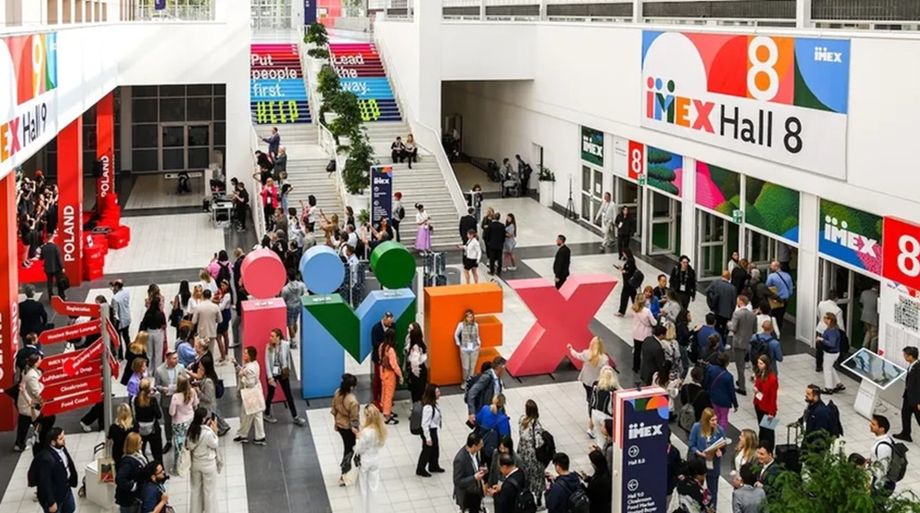
Against a backdrop of geopolitical tensions and travel uncertainty, Middle Eastern destinations maintained a strong presence at this year’s IMEX Frankfurt, eager to signal to the global meetings industry that the region remains open for business.
More than 5% of the 2,659 organisations exhibiting at the trade show operate in the Middle East, with major destinations including Abu Dhabi Convention & Exhibition Bureau, Visit Qatar, Oman Ministry of Heritage & Tourism and Dubai Department of Economy and Tourism represented on the show floor.
Airspace disruptions, heightened security concerns and travel advisories linked to wider regional conflicts have affected sentiment and planning cycles. But exhibitors at IMEX Frankfurt stressed that visibility and engagement with global buyers is critical even during periods of instability.
While the Middle East’s major aviation and business events hub of Dubai is in the centre of impact from international tourism and MICE sectors, the Dubai Department of Economy and Tourism kept up a strong presence at IMEX Frankfurt with Dubai Business Events leading a delegation of 20 co-exhibitors.
UAE charts its path
Outside Dubai’s shadows, Abu Dhabi is rising fast as a UAE MICE powerhouse, with the Department of Culture and Tourism – Abu Dhabi reporting a 40% increase in MICE delegates to 2.2 million in 2025 over the previous year. The UAE capital was also in attendance at IMEX Frankfurt with a pavilion comprising around 22 partner companies.
Jasmine Lew, senior project head at Abu Dhabi Convention & Exhibition Bureau, said most event organisers have remained committed to the destination despite heightened uncertainty, with postponed events outweighing outright cancellations.
“Business travel tends to be more resilient than leisure travel. People still want to understand what opportunities exist and what business can be done,” Lew remarked.
CVB support has been key to keeping trade confidence strong, with Abu Dhabi Convention & Exhibition Bureau working closely with organisers who may need fast answers or rescheduling support.
Significantly, the CVB supports organisers with negotiating for more flexible contracts with venues. “We intervene to say: let’s be considerate. This is a mutual situation. It’s not the first time organisers and venues have been [in a similar fix], but challenges during Covid-19 have taught everyone [to be more agile and collaborative],” Lew told M&C Asia.
Organisers aside, attendee confidence is a whole other ballgame.
“[Visitor confidence] needs to be tackled collectively. It is not enough for us to say that we are safe. Embassies are involved and there are travel advisories we cannot control. Still, we have already initiated conversations with governments. It boils down to bilateral relations,” Lew said.
Indeed on the sidelines of IMEX Frankfurt, Mohammed Al Kait, Advisor to the UAE’s Minister of Economy and Tourism. conducted several bilateral meetings with international entities with the aim of enhancing tourism cooperation and attracting more global events to the UAE. The meetings saw UAE tourism representation by Abu Dhabi, Dubai, Ajman and Ras Al Khaimah.
Lew also suggested that the UAE as a whole is increasingly signalling an independent approach to its economic and trade positioning amid global uncertainty, pointing to its recent decision to leave OPEC as an indication of its willingness to “chart its own path”. “When the time is ripe, we will go out and talk about what the next five to ten years will look like,” she said.
Qatar connected
Visit Qatar similarly used IMEX Frankfurt to reinforce its long-term MICE ambitions despite current headwinds, intent on projecting strength and continuity.
“MICE is one of the key pillars for Qatar,” said Jassom Almahmoud, PR and communications director at Visit Qatar, adding that the destination has the events infrastructure, assets, accessibility and hotel inventory to support a strong and growing MICE sector.
This month, Qatar Airways announced that it is expanding its international flight network, with services to over 150 destinations from 16 June 2026.
“Things are looking promising. Some events have been rescheduled, but there have been no cancellations. As we speak, there is a book fair exhibition taking place in Qatar. We are back in operation. Qatar Airways is also back to business including in Asian destinations,” Almahmoud said.
Restoring confidence is “exactly why we are here at IMEX Frankfurt”, he said. “We want to show the industry that operations continue, that Qatar remains connected to the world, and that we are still planning for growth.”
“We have been through difficult moments before, and each time we have come back stronger,” he said.
Despite ongoing regional tensions, Almahmoud stressed that there remains international interest in Qatar.
During IMEX Frankfurt, Visit Qatar met with International Congress and Convention Association about bringing future conferences to Qatar, which he said was a sign that buyers and associations continue to consider the destination seriously.
The mood among Middle Eastern exhibitors at IMEX Frankfurt reflected cautious optimism and longer-term ambitions rather than denial of the challenges facing the region. For many, maintaining visibility at international trade shows has become as much about restoring trust and signalling a pro-trade stance as it is about business generation.