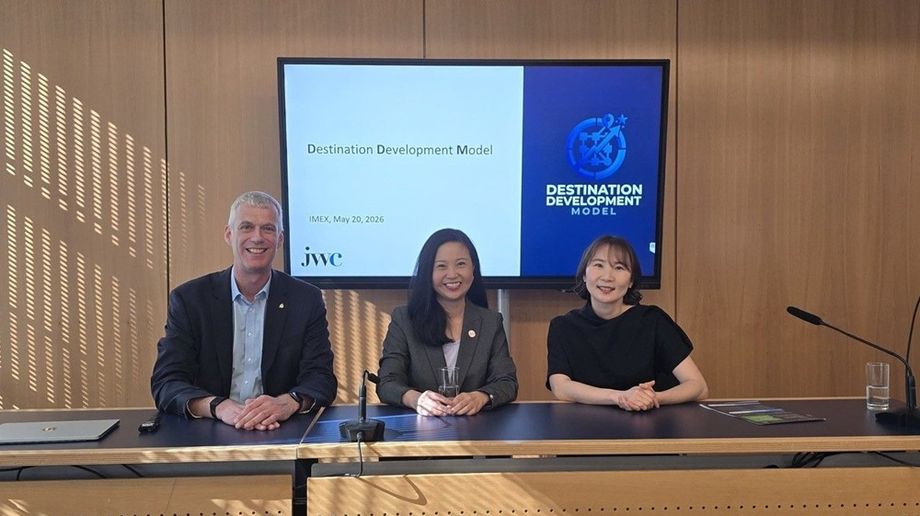
 The new framework by jwc, piloted with the Singapore Tourism Board, was launched at IMEX Frankfurt 2026. Photo Credit: jwc
MICE-focused consultancy firm jwc has introduced a new analytical framework designed to help destinations demonstrate how business events contribute to wider public-policy objectives beyond traditional tourism metrics.
Called the Destination Development Model (DDM), the framework was unveiled following the completion of a phase one pilot with Singapore Tourism Board (STB), which tested the model in a mature business events destination environment.
Evidence of longer-term contributions
According to jwc, the DDM responds to growing pressure from governments and policymakers for clearer evidence of how business events contribute to long-term development goals such as talent development, innovation, sustainability and economic resilience – rather than focusing solely on visitor spending, room nights and direct economic impact.
“Destinations are not funded based on activity. They are funded based on outcomes,” said Kai Hattendorf, partner at jwc. “For decades, the business events industry has been good at measuring outputs – visitors, spend, square metres, room nights. But governments think in terms of outcomes: talent, innovation, resilience, sustainability, economic positioning and community value.”
The DDM evaluates business events across 15 dimensions grouped into four impact clusters: People & Community, Skills & Knowledge, Economic Impact, and Reputation & Legacy.
Unlike conventional impact studies, the model is intended as a decision-making tool to help destinations align event portfolios with broader policy ambitions and identify where gaps or future investment opportunities may exist.
“The DDM is a policy alignment and decision tool,” Hattendorf said. “It shows where a destination’s event portfolio already creates strategic value, where gaps remain, and where future policy, investment or portfolio choices can deliver stronger outcomes.”
The framework connects three areas – policy ambition, event contribution and measurable outcomes – using destination-specific data, industry indicators and structured modelling.
Singapore pilot
Singapore played a central role in the model’s first development phase, with STB contributing policy insight, destination context and industry data for the pilot analysis.
The project also included an academic research component with Singapore Institute of Technology, where students explored potential data points and sources that could feed into the framework.
Ong Huey Hong, assistant chief executive of industry development group at STB, said the framework provides a more structured way to evaluate the wider value generated by business events.
“We want to ensure that growth is underpinned by lasting value for our destination, industries and communities, and the DDM gives us an evidence-based framework to demonstrate that.”
Focus on policy alignment
According to jwc, the framework is aimed at destination leaders, convention bureaux, tourism boards and public-sector stakeholders seeking to better align business events with policy priorities and funding strategies.
The consultancy said the next phase of development will involve working with additional destinations and convention bureaux to refine destination-specific data inputs and expand the framework’s application across different markets.
Founded in 2007, jwc specialises in consultancy work for the exhibition, trade fair and conference sectors, advising organisers, venue owners, governments and industry associations across Europe, Asia and the Middle East.