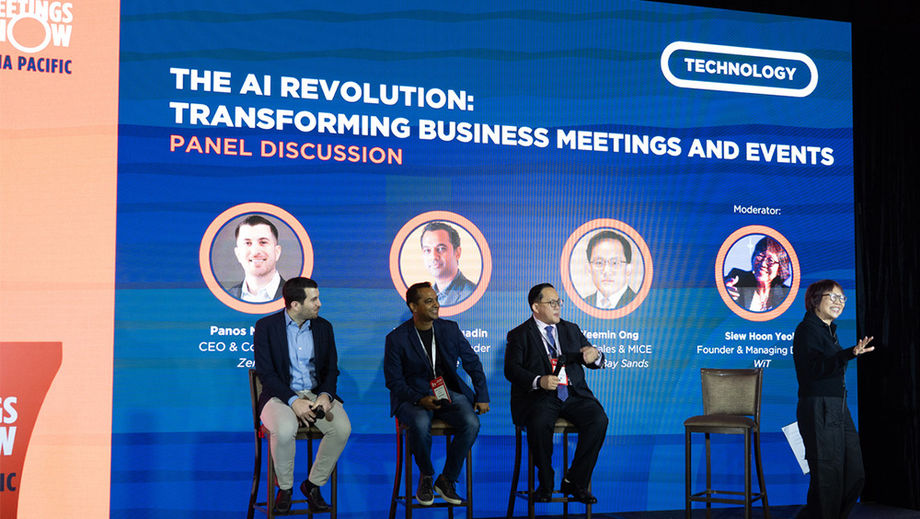
 With AI offerings, conferences and meetings can potentially overcome traditional challenges such as language barriers and gain insight into audience interest. Photo Credit: The Meetings Show Asia Pacific
AI-powered insights makes conferences more accessible
Cutting-edge AI tool distills key takeaways from The Meetings Show Asia Pacific.
Read more here.With artificial intelligence already changing the way people live
their lives and conduct business, it may very well become a mainstay of
events planning and management.
The recent Meetings Show Asia Pacific – held in Singapore on 17-18
April – provided key examples of AI-enabled technologies in action from
companies such as Pigeonhole Live and Zenus.
It’s all Greek to me - not anymore
Hew Joon Yeng, co-founder and chief business officer of Pigeonhole
Live, a web-based app that provided a platform for attendees to ask
questions in any language during presentations and panel discussions,
shared: “AI-powered tools such as our real-time translation tool for audience Q&A are set to significantly transform the MICE industry.”
Attendees can participate in Q&A sessions by scanning a QR code
onscreen, which allows them to ask questions in their preferred language
of English, Simplified Chinese, Malay, and Korean. With the help of AI
technology, these questions are then translated in real time into
English (the main event language) for broadcast, and similarly from
English into each attendee’s preferred language choice on their own
personal device.
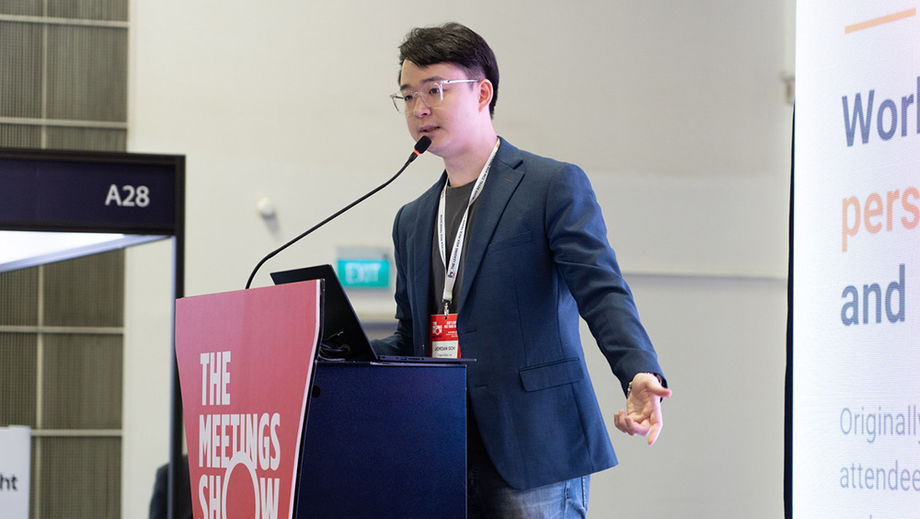 Pigeonhole’s account executive Jordan Goh speaking at the recent Meetings Show Asia Pacific, held in Singapore.
However, there are still some challenges that need to be overcome –
Hew shares that one major difficulty when it comes to languages is that
each one has its own nuance and complexity, and it can be tough working
with translation algorithms that can successfully convey these with
accuracy.
The platform may also struggle with industry-specific jargon that
requires specialised knowledge beyond its current capabilities, and the
team makes use of feedback that they receive from customers to improve.
Beyond The Meetings Show Asia Pacific, Pigeonhole Live has been used
with other companies in sectors that span consumer goods, technology,
luxury brands, and banking, including European, Asian, and Japanese
firms.
“As pioneers in this field, we foresee that such features will soon
become standard offerings in the future. This will become especially
crucial for events with diverse audiences, ensuring that every
participant can interact and engage with the content effectively,
regardless of language barriers,” said Hew.
What’s left unsaid says it all
Not all communication comes in the form of the written word, however, and this is where facial analysis platform Zenus comes in.
CEO and co-founder Panos Moutafis explains more: “When it comes to
any type of online marketing activity, you can measure everything – what
your audience does, how long they stay on an email, where they clicked
off. Everything is recorded. When it comes to offline marketing
activities like a tradeshow, it can be much harder to have that same
kind of measurement. So, we have developed a technology that can detect
and analyse faces without having to identify them.”
In other words, Zenus helps event organisers figure out what
audiences want – without the audience having to say a single word. By
scanning and analysing facial expressions, the technology allows
organisers to understand audience behaviour and engagement.
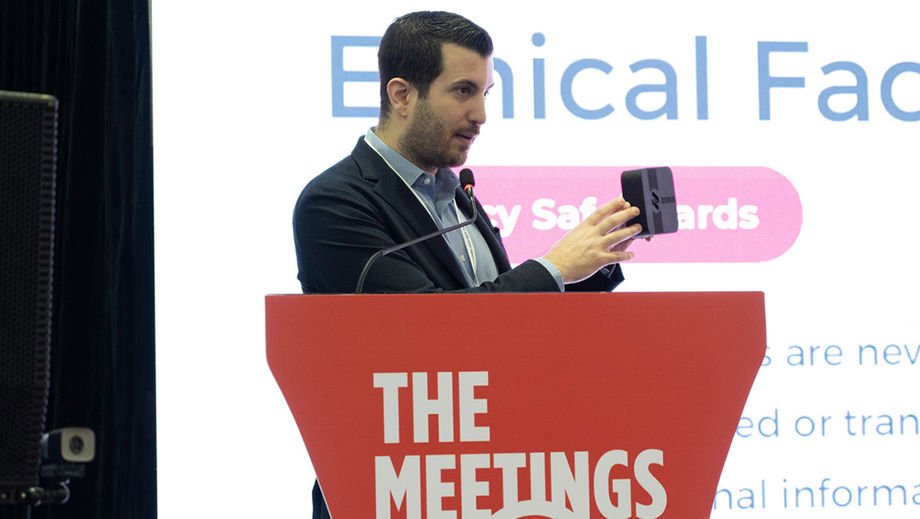 Panos Moutafis, CEO and co-founder of Zenus, showing a tech demonstration during the recent Meetings Show Asia Pacific.
“So we get an idea around density and traffic – are people staying,
are they moving away? Are they not interested? You get an idea of the
flow and engagement, and if they’re staying at a particular point of
interest during the session, maybe 20 minutes in,” Moutafis said.
For a platform like this, it’s imperative to assure audiences – who
have shown increased awareness and concern around issues such as data
privacy – that their identity and data remain safe.
“What we do is scan the environment and convert that into statistics,
without storing any video or taking any pictures – our device just
clips all this information, consolidates it into statistics, and sends
it to the cloud.”
So far, Zenus has seen hundreds of deployments, including exhibitors
who want to understand how they can optimise their booth’s design
effectiveness at tradeshows, and large-scale event organisers who have
an eye on event traffic and operations.
“You cannot improve what you cannot study and measure, and we’re
modernising the entire flow of end-to-end events,” said Moutafis. “At
the end of the day, people want to connect. With tools like these, you
can create – you can study and design spaces in a way that facilitates
these connections and foster these one-of-a-kind experiences for
people.”