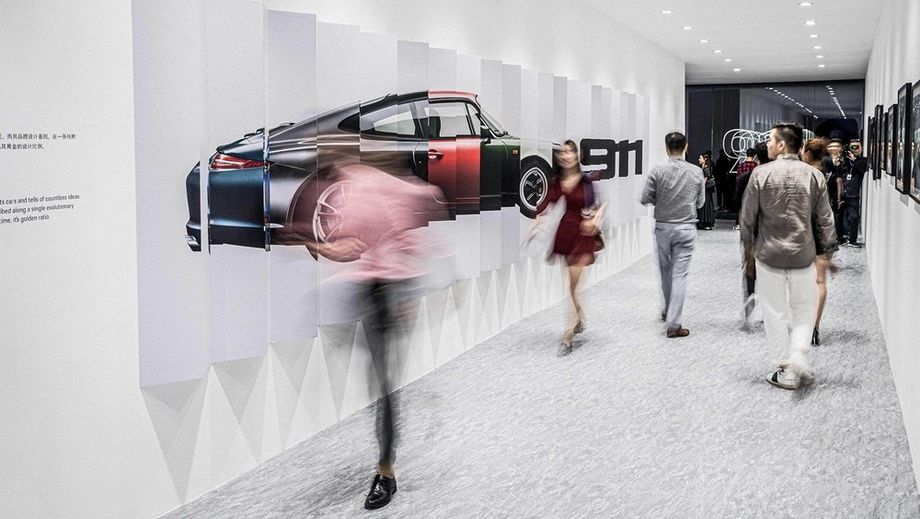
 Opportunities abound for event heavyweights looking to anchor global events in the market or to take Chinese brands global. Photo Credit: Vok Dams
Informa Markets China's recent unveiling of Hongqiao Tech Week is the latest sign that the global technology events landscape is becoming closer tied to the Chinese market.
Scheduled for 20-22 November 2026 at Shanghai's National Exhibition and Convention Center, the event is themed "Where Global Tech Ambition Meets Chinese Scale" and will bring together enterprises, startups, investors and technology leaders across sectors including artificial intelligence, future mobility, digital infrastructure, Industry 4.0 and life sciences.
The launch reflects a broader shift in the global events ecosystem. Event owners and agencies are training their sights on China – where technology and automotive innovation are accelerating at breakneck speed – whether to anchor global events in the market or to bring fast-growing Chinese brands to the global stage.
"The momentum is undeniable," said Benoît Thebaut, managing director for Greater China at Vok Dams, which recently opened a new office in Shenzhen – its third location in Greater China after Shanghai and Hong Kong.
“By opening now, Vok Dams gains a first-mover advantage in the Greater Bay Area before the market becomes crowded, positioning us as the go-to partner for Chinese brands going global and international brands activating in China.”
The expansion follows Vok Dams' delivery of the fifth SAP Globalization Summit in Shenzhen, an AI-centric event that drew nearly 1,000 in-person attendees and more than 10,000 online participants, according to Benoît Thebaut, managing director for Greater China at Vok Dams.
Related: Vok Dams expands into Shenzhen, Singapore next
Agencies move closer to the action
Describing Shenzhen as "the real-life prototype of the future" that combines hardware, AI, manufacturing and speed, Colja Dams, co-CEO, Vok Dams, sees the city as a natural engine for the agency's next phase of growth in China.

“By opening now, Vok Dams gains a first-mover advantage in the Greater Bay Area before the market becomes crowded, positioning us as the go-to partner for Chinese brands going global and international brands activating in China.”
Benoît Thebaut, managing director for Greater China, Vok Dams
"Unlike Shanghai, which is China's commercial and financial capital, or Beijing, its political and cultural centre, Shenzhen is uniquely defined by speed, innovation, and agility," added Thebaut. "It's a younger city with flatter hierarchies and faster decision-making, feeling closer to Silicon Valley than to traditional corporate environments."
While Shanghai remains China's primary international gateway for exhibitions, investors and multinational companies, Shenzhen offers something different: proximity to the engineers, founders, manufacturers, supply-chain partners and investors who are actively building new technologies.
"For tech events, this changes the game because your audience isn't just buyers or media," said Phyllis Teo, VP and managing director, Greater China, at George P. Johnson. "It includes the engineers, founders, manufacturers, supply-chain partners, investors, and product decision-makers who actually build things."
Where events take off
The pace of innovation is mirrored by the pace of event delivery.
The city's manufacturing ecosystem also accelerates event execution. According to Teo, an exhibitor can prototype a demonstration unit one day, ship it the next and have it exhibition-ready shortly after – a speed that would be difficult to replicate elsewhere.
"China operates on a completely different timeline and risk appetite than the West. It is faster, more fluid, and hyper-execution-intensive," said Teo.
In Europe and North America, production often follows a linear sequence of approvals and fabrication. In China, she said, many of those processes happen simultaneously.
"Last-minute changes aren't the exception; they're the baseline expectation. A top-tier Chinese production team has to design, price, fabricate, and troubleshoot almost completely in parallel."
To help clients move at China's pace, Vok Dams has developed an AI predictive model called "The Digital Doppelgangers," which supports decision-making on event formats before the first dollar is spent on physical activation.
"China operates on a completely different timeline and risk appetite than the West. It is faster, more fluid, and hyper-execution-intensive.”
Phyllis Teo, VP and managing director, Greater China, George P. Johnson
Chinese brands go global
For event companies, opportunities lie not just in establishing technology events in China, but also in catapulting Chinese brands onto the global stage.
Electric vehicle maker XPeng, for example, has announced plans to expand into 60 international markets, while BYD has set an overseas sales target of 1.3 million vehicles in 2026.
To agencies such as Vok Dams, those ambitions are translating directly into demand for international event support.
The company has already delivered XPeng's pan-European test-drive programme in Barcelona and is currently working on an event for Shenzhen-based Xtool in Berlin.
“What we are seeing is a significant shift where Chinese tech and EV companies are rapidly going global,” said Thebaut. “They want localised, high-impact event experiences that travel with them.”
Having a presence in Shenzhen allows the agency to get a headstart on engaging brands in their expansion journey, he added.
"It allows us to partner with them early, understand their brand DNA, and then join forces with our European offices to serve them seamlessly across multiple markets in their own language."
The next chapter
Whether for global events going to China or Chinese brands going global, the opportunities for international event giants are undeniable in the market.
“For many international brands, success in China is no longer optional – it's essential," said Thebaut. "That is why Vok Dams is making a clear commitment to being where the future is being built.”