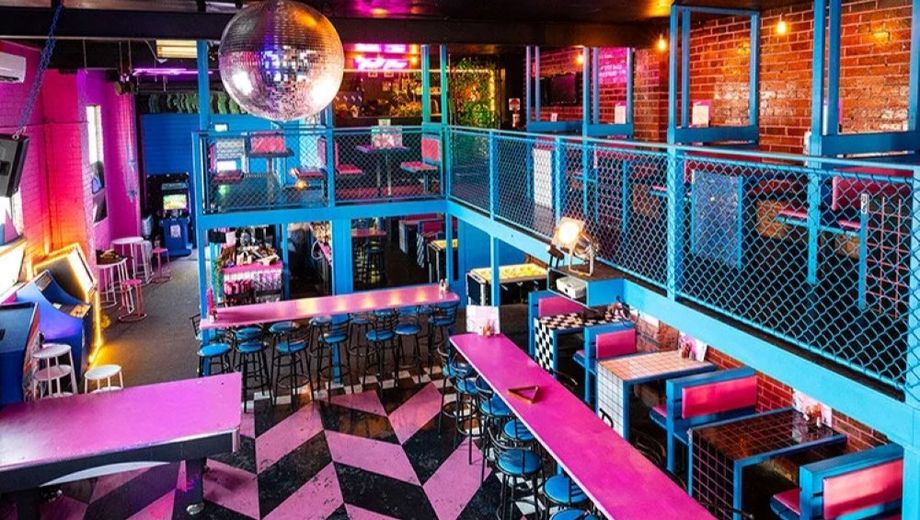
 Only 3.4% of respondents said they see no value in non-traditional venues, yet more than six times as many (21%) only use traditional venues. Photo Credit: Evie's Disco Diner
For an industry big on creating memorable experiences, event planners can be surprisingly conservative when it comes to venue selection.
According to the latest Experience Design Report from Boldpush and Encore, 63% of the 447 event professionals surveyed use traditional or mostly traditional venues as a default.
Why, despite all the talk about novelty in the events industry, do so many continue to rely on the same convention centres, hotels and meeting spaces they've always used?
It isn't due to a lack of interest in unconventional venues. In fact, the survey showed that only 3.4% of respondents said they see no value in non-traditional venues, yet more than six times as many (21%) only use traditional venues.
The problem isn't creativity. It's practicality.
The report suggests the barriers are operational: cost, infrastructure and logistics.
A warehouse, museum, rooftop, industrial site or outdoor venue may offer a more distinctive backdrop than a ballroom, but each comes with additional questions around power supply, rigging, connectivity, transportation, accessibility and production requirements.
It is no wonder many planners gravitate towards more standard and predictable venues, or paths of least resistance.
However, navigating the limitations of unfamiliar venues is not a high barrier to climb.
The Encore-Boldpush report suggests that non-traditional venues are viable options if production partners are involved in earlier stages of event planning.
This allows production partners to figure out solutions for infrastructure and logistical barriers at the concept stage
Microevents boost attendance
The report also shed light on how planners are approaching programming and content.
One notable finding concerns microevents: smaller, focused experiences that sit alongside larger conferences or exhibitions.
Among organisers that offer them, 76% reported a positive impact on registration numbers, while 26% cited a significant positive impact.
This doesn’t automatically mean that all planners should start looking at microevents.
Scale matters
Event scale evidently matters. Among events attracting between 5,000 and 10,000 attendees, 38% of planners identified microevents as a key selling point.
For events with fewer than 500 attendees, that figure falls to 21%.
At mega-events with more than 10,000 participants, panel discussions emerge as the leading driver of attendee satisfaction. Roundtables, often celebrated for their intimacy and interaction, become less influential at that scale.
Buzz over wellness
When it comes to side events, the classics still win. The report found that social and entertainment experiences are the most in-demand type of side event, chosen by 37% of respondents.
Health and wellness activities, despite all the buzz about sober and healthy work events, take last place, with only 8.5% of planners identifying them as a favourite.