 Corporate travel agencies see plenty of reasons to expect increasing levels of international business travel throughout Asia Pacific in 2022 and beyond. Photo Credit: Gettyimages/CreativaImages
After two years with some of the world's strictest entry and travel
restrictions during the Covid-19 pandemic, the Asia-Pacific region
appears primed for a business travel comeback. But geopolitical events
as well as some countries' unclear pandemic strategy have coloured that
optimism with a cloudy veneer.
Unlike most of North America and Europe, the wave of the Omicron
variant of Covid-19 in some locations in the Asia-Pacific region still
hadn't peaked. Countries including South Korea, Malaysia and Vietnam in
mid-March still were seeing record-high daily levels of new Covid-19
cases, several weeks after the wave peaked in the United States.
And while most experts expect the Omicron experience in Asia-Pacific
generally to follow the pattern the variant established — run through
the population with an extremely high caseload that recedes relatively
swiftly with comparatively milder outcomes — another factor has roiled
travel forecasts for the region. Russia's ongoing invasion of Ukraine
triggered sanctions and reciprocal airspace closures throughout Europe,
spurring international carriers to cancel some Asia-Pacific service and
reroute others away from Russia.
The International Air Transport Association this month suggested the
"sanctions and airspace closures are expected to have a negative impact
on travel, primarily among neighbouring countries," particularly as the
cost of fuel rises.
Still, there are plenty of reasons to expect increasing levels of
international business travel throughout the Asia-Pacific region in 2022
and beyond. Several countries are beginning to ease travel and entry
restrictions or have announced timelines for doing so, and corporates in
the region, as in other regions, appear to have a level of pent-up
business travel demand.
Whether
the resulting volume will increase throughout the region or recover
first in particular locations remains to be seen, but there is
significant variance in this year's edition of BTN's Corporate Travel
Index.
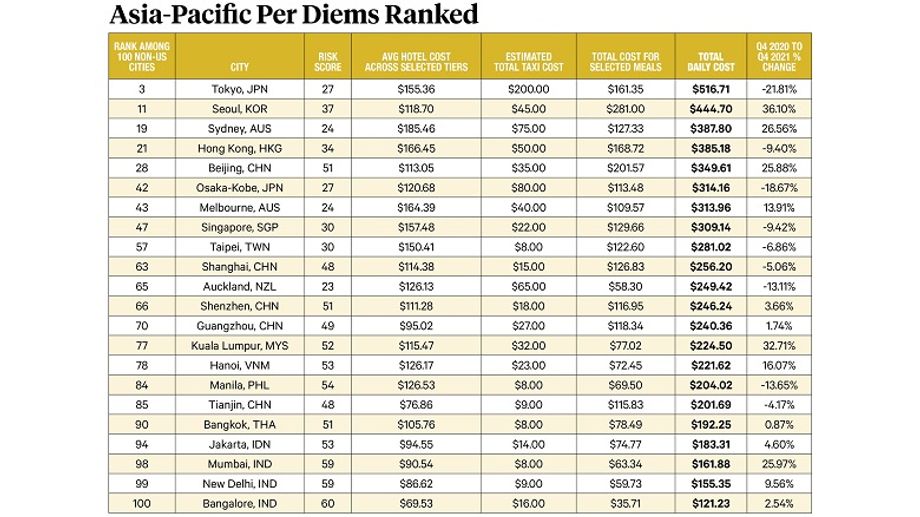
Pricing disparities
On the whole, the average total business
travel per diem in the region in the fourth quarter of 2021 were very
close to its level in the fourth quarter of 2020, only about US$2 lower,
less than a 1% decline. But that consistent average conceals some
dramatic changes, particularly in Japan.
The average Q4 2021 business travel per diem in Tokyo, frequently the
world's most expensive city in prior editions of the Corporate Travel
Index, declined 38.5% year over year, and per diems in Osaka-Kobe
declined nearly 19%. Locations in Australia started to recover,
conversely, with Q4 2021 business travel per diems in Melbourne and
Sydney up not only 14% and 27% year-over-year respectively but also
exceeding the pre-pandemic levels of the fourth quarter of 2019.
2022 outlook
Australia in fact appears to be on the vanguard of
2022 corporate travel recovery as well, after the federal government in
February lifted nearly two years' worth of entry restrictions and
allowing fully vaccinated foreign visitors. It's a move that experts
believe will help kickstart demand in the area and could prompt other
area governments to similarly lift restrictions.
"Things
are quite optimistic in Australia at the moment, because of all of the
recent changes in border opening and lessening of restrictions," said
Charlene Leiss, president of the Americas for Australia-based global
travel management company Flight Centre Travel Group. "We've already
seen considerable uptick in the corporate business."
Jamie Pherous, managing director of Australia-based TMC Corporate
Travel Management, said "we're all seeing a very, very strong rebound"
after Australia lifted restrictions and projected that market would
strengthen further.
"We're quite optimistic about the business travel space as we're
moving forward, though we're also quite cautious, should governments
start changing their minds again," he said.
"We really see things in Australia rebounding by far, and we've seen
that already," Pherous said. "We've seen very strong compound
double-digit growth week-on-week in domestic. International will come. I
think international, as the impediments drop, that'll be mature."
Loss in commerce opportunities, Pherous said, should be a key driver
of pandemic policy and corporate strategy throughout 2022 as business
results vary based on the ability to travel domestically and
internationally.
"If you're closed out, you're going to miss winning market share or
you're going to lose customers," Pherous said. "And as we all know,
supply chain issues right now are a big, global problem. Those that can
get on planes and see their supplier and sort it out get in front of the
queue of the others that can't. There's a real cost now to those that
don't open up when the rest of the global economy has opened up."
China, however, throughout the pandemic has pursued its own stringent
mitigation strategies and entry restrictions and hasn't appeared overly
sensitive to any market pressure, notably during last month's Winter
Olympics in Beijing when the government's zero-Covid approach drew
international attention and criticism. Still, Flight Centre Travel
Group's Leiss projected even Beijing will not want to be left behind in a
swelling international economy.
"We think in order to benefit the local economy and trade and
everything else, they'll have to follow suit," Leiss said. "Because the
world seems to be opening up and learning to live with this virus, which
is moving from pandemic to endemic, and I don't think any country's
going to want to be left behind for too long."
Pricing outlook
Given
what appears to be increasing demand for business travel, buyers could
well find themselves in an environment in which suppliers are gaining
pricing power. Pherous suggested the price hikes buyers can expect will
be a function not solely of market conditions.
"I think through Covid, all industries that were impacted are looking
at doing business smarter and better," Pherous said. "For suppliers,
that goes for yield as well. What we've seen in other markets, yield
increases a lot quicker than it ever used to because they're used to
better management over the last two years in downtime in managing
yield."
The result, he said, are quickly rising prices through all sectors of the business travel market.
"We've seen in markets that are already open that, whether it's hotel
rooms or seats in aircraft, rates are actually getting really high very
quickly," Pherous said. "If the suppliers are better at managing that,
that means they're managing supply and demand, which means U-curves will
go up to corporations now. We see a paradigm shift."
Source: Business Travel News