 The Reimagining Business Events – Through Covid-19 and Beyond white paper was launched at the first hybrid Singapore MICE Forum x IBTM Wired on Monday.
There is a need for business events players to “modify or abandon” certain legacy offerings, argues an industry white paper released this week, which shows Asia-Pacific demonstrating a stronger propensity to chart new paths to recovery and transformation.
The **Reimagining Business Events – Through COVID-19 and Beyond** white paper, a collaboration between Singapore Tourism Board (STB), Professional Convention Management Association (PCMA) and UFI (The Global Association of the Exhibition Industry), was launched at the first hybrid Singapore MICE Forum x IBTM Wired at Marina Bay Sands on 28 June 2021.
Light at the end of the tunnel
Citing statistics from a recent UFI report, the white paper revealed that the global exhibitions category contracted by 68% in 2020. More than half of the 450 companies in the exhibitions industry polled by UFI in January 2021 have had to reduce their workforces. Thirty per cent saw profits plummet more than 50%, while a tenth said they would have to close if business didn't pick up in the next six months.
Since then, some optimism has returned to the sector. In June this year, around 69% of event planners and 64% of suppliers indicated they were hopeful, compared to less than 50% of both groups of respondents in January, according to a PCMA survey.
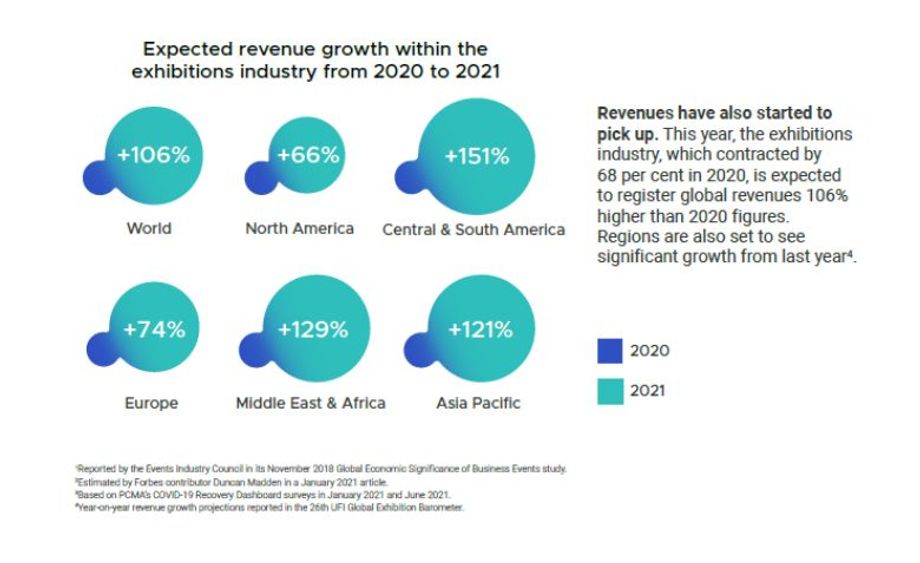 Exhibitions industry revenues expected to rebound in 2021.
That said, the reality is that travel remains a no-go for a considerable section of the industry, and business events as we know it would have to evolve. The same PCMA survey found that 23% of suppliers and 44% of planners are unwilling to travel for events, although those who are willing to travel any distance for a good programme also constituted a sizeable portion (31% of suppliers and 25% of planners).
Asia leads the way
“Exhibitions in Asia are likely to see stronger growth in participation from both visitors and exhibitors compared to the rest of the world. Respondents in Asia are more than twice as likely to have participated in digital or hybrid events,” shared STB senior lead specialist (learning), corporate group, Michelle Chan.
Insights from the white paper point to a need to innovate beyond the mere adoption of event technology, she added. “We need to be ready to modify or abandon some legacy operations and be agile to adapt to the fluid Covid situation and evolving customer needs.”
In this regard, APAC planners have tried new ways to improve audience participation and interaction. Of the APAC respondents planning a hybrid event in 2021, nearly 80% planned for their in-person and virtual audiences to interact, compared with 27% of North American planners, PCMA’s APAC Dashboard Survey found. Some 38% of planners in APAC were planning to simultaneously stream in-person event to virtual audiences, compared to just 17% of their North American counterparts.
What’s the secret sauce?
Karen Bolinger, PCMA’s APAC managing director, posited that such an inclination towards hybrid formats has to do with diversity within the region. Online formats have in ways helped circumvent language barriers and geographical distance that may have previously hindered onsite participation.
Offering further insight into why Asia might have taken to change at a quicker pace, Oscar Cerezales, MCI Group’s global executive vice president, shared at a separate IBTM Wired session: “Asia is way ahead. Because of culture, countries in APAC are highly pragmatic. Also, Asia was where we first heard about the virus and was [quick and decisive] in its response to the situation.”
He further suggested that public-private partnerships and government support have played a major part.
“Destinations such as Singapore, Sydney and Melbourne were top in bringing the government closer to the industry. There has also been significant support and funding for the industry in the region. South Korea and Japan did a good job with funding. In Australia and Singapore, we see great support to the industry in the form of grants and funds.”
The success of these destinations ultimately boils down to a forward-looking vision cast far beyond a wait-and-see approach, or anticipation of a return to normal, he summed up. “These destinations think long-term. They do not see the industry as all about tourism [and how to attract more visitors] -- their response has been geared more towards economic development and social transformation.”