 Truly Robotics’ Janice Yee. Photo Credit: Truly Robotics
Robotics products and solutions are increasingly making their way
into MICE venues to take care of mundane and repetitive work. Truly
Robotics (TR), a robotics solution provider with tech solutions ranging
from IoT, AI, to facility management, has made its foray into the MICE
industry. Janice Yee, the company’s CEO, shared how TR has helped to
alleviate the hotel manpower crunch.
The management team of TR has more than 50 years of experience in the
MICE industry, holding roles such as venue operator, and exhibition and
conference organiser. Their deep understanding of the MICE industry
allows them to find areas in which robotic solutions can play a part to
reduce some of the key challenges facing the industry.
Top sellers
The top-selling product to hotel clients is its autonomous vacuum
cleaning robot, Whiz, which helps with floor care. Said Yee: “The robot
is able to effectively clean and cover large floor areas with little
human intervention in an autonomous manner. This frees up the human
manpower to cover other high-touch areas and work on areas that are
currently not accessible to the robots.”
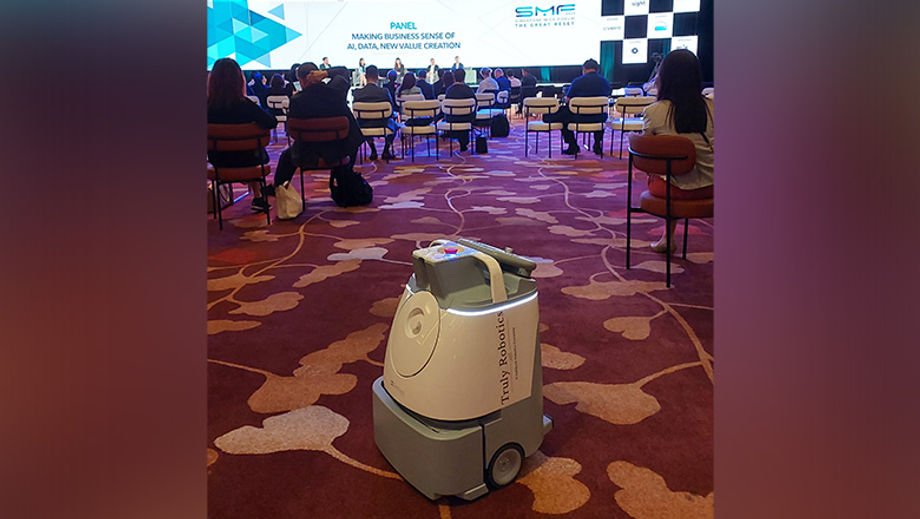 Whiz, Truly Robotics’ best seller. Photo Credit: Truly Robotics
Whiz is selling well primarily due to the ease of usage without the
need of a technical engineer. As such, this makes it easy for adoption
by the housekeeping team of hotels. Currently, there are more than
20,000 Whiz being deployed worldwide and the number continues to climb
at a steady rate.
The company’s service delivery robot, Keenon, is also doing well and
is being adopted by restaurants and hotels in Singapore. The reliability
of the robot provides a stable workforce to help supplement the current
manpower shortage faced by the F&B industry.
“Many hotels operate all-day buffet dining restaurants where there is
a need to constantly clear the soiled plates and cutlery from the main
dining area and return them back to the stewarding area for washing.
With the usage of our Keenon service delivery robots, service staff no
longer have to carry the heavy load of such items. Instead, they are
able to focus more attention on the guests and provide better customer
service rather than doing the runner job which is now well taken care of
by the robot,” said Yee.
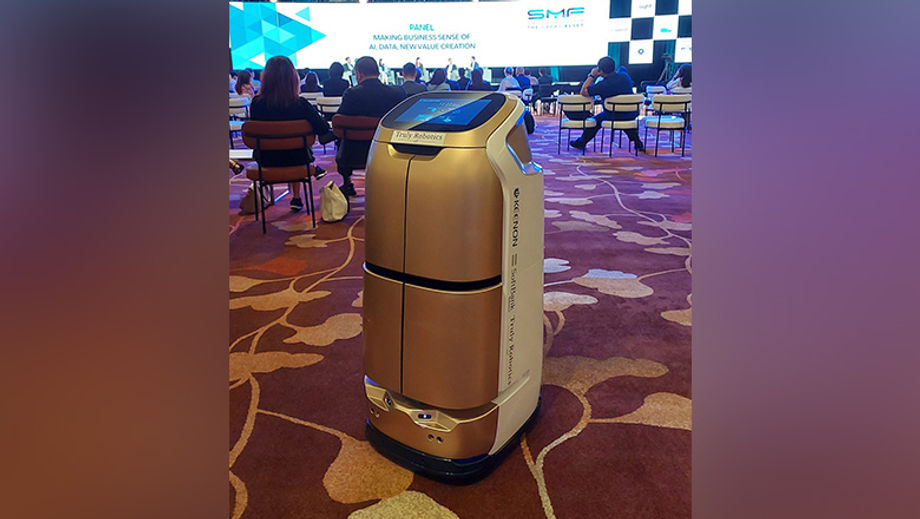 Keenon: helping to free up human resources to focus on higher value-added tasks.
Another invention, the hotel butler robot, with its lift integration
capability, allows housekeeping and room service staff to send items to
guest rooms without using a human runner. “This frees up the manpower
resources to focus on other higher value work in the hotel,” said Yee.
Helping clients to understand
One of the challenges facing TR is helping clients to understand how
the deployment of robots impacts operations. She cited an example: “Some
clients are under the impression that when they deploy a robot, they
can remove staff from their roles. In reality, it does not work as such.
The robots will collaborate with the human and there are some tasks
that the robot is unable to do which would still require the human to
handle. It is most effective in doing roles that are repetitive and
mundane, where humans may not like to take on such tasks - vacuum
cleaning/scrubbing of large area of flooring.
“There is also an expectation that the price of the robot must be
extremely low in order to be considered worthwhile in investing. In
reality, most good-quality robots do not come cheap. The better-quality
ones come with higher quality parts and components and this also means a
longer service life and also reduced breakdown frequency.”
Resistance can also come from clients who think that adopting robots
will cause hotels to lose the human touch if robots are deployed in
operations. “However, we have many use cases that show that this is not
the case as the robots are supporting the staff on the backend and the
final touch point still remains with the human handling their clients,”
said Yee.
Goals for the future
TR will be focusing on addressing the needs of the hospitality,
tourism and MICE industry for the upcoming year given that there is a
lot of interest from MICE players. The team will continue with sharing
knowledge on how companies can adopt IoT and robotics technology in
their field of work, where data and analytics can sharpen their focus
for decision making and cost efficiencies. “With the adoption of
technologies, they can also motivate, attract and retain talent through
job transformation and upskilling,” said Yee.
After-sales support and value add
Besides expanding its reach to new clients through the addition of
new robot platforms, and sharpening after-sales support with a dedicated
robotics repair service centre, TR will aim to provide a seamless
experience for customers.
Said Yee: “We foresee that there will be exponential increase in the
adoption of robotics products and solutions in hotels, conventions and
exhibitions centres as the benefits far outweigh the costs. With the
current manpower shortage and rising costs, hotels are starting to
assemble project teams to dive deep into integrated solutions where
multiple technologies such as IoT and robots can be integrated onto
software platforms for end-to-end solutions.
“The work of operations, facility management and cleaning all come
together with a common goal of achieving manpower efficiency and a
higher skilled workforce. There is also an increased focus on driving
greater innovation and productivity through the usage of robotics
technology in order to free up human resources to focus on higher
value-added tasks.”