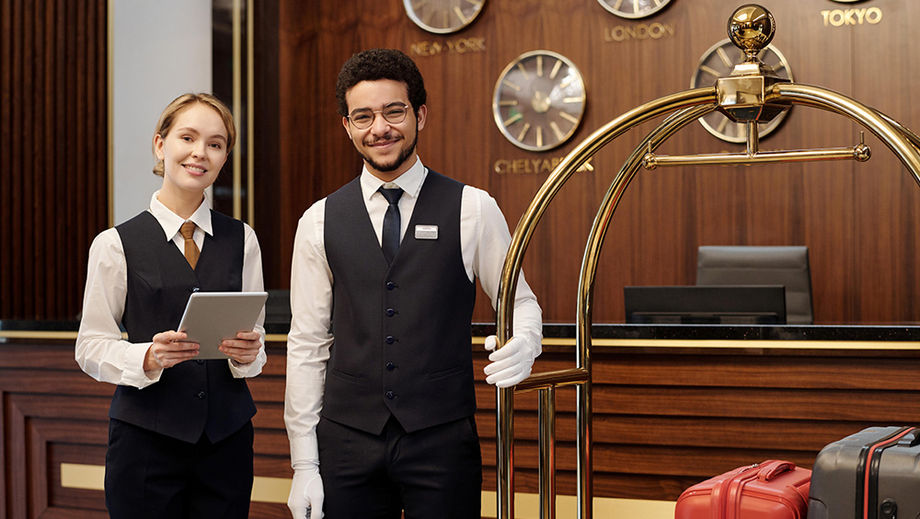
 More time for personalised service with AI. Photo Credit: Adobe stock/press master
AI can help streamline corporate travel and offer business travellers
more personalised, tailored experiences. But to capitalise on its
potential, there needs to be a combination of the right data and digital
channels, working together with AI technology.
This was the subject of a recent podcast, hosted by the Global
Business Travel Association, on how hotels and airlines are leveraging
AI to improve revenue management, operations, sustainability and the
business traveller experience.
Ryan Mann, partner at McKinsey, envisages a future where AI is
empowering staff at hotels, improving the way they do their jobs and
enabling them to spend more time with guests. “Some visions of AI are
pretty bold and imaginative - frankly not the ones we really want to
see happen,” he said. “Hospitality must always include the human touch, a
human smile and human empathy. (AI is impacting) areas such as hotels’
revenue generation, their cost operations, and their customer
experience. At the end of the day, it’s about raising the bar on the
essence of what hospitality is.”
Streamlining feedback
One example where AI is benefiting the business travel customer
experience is its ability to help streamline feedback. “One of our
clients operates a large conference hotel in a big city and the general
manager receives many emails from corporate groups with feedback, which
tend to be verbose and not written in the clearest way,” said Mann. “My
client is using AI to read through those emails quickly, summarise and
suggest a response, saving them hours (and enabling them to respond
quicker) - it’s a huge game changer.”
Using guest profiles effectively
AI is also enabling hotels to deliver a more personalised customer
service. As Mann pointed out, hotels have guest profiles with lots of
rich yet unstructured notes about their best guests. “When we talk to
general managers (at the hotels), they tell us these notes are useful
but not actionable or organised in the best way possible,” said Mann.
“Now they are including AI- driven ‘best guest’ action based on
analytics for the frontline staff and it's created a huge change in
guest experiences.”
AI is going to need to show up in a big way to capture the hearts and
minds and the wallets of business travel, according to Alex Cosmas,
partner at McKinsey. He says concierge-level servicing, and how trips
are planned and experienced, will become increasingly important.
“Delays happen, meetings get cancelled - business travel needs to be
faster, more tailored and more instantaneous than the leisure market,”
he said. “It’s time for business travel to catch up with how AI is
penetrating consumer lives,” added Cosmas.
AI can be applied to any part of corporate travel - pre-, during and
post-trip and Cosmas pointed out how the technology can help alleviate
certain ‘pressure’ points, such as anxiety pre-trip and the time needed
to recover from a trip.
Taking the first step
The podcast also reinforced how the most important element with
regards to AI and business travel is about experimenting, particularly
as the technology and its applications continue to develop at a rapid
pace.
“Don’t wait for perfect; start today and add as you go along,” said
Mann, while Cosmas added: “If you can't measure the cause and effect
precisely from an AI intervention or an AI outcome, then don't even go
down the path of the experiment. I'd rather experiment correctly on
something small, than swing for the fences and have no idea where the
ball got hit.”