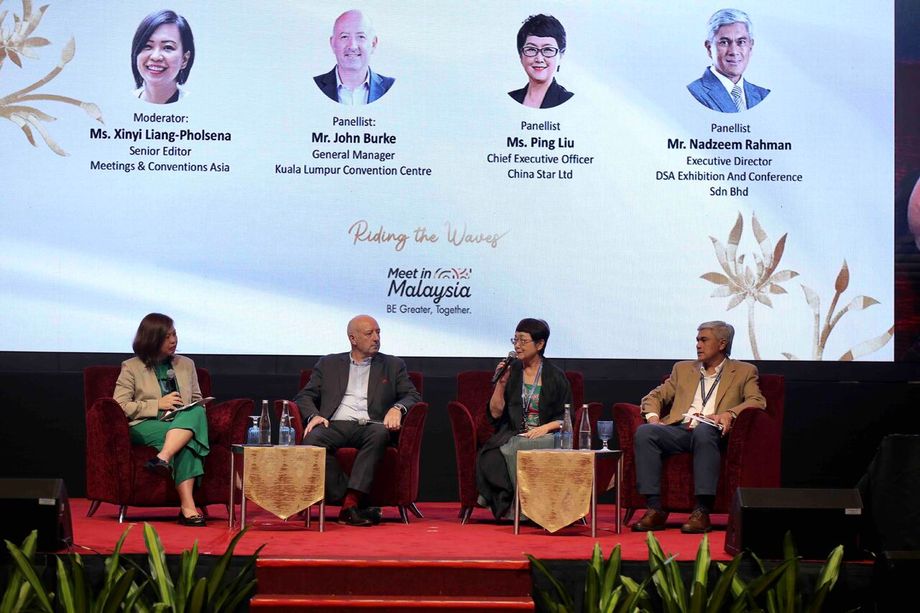
 (from left) M&C Asia’s Xinyi Liang-Pholsena; Kuala Lumpur Convention Centre’s John Burke; China Star’s Ping Liu; and DSA Exhibition And Conference’s Nadzeem Rahman speaking at the “Crisis Communication” panel of MyCEB’s Malaysia Business Events Week. Photo Credit: MyCEB
In times of crisis, a robust crisis communication plan becomes a
cornerstone. The imperative of delivering transparent and timely
communication to navigate challenges, sustain stakeholder trust, and
safeguard reputations took center stage in the "Crisis Communications"
panel discussion at the Malaysia Business Events Week (MBEW) 2023
organised by the Malaysia Convention & Exhibition Bureau (MyCEB) in
Kuala Lumpur.
Throughout the discussion, moderated by Xinyi Liang-Pholsena, senior
editor of Meetings & Conventions Asia (M&C Asia), the resounding
message from the discussion was the importance of preparedness.
Anticipating potential crises and crafting a comprehensive crisis
communication plan can be the difference between chaos and control.
Here are the key takeaways from the discussion:
‘No comment’ is not an option
Swift action and solution-oriented communication are key when facing a
crisis. Addressing both the problem and the solution in tandem
reinforces an organisation's commitment to resolving issues and
recovering. Said John Burke, general manager of Kuala Lumpur Convention
Centre, “Being quick to respond, letting people know that you’re trying
to find out more information shows that you own the problem.”
Being quick to respond, letting people know that you’re trying to find out more information shows that you own the problem.
John Burke, general manager of Kuala Lumpur Convention Centre
Burke recounted an incident where a visitor's threat to harm
participants went viral on social media. “From the perspective of the
venue," he explained, "the key was to collaborate swiftly with the
client to determine communication ownership. In this specific case, as
the organiser had the quickest communication channel, we leveraged it
and released a joint statement.”
Speak in one voice
A consistent message must echo across departments, maintaining
clarity and unity in times of crisis. Beyond internal unity,
organisations must also forge a strong external communication strategy.
“Having an aligned internal narrative, where employees are on the same
page, helps the efficacy of an organisation's communication strategy to
external parties,” said Nadzeem Rahman, executive director, DSA
Exhibition And Conference.
Speaking in one voice, both internally and externally, can
effectively mitigate confusion and uphold the organisation's
credibility. Nadzeem recounted the Defence Services Asia Exhibition and
Conference 2022, which involved the participation of Russia, Ukraine and
Belarus just as the Russia-Ukraine war broke out. While Malaysia
remained neutral, concerns arose regarding potential conflicts between
participants and exhibitors owing to their countries' stand towards the
conflict.
“In this instance, a simple clause proved to be the game-changer and
diffused the situation. But, the success of the event hinged on everyone
[as the exhibition organiser] adhering to a unified narrative,
especially when communicating the narrative to external parties and the
media.”
Let the truth persist
“Having a crisis communications handbook is essential,” shared Ping
Liu, CEO of China Star. “We want to be honest in our communication, even
when addressing unfavourable situations, because it builds credibility
and trust.” Having a handbook or the right protocols can provide
organisations with the tools to tactfully manage the narrative, thus
shaping public perception.
We want to be honest in our communication, even when addressing unfavourable situations, because it builds credibility and trust.
Ping Liu, CEO, China Star
Reflecting on past experience, she recounted a crisis during the 2008
Beijing Olympics involving a tragic murder of her client and injury of
another client and a team member while they were on a sightseeing trip
in the city. The high-profile incident, which got the attention of the
heads of state of both China and the US, led to an official
investigation. "We upheld honesty and transparency while interacting
with the investigating team. However, our responses also required
diplomacy,” she explained. No wrongdoing was found for her company, and
the stabbing attack has been described as an isolated incident.
Drawing upon her diplomatic service background and prior experience
of being an interpreter, this experience led her to the creation of a
comprehensive handbook to handle unexpected situations with integrity
and tactfulness.