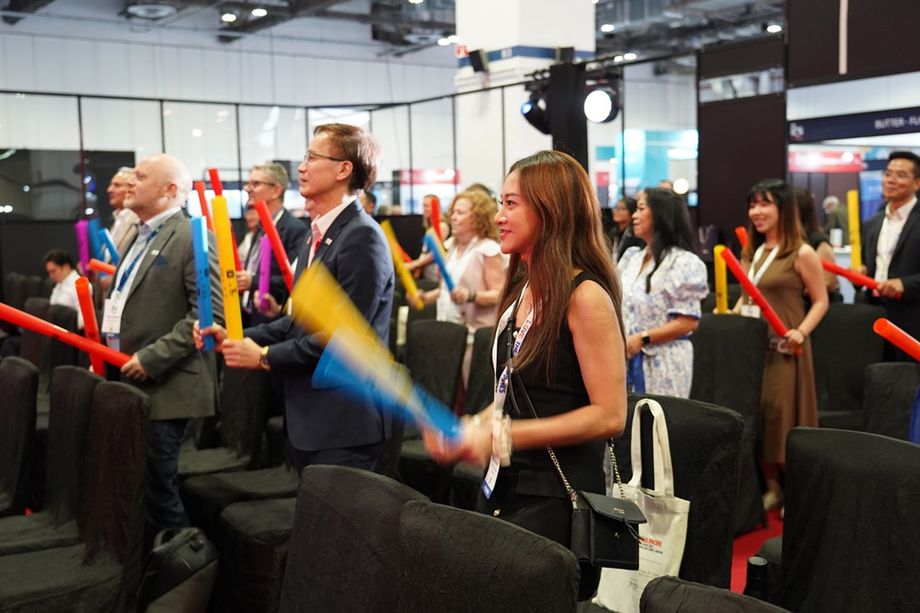
 Engagement, emotion and experience are rewriting the event playbook. Photo Credit: Northstar Travel Group
Return on investment is no longer just about cost versus revenue. It now includes metrics that reflect audience engagement, brand visibility, and content retention. Clients are increasingly looking at qualitative measures like attendee satisfaction, the number of meaningful business connections made, and post-event behavioural change.
A survey released last month from Forrester, looking at the global state of B2B events, highlighted how marketers are focused on extending event impact. To improve event ROI, 92% of survey respondents said they plan to improve their post-event attendee follow-up this year, and 77% are taking this further and looking to build year-round attendee engagement, by building integrated 12-month event plans. According to Forrester, these incorporate a range of event formats and use data and repurposed event content to drive ‘in-between’ event engagement.
Impact and experience matter
“For B2B events especially, we track follow-up actions such as meeting conversions or sales pipeline influence,” says Atika Rosli, chief and founder at Beyond Events. “Mobile app data, session attendance, and survey feedback also help demonstrate value. ROI dashboards are now built to include both hard KPIs and softer indicators. This shift is especially important for corporate clients looking to justify investment to leadership. Effectiveness today is about both impact and experience.”
Budget constraints have made ROI reporting more creative, and non-monetary value is being acknowledged more.
“Internal feedback from the company’s own team is now often treated as part of the measurement,” adds Rosli. “Clients are looking for broader indicators of success that justify future investment.”
Internal feedback from the company’s own team is now often treated as part of the measurement. Clients are looking for broader indicators of success that justify future investment.
Atika Rosli, chief and founder, Beyond Events
Brett Han, managing director at iCube Events, says new and emerging metrics being used include ‘engagement quality dwell time per booth/session’, namely how long attendees spend in specific zones or sessions. There’s also ‘interaction rate’ measurements, such as participation in polls, Q&A, gamification or networking and ‘pipeline Influence’, which measures the value of deals touched by the event (pre, during, post).
Post-event, consider the number of sales meetings booked, which can be especially relevant for B2B, while content engagement post-event includes views or downloads of session recordings or materials, as well as social amplification such as shares, mentions, or hashtag reach on platforms like LinkedIn or X.
Which interactions are worth it?
“In today’s constrained economic climate, organisations are under pressure to justify every dollar spent on events,” says Han. “While traditional KPIs like lead generation and revenue attribution remain important, they often fail to capture the full spectrum of an event’s impact, especially in the short term. Instead of simply counting attendees, savvy organisers can approach the way of measuring the quality of interactions.”
He encourages planners to ask the following: Were high-value clients or key decision-makers present? Did the event facilitate deeper conversations or help build strategic partnerships?
“Tools like CRM tagging and post-event follow-up outcomes offer rich insights into relationship-building effectiveness,” he says. “Influencer shoutouts, and organic social shares are increasingly used to evaluate brand lift. Monitoring hashtags, backlinks can help quantify exposure and public sentiment.”
Instead of simply counting attendees, savvy organisers can approach the way of measuring the quality of interactions.
Brett Han, managing director, iCube Events
Making your feelings known
Tracking delegate emotion is also emerging as a key metric for understanding true impact. Clients are increasingly interested in how attendees feel during and after an event - and not just in what they do. Emotional response provides valuable insight into brand affinity, content resonance, and overall experience quality. On the digital front, sentiment analysis of social media posts, live chat comments and post-event surveys help capture the emotional tone of the audience.
Clients can use these insights to assess what moments sparked excitement, confusion, or even disengagement. Emotional engagement often correlates with memory retention, brand loyalty, and word-of-mouth referrals, making it a powerful indicator of long-term ROI.
Return on engagement (ROE) is also gaining prominence as a valuable complement to traditional ROI, particularly for events focused on brand awareness, community building, and long-term relationships. While it’s not as easily quantified as financial returns, it can be effectively measured using the right mix of qualitative and behavioral data.
“ROE is more abstract but increasingly important,” says Rosli. “It involves measuring the level and quality of interactions – how often and how meaningfully delegates engage with content, speakers, or each other. Tools like in-app engagement analytics, QR code scans, gamification participation, and breakout room activity help quantify it.”
But ROE also requires context, Rosli points out. It means different things to a product launch versus a leadership retreat. What’s important is setting engagement KPIs in advance, such as interaction rates or participation in surveys or activations. While it’s not as straightforward as financial ROI, it gives a clearer picture of an event’s emotional and relational success. While ROE doesn’t always translate directly into revenue, it reflects the depth and quality of audience engagement, an important predictor of future loyalty and conversion.
Related: Is ROR the new currency for business events?