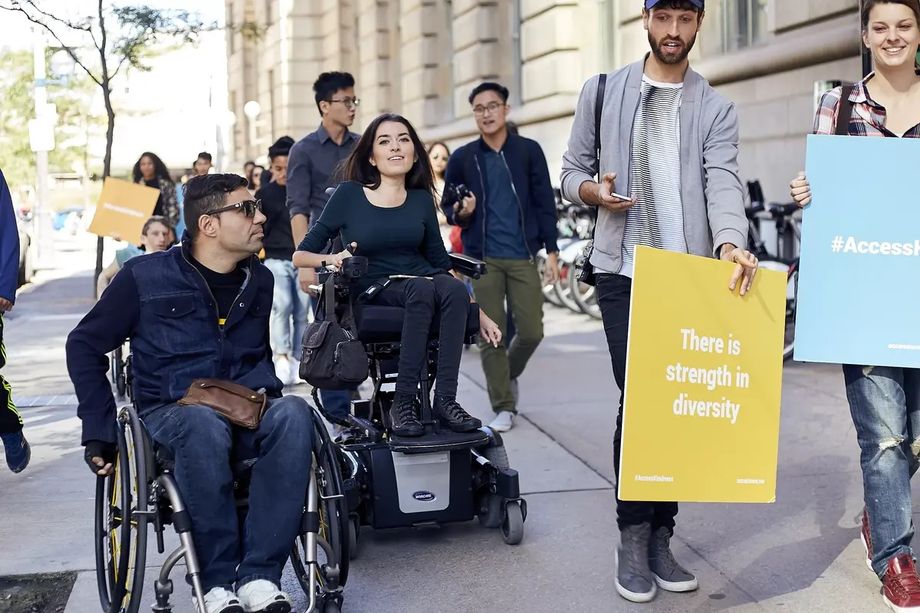
 (second from left) AccessNow’s Maayan Ziv: advocating for better accessibility information. Photo Credit: AccessNow
The meetings industry has a lot to learn - and unlearn - about
accessibility, said Maayan Ziv, the visionary force behind AccessNow.
The company was launched in 2015 as a solution to Ziv’s own challenges
as a wheelchair-user seeking reliable information about accessible
spaces.
A featured keynote for MPI’s Education Day during IMEX America, Ziv
met with Northstar to discuss this important topic. In this insightful
Q&A, she shared her perspectives, challenges conventional notions,
and advocates for a future where inclusivity is not just a checkbox but
an integral part of our shared experiences.
Tell me about the genesis of AccessNow
AccessNow really started out of the response to a personal need that I
had. I'm a wheelchair-user, and it's very difficult to find reliable
information about the accessibility of spaces. When we launched, there
was absolutely no information available online, and it was very
difficult to do the research to find it. We started building an online
community that allows people to share information, and we've really
grown from there.
How has AccessNow evolved from its initial focus on an online community?
In addition to allowing people to add reviews about spaces, we do a
lot of work directly with DMOs to promote the accessibility of their
destinations and spaces. That can be from a personal or a leisure-travel
perspective, but also from the perspective of a business event or a
large event like IMEX America.
How do you advise clients on inclusivity for a wide range of disabilities, including both visible and invisible?
Accessibility is a journey, not a destination. There's a continuous
process to understanding what defines access and to whom. ADA (The
Americans with Disabilities Act) compliance is different than usability.
We often look at the basics of ADA compliance, but there are many
aspects of the experience that are not captured by laws or regulations.
It's about customer experience or user testing, ensuring that people
with diverse needs can feel a sense of belonging.
What are some common accessibility barriers you face at meetings?
It's not just about physical access. Something as simple as the
language we use in communication can be a hindrance. For example,
instructing everyone to stand up without acknowledging that not
everybody in the room may be willing or able to do so. We need to be
looking at all aspects — space, programming, communications and
marketing materials — to ensure accessibility at every stage of the
event.
What are some easy measures planners can implement for more accessible events?
Including an accessibility desk in an event space can be a simple yet
impactful way to let people know that accessibility has been taken into
account. Sharing information in advance is crucial, including details
like the availability of sign-language interpreters, captioned sessions,
gender-neutral washrooms and quiet spaces. Making accessibility visible
in communications is key.
How can planners incorporate access more fully into their event-design process?
Including consultants or staff with disabilities in the event
planning team is crucial. There are not-for-profit organisations
representing people with disabilities, and consulting companies that can
help organisations create accessible events. Including individuals with
disabilities in the planning process ensures authenticity and
representation.
What percentage of a typical audience is affected by disability?
Disability represents over 20% of the population, whether visible or
invisible. It touches every person in some way, making it crucial for
event planners to recognize the market opportunity. Investing in access
is not just about compliance; it opens opportunities to engage a large
and loyal audience that appreciates inclusive experiences.
How can we make faster strides as an industry to be more inclusive and accommodating?
Unlearning traditional approaches and being open to innovation are
crucial. The pandemic taught us that events can take on different
shapes, from in-person to virtual or hybrid. Challenging preconceptions
and being open to difference can lead to creative and innovative
solutions. Accessibility is not just about physical access but also
about creating inclusive and flexible experiences for all.
Source: Northstar Meetings Group