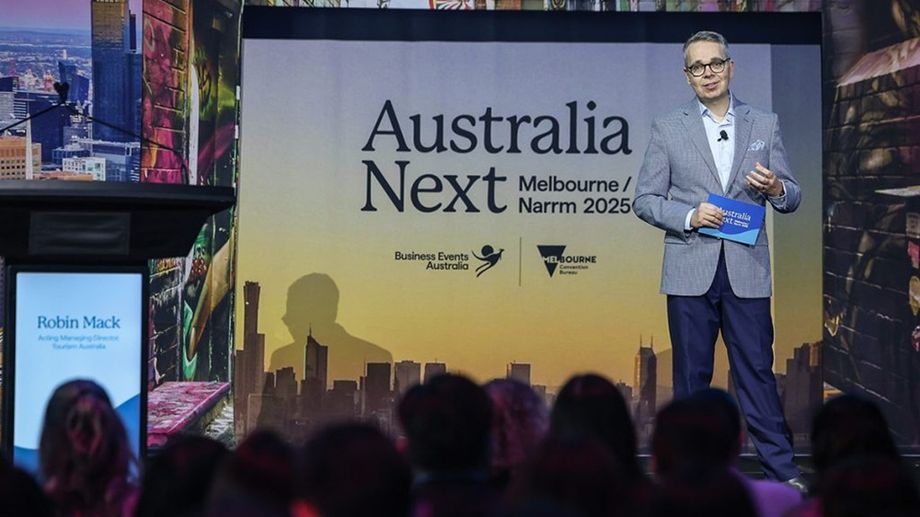
 Robin Mack, acting managing director of Tourism Australia, presenting his keynote speech at the Australia Next 2025 opening ceremony.
Global competition for high-value corporate travel is fierce, and Australia’s commitment to securing elite business events was on full display at Australia Next 2025, returning to Melbourne for the first time since 2013.
Business events are among Australia’s most profitable visitor segments.
Leading the charge is Robin Mack, acting managing director of Tourism Australia, who spoke to WiT about how Australia is recalibrating its strategy for a world where incentive planners are thinking not just of logistics and budgets, but of wellness, purpose, and emotional resonance.
“Our business events visitors spend 38% a night more than a leisure visitor,” Mack said. “It’s very high-yielding for us.” He added that business events now contribute “AU$4.15 billion in economic value,” aligning with Australia’s broader tourism strategy. “We look at the spend that comes through,” he explained, adding “the incentive groups business events, in general, is very powerful.”
Australia still grapples with perceptions of cost, he admitted. “While we wouldn’t be the cheapest, the value for money equation is real. Our visitors rate us higher for value for money after they visit.”
China picking up the pace
Despite common assumptions, China is not currently Australia’s largest inbound incentive market, but it is the fastest-returning.
“Globally, number one is New Zealand, number two is the US, and number three is China,” Mack said. “But if we look at spend, the US is number one, China is number two.”
The nuance matters because the rebound is not uniform.
“China is actually the standout market for us,” he said. “It’s 10% beyond where it was pre-COVID, and that’s on spend and visitors.” He pointed to the massive Amway China incentive trip earlier this year. “Six weeks, 16,000 delegates, worth 100 million to the visitor economy. They also went on to Hobart and Sydney. It was a nice dispersal piece.”
Australia is also watching other markets closely. “Malaysia is doing well, slower to return,” Mack said, before adding, “India is doing really well for us. Indonesia is doing very well. There’s lots of growth markets coming back”.
Distance, geography and reality
Australia’s distance is frequently cited as a barrier. Mack doesn’t deny the perception, but he does dispute the reality. “For a lot of people, it is perception, not reality,” he said. “We try to myth-bust. We’re closer than you think.”
Aviation is the linchpin, and advances in aircraft are opening new possibilities. “We are back to 100% of where we were pre-COVID in terms of seats into the country. We’re also back for domestic travel. That long-haul, short-body, narrow-body aircraft allows more point-to-point flights,” Mack added.
Partnerships help drive confidence, which was demonstrated by the number of delegates flown to Australia Next from around the world by Singapore Airlines and Qantas. “Singapore Airlines is a big partner for us,” Mack said, “but we work with a lot more to showcase what they do to make it easy for incentive groups.”
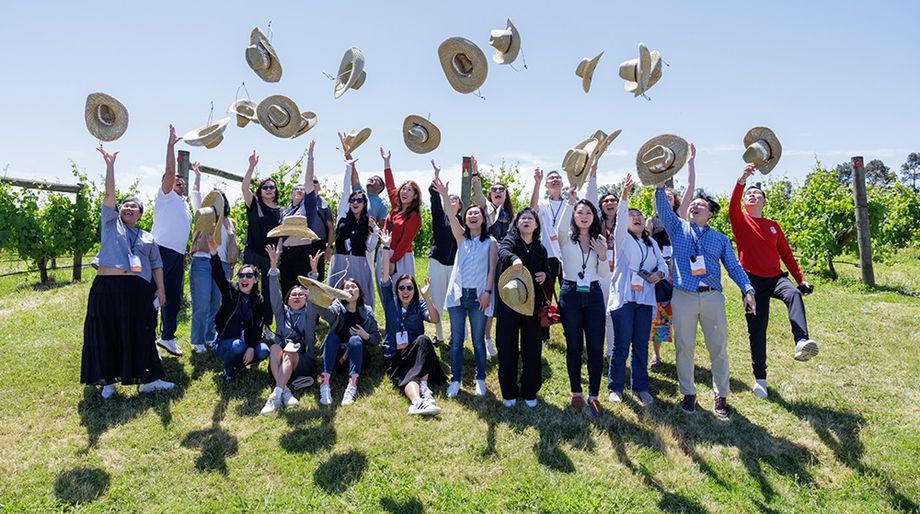 Delegates (agents, buyers, and media) are given a sample of incentive destinations and offerings in a showcase of host city Melbourne.
Mack also revealed that the conversion rate from business traveller to holidayer is promising. “We’re often seen as a bucket list incentive destination,” he acknowledged. “But people take a bucket list trip and then move on. What we see is great repeat visitation.”
From Singapore alone, he noted, “repeat visitation is in the 80% range”.
Distance may not be the deterrent many assume. “38% of incentive or business event visitors will go on to a second or third destination while they’re here,” Mack said. “They want to explore more depth and diversity.”
What is ROI, really?
What’s interesting is that in the last few years, the definition of an incentive trip has evolved, and so has the way companies calculate their returns on such trips. Soft ROI, such as team cohesion, mental health, employee wellness and morale may not be easily quantifiable but they’re very real outcomes of incentive travel.
When asked about ‘Soft ROI’, Mack immediately responded with, “I love that. It’s actually really important to us because it links to purposeful travel, and that’s something we celebrate as a destination.”
One area where Australia excels, he argued, is corporate social responsibility. “If you’re looking for incentive groups building purposeful giving-back into an itinerary, we can really deliver that.” He recalled a trip in Cairns where delegates released a rehabilitated turtle. “People were crying, seeing that happen at the Great Barrier Reef,” he said. “It’s those moments that bring teams together.”
Wellness is threaded through strategies across bureaus and DMCs. “They understand the objectives of the planner,” Mack said. “They make it happen.”
Where the investment goes
Tourism Australia groups its business events into two major pillars: corporate incentives and associations.
“In Asia, we focus solely on incentive groups,” Mack said. “Everything in the Asia region leans toward incentives. We do incentive groups in our Western markets, but we also do an association focus for the hubs in North America and UK, Europe. Our campaign overall is ‘There’s Nothing Like Australia’ for business events, and it’s tailored for incentive groups or associations,” he explained.
The Business Events Bid Fund Program (BFP) has been a cornerstone of this strategy. This programme helps Australian partners secure international bids against global competition. “We launched the programme in 2018,” Mack said. “Since then, we’ve had 199 wins, worth 1.3 billion to the visitor economy.”
The ROI, he added, is staggering. “Every dollar we invest, we get AU$53 back.” The programme is also future-focused, as it gives Tourism Australia “a pipeline out to 2029.”
“We want delegates and incentive groups to go home feeling they got something out of the trip,” Mack emphasised. “We can overdeliver, and we know it works.”
After hosting the Australia Next event three years in a row to boost inbound recovery, it will go back to being held every second year, with the next showcase heading to Sydney in 2027. Mack said hosting the event back-to-back had done its job and secured Australia hundreds of business leads worth many hundreds of millions of dollars.
Source: WIT - Australia’s $4 billion incentive engine is fuelled by recovering markets, soft ROI and the $53-for-$1 return