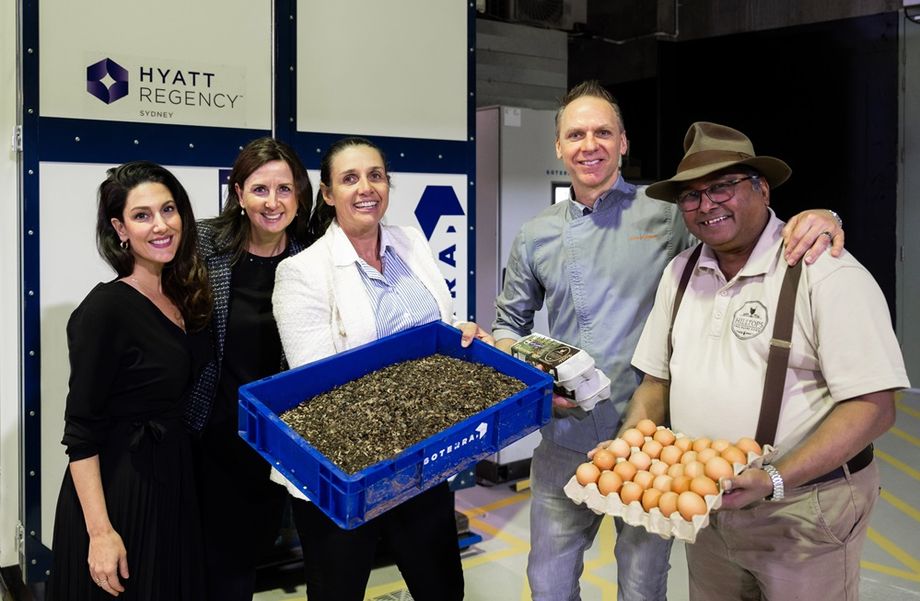
 Hyatt Regency Sydney is teaming up with Canberra-based tech scale-up Goterra to process hundreds of tonnes of the hotel's annual food waste using an innovative, insect-based system. Photo Credit: Hyatt Regency Sydney
Hyatt Regency Sydney, Australia's largest hotel, is revolutionising
its approach to sustainability through a groundbreaking partnership with
Canberra-based tech scale-up Goterra to process hundreds of tonnes of
the hotel's annual food waste using an innovative, insect-based system.
Created by Olympia Yarger, Goterra’s technology will make use of
black soldier fly larvae to rapidly break down food waste on-site in
high-tech, containerised units dubbed “Maggot Robots”, which can reduce
food waste by 95% in just 24 hours.
"When you manage food waste with insects, you radically reduce the
impact it has on the world,” says Yarger, CEO of Goterra. “Using insects
in tandem with industrial robotics means we manage waste efficiently,
producing a sustainable protein that can be used in agricultural supply
chains, creating a truly circular system."
The 878-room Hyatt Regency Sydney, boasting 4,000 sqm of event space
for up to 1,000 guests, aims to set a new benchmark for sustainability
in the hospitality sector with this initiative.
The processed waste, an insect protein byproduct, will be supplied to
the hotel's key egg provider, Hilltops Free Range, as an alternative
feed mix.
In a Facebook post, Hyatt Regency Sydney said: “The insect protein is
fed to chickens from Hill Top Free-Range eggs which produce eggs for
our hotel guests to enjoy. The eggshells and leftovers are then fed to
the insects and the cycle repeats, creating a sustainable circular
economy.”