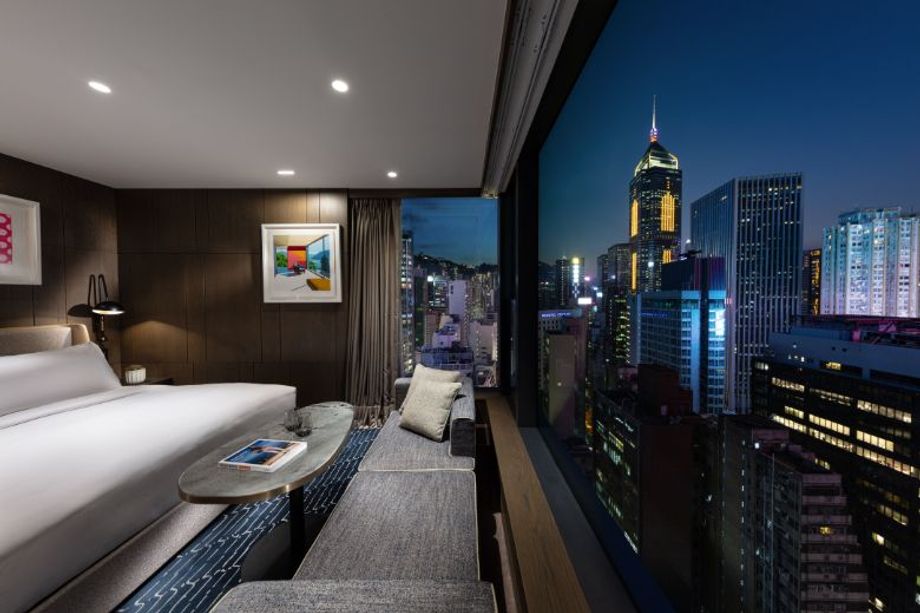
 The Hari Hong Kong (pictured), together with Marriott's Sheraton Hong Kong Tung Chung Hotel and Four Points by Sheraton have installed biosecurity protocols and non-invasive technologies wherever possible.
Despite Hong Kong’s continued battles against Covid-19 outbreaks —the
SAR’s health department declared an official fourth wave in late
November — the hospitality industry is gearing up for 2021 and beyond,
and hotel groups with plans to open new properties in December are
forging ahead.
The latest brands to announce new or expanded presences are The Hari
and Marriott International. The Hari Hong Kong, scheduled for a 12
December opening, is the brand’s second location after London, while the
Sheraton Hong Kong Tung Chung Hotel and Four Points by Sheraton
represents the city’s second Sheraton property. The former opened its
doors on 1 December; Four Points will follow in the first quarter of
2021.
The Hari Hong Kong takes a boutique approach to its operations and is
defined by an art and design-forward aesthetic. “We want to have some
fun with our guests,” said general manager, Rory Slater.
Designed by Atkins, with interior architecture by Tara Bernerd &
Partners, the 210 twin, king, corner and premium corner rooms (which
look over the Causeway Bay or Admiralty districts), and three rooftop
suites with terraces, and its public spaces are exemplars of progressive
boutique hospitality. There are no single use plastics in the hotel,
and bottled water is filtered and carbonated on site. Bernerd’s scheme
is meticulously mismatched, with brass, bronze and leather accents
giving the hotel a homey, literary personality, which Slater expects
will appeal to MICE guests from non-traditional industries and local
enterprises.
“There will be a lot of spin-off from the convention centre. There
are plenty of travellers who are mandated to stay at [other hotels],
but… I think there’s an appetite to stay someplace quirky, and
different, and a little less corporate,” he says, citing the arts and
culture and tech fairs that are regulars at the Hong Kong Convention and
Exhibition Centre, a 10-minute walk away. “But we have to establish
ourselves in the market as a luxury hotel first, and within that there
are several different areas we need to capitalise on.”
Those areas include F&B options. As The Hari Hong Kong has no
dedicated MICE space it is instead actively promoting use of its public,
living room-style spaces, including the Italian Lucciola Restaurant
& Bar, which spills out to the first floor open-concept lounge, and
the Japanese Zoku Restaurant & Terrace, overlooking Lockhart Road.
The first floor is also home to a fully equipped boardroom able to
accommodate up to 10 pax, and the hotel will also be highlighting its
rooftop suites for more private MICE events targeted at smaller groups.
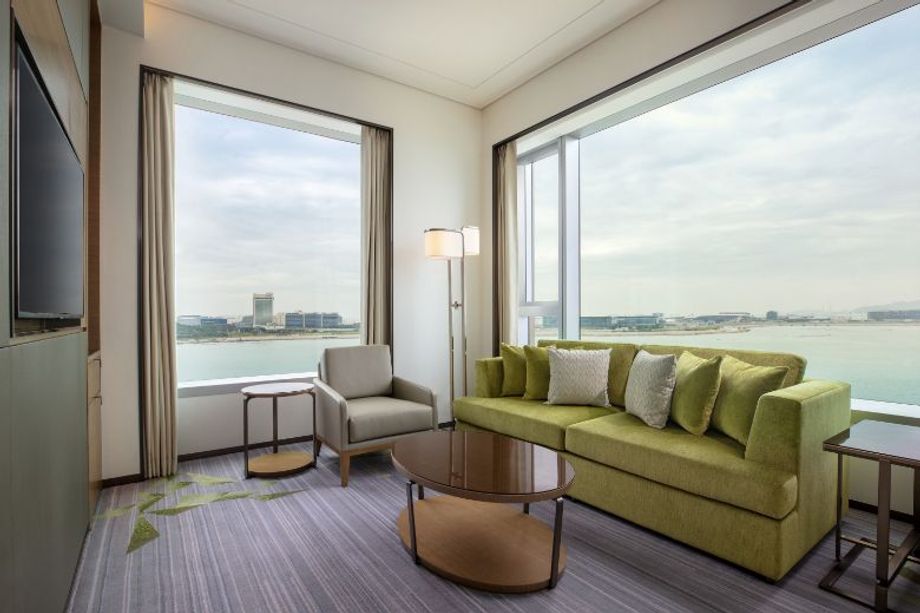 "Groups will return, regardless of the industry," predicts Sheraton cluster general manager, Sander Looijen.
At the other end the spectrum, the HBA-designed Sheraton Tung Chung —
which will have 218 rooms, plus approximately 1,000 when the Four
Points opens next year — was built and designed to accommodate
traditional, large MICE events, especially in light of its location a
10-minute shuttle ride to the airport and practically on top of the
border crossing at the Hong Kong-Zhuhai-Macao bridge. Cluster general
manager, Sander Looijen plans on making the most of that in 2021.
While focusing on local travel at opening, looking at 2021 and
beyond, “Groups will return, regardless of the industry,” states
Looijen.
“For weddings and social events we have a unique space. People are
hesitant right now but the demand is already there. There are local
companies interested in the built-in conference systems, so businesses
here might use a meeting room and connect with others in a room in
Singapore. That’s something we’re working on.”
And despite prevailing notions that the new work normal has made
business redundant, Looijen isn’t worried. “We believe that face-to-face
meeting will return. There’s nothing like meeting in person, and
companies will find that essential for success.”
The Lantau location means the Sheraton is able to respond to an
increasing demand for outdoor space, and includes terrace and garden
venues for receptions. The Grand Ballroom, Hong Kong's fourth largest,
spans over 1,600 sqm plus a 450sqm pre-function area, outfitted with
integrated LCD projectors, comprehensive A/V equipment, three high
definition screens and teleconferencing facilities. Theatre style
accommodates 1,300 pax, and 816 in banquet settings. An additional
480sqm can be found in four meeting rooms, with capacity of up to 100
pax in a theatre configuration plus 213 sqm for pre-function.
For the immediate term, both hotels are observing all recommended
biosecurity protocols and exploiting non-invasive technologies wherever
possible.
The Hari’s arrival lobby features a camera that sends staff
smartphone alerts in real time if anyone entering the building is
running a temperature. The Sheraton’s thermometers scan from a distance
and politely remind guests to wear a mask if they’re not. The question
now is whether the measures will linger after Covid-19 is no longer an
imminent threat. On that Slater and Looijen agree: it may come down to
guest demand.
“A lot depends on how things develop, and what guest exceptions are,”
says Looijen. “We always want to achieve a level better than
expectation.”
“The lobby camera was built to be removed easily,” adds Slater. “We’ll just have to wait and see what everyone prefers.”