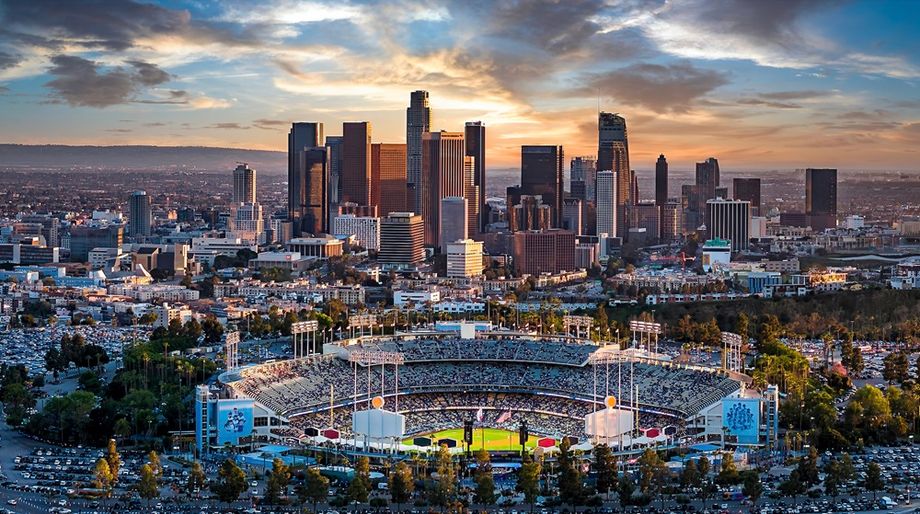
 Casey Wasserman and Karen Bass discuss plans for the Los Angeles Olympic Summer Games in 2028. Photo Credit: Adobe Stock/Larry Gibson
The success of the 2024 Olympic Summer Games in Paris has put Los
Angeles in the spotlight as the LA28 organising committee switches fully
into operations mode.
At a press conference to close the Paris Games, LA28 Chairman Casey
Wasserman and Los Angeles Mayor Karen Bass outlined some of their own
ambitious plans for the Games in 2028. And among them is something that
goes against the grain in Los Angeles: Bass pledged for the event to be a
“no car Games.”
How exactly that can be accomplished in a city that lives and dies by
the car remains to be seen. Bass outlined how she thinks it can happen,
starting with a massive investment in public transportation, an equally
big procurement of buses and a commitment for people to work remotely.
“The ‘no car Games’ means that you will have to take public
transportation to get to all of the venues,” she said. “In order to do
that, we have been building out our transportation system. That’s not
going to be enough. We’re going to need over 3,000 buses that will come,
we will borrow them from all around the country. And you can’t do that
without cooperation on every level of government. And I’m happy to say
that we certainly have that.”
Wasserman and Bass addressed several areas of the upcoming preparations:
Security
Wasserman noted the Games received a national special security
exemption in January, three years earlier than any other sporting event
has received in the United States. The plan, he said, is to take
advantage of the time until 2028 to prepare, similar to the way London
organisers did in the Wimbledon before their Games, treating it like
they would the Olympics to prepare local residents and fans.
Bass noted all the city and county’s lead security and public safety officials came to Paris to observe the Games.
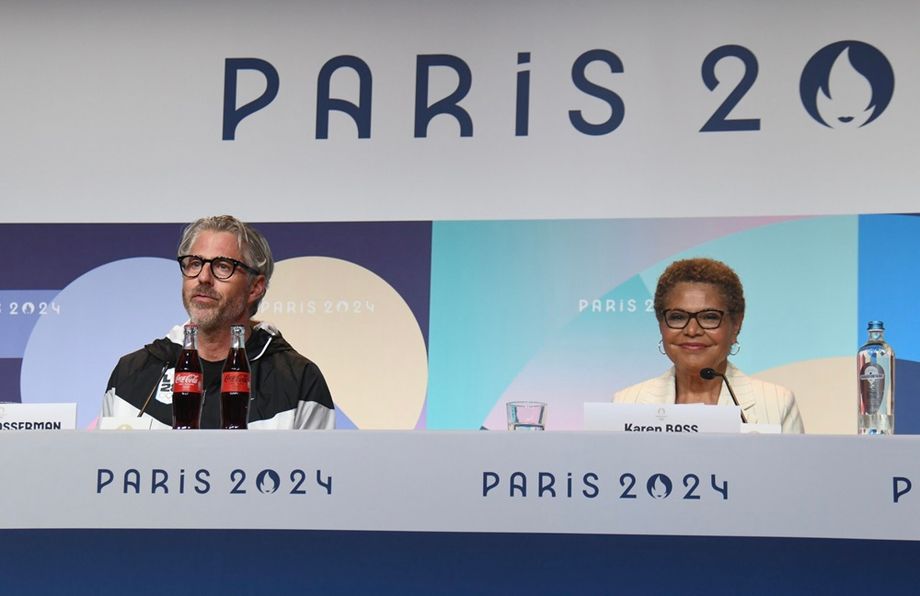 Casey Wasserman and Karen Bass discuss plans for the Los Angeles Olympic Summer Games in 2028. Credit: Jason Gewirtz
Ticketing
Paris set a record with 8.3 million tickets sold, selling nearly all of them. Can Los Angeles top that?
Wasserman said they won’t know the total inventory until final venues are confirmed.
“We have a pretty good idea of how many tickets we have to sell, but
the exact manifest of those facilities won’t be finalised until every
venue is finalised and we have a couple of sports where we have a lot of
flexibility of where they can be,” he said. “So, we can optimise those
for both our financial responsibility and our operational responsibility
to deliver the Games.”
He noted Los Angeles has the opportunity to sell “significantly” more
tickets than Paris. “But Paris sold every ticket they had and they
deserve a lot of credit for that.”
Authentic L.A.
Asked what aspects will make for an “authentic” Los Angeles Games,
the leaders said they had different criteria. Wasserman said the city
will aim to highlight itself at the Closing Ceremony. But as for 2028?
“I think we are the place in the world where culture is made and
culture is started,” he said. “Whether it’s our incredible history in
the film industry, the music industry. L.A. has become so much more:
fashion and film and food. And all of those things and all of the star
power and opportunity to showcase that to the world.”
Bass said the city will also lean into its significant ethnic diversity.
“What is authentically L. A. are Angelenos,” she said. “And Angelenos
representing every part of the world. I’ll be excited when people come
from Bangladesh and find out that there’s a Little Bangladesh, and a
Little Ethiopia, and a Little Tehran. All around the world, there will
be people coming from countries who will come and see their diaspora.
And I’m hoping that that’s something that we can really build upon.”
Legacy
Wasserman said the committee has an early commitment of US$160
million toward youth sports programmes in the Los Angeles area. “It is
the largest single investment in youth sports in the history of America
in one city and that’s before we even hosted the Games,” he said. “So,
we are proud of that.”
Beyond that, he noted that the U.S. has not hosted an Olympic Games
since 1996, meaning there is the opportunity to inspire a new generation
of sports fans.
“A lot has changed since 1996, suffice to say. And so, the
opportunity to have one of the great sporting cities in the world
showcase the greatest sporting event in the world and the place where
the world comes to tell their stories, we think is a really powerful
opportunity.”
Paralympics
Wasserman also noted that the 1984 Games included several adaptive
sports as exhibitions even though the Paralympic Games weren’t tied then
with the Olympic Games.
“I think our history of access and accessibility for physically
impaired individuals in the United States is world class. I think L.A.
is at the top of the heap in that regard and I think the opportunity to
showcase these stories and to showcase these athletes is incredible,” he
said.
Team USA’s Paralympic team includes 25% who got their physical
impairment while serving in the military. “As special as the Olympics is
going to be, the Paralympics will be a truly electric and a special
opportunity with just as much thought, just as much energy and just as
much excitement for the city of L.A. and the world.”
He also noted the youth sports initiative in place includes
programming for adaptive sports. “One of our future Paralympic champions
is going to come through that Play LA program that we started with the
city.”
Bass said she also intends to return to Paris for the Paralympic
Games as well. “I’ll be extremely honoured to be here for the Closing
Ceremony and really look forward to the Paralympics in Los Angeles.”
Venues
While there wasn’t much discussion about venues that will be used in
Los Angeles, there’s one thing LA28 won’t be doing: Cleaning up their
river like Paris did with the Seine. “It doesn’t mean we’re going to be
in the L.A. River, but I think they get a lot of credit for taking
chances.”
Source: SportsTravel Magazine