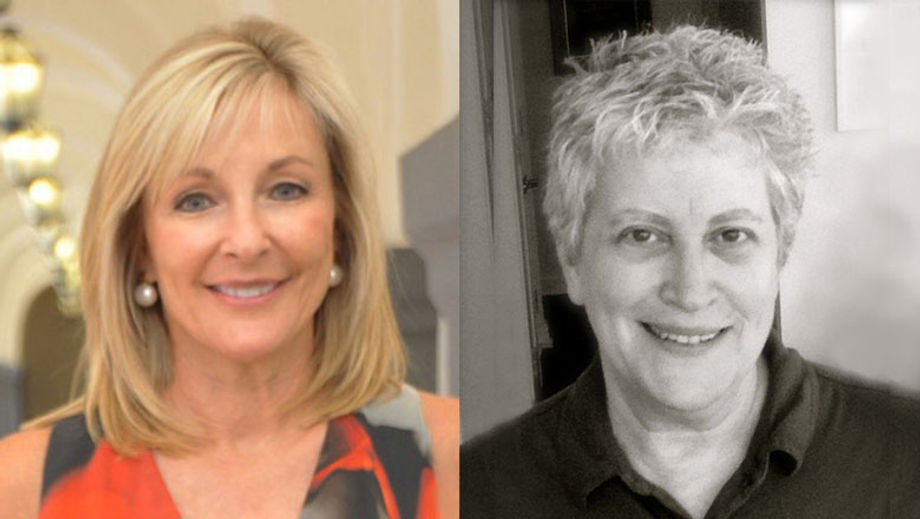
 Susie Ellis, chair and CEO of GWS and GWI (left) and Nancy Davis, chief creative officer & executive director of GWS. Photo Credit: Global Wellness Institute
Wellness is forming the core of post-Covid meetings and events, not
just in form but also in content, revealed Nancy Davis, chief creative
officer & executive director of the Global Wellness Summit.
The annual Global Wellness Summit (GWS) is the world's foremost
gathering of international leaders in the US$ trillion global wellness
economy, organised by leading research and educational resource and
non-profit, the Global Wellness Institute (GWI). The Institute publishes
the annual "Global Wellness Report" which outlines and analyses trends
and consumer demands in the global wellness industry.
The
pandemic has driven people to embrace wellness and self-care and,
according to Davis, this trend has led to new ways of reimagining and
designing meetings and events. In a thought leadership piece she wrote
entitled "Resetting Events with Wellness" for the 2021 Global Wellness
Report, Davis said, "This trend reinforces the importance of what is now
top of mind everywhere—health, safety, strengthening immunity, and
employing protocols and technologies that can mitigate risk."
In a conversation with Meetings & Conventions Asia, Davis
recently shared what the GWI seeks when selecting a destination venue
for the GWS and how wellness can be incorporated in the content
programme and event design.
Davis noted that the GWS is "unique in that destinations actively
court us. They come to us to pitch why their destination (city, region,
country, property) would be an ideal host sponsor for our annual
conference." In this connection, she said that the GWS has a "very
defined RFP" process which prospective host sponsors must complete and
comply with, in order to be considered.
"We always look for a win-win: a place that would be of interest to
our global audience of wellness thought leaders and decision makers,
most of whom are well-travelled, and a reason for the host sponsor to
consider the investment," Davis said.
With the return of in-person events, Davis emphasised that the most
important aspect of the GWS is the "sense of community" that it offers.
She added that the delegates' engagement is more crucial than ever,
highlighting the need for quality content and "moments that move the
audience" – in both the literal and figurative sense.
"Our agenda is embedded with movement, art, culture, music, dance as
well as activities like breathwork, yoga, walks in nature, easy access
to fresh air and healthy food," she said.
Meanwhile, GWS has rolled out new initiatives, for instance, it
partnered with Thailand’s Miskawaan Health Group for a first-of-its-kind
hybrid symposium on the emerging field of functional medicine, defined
as a “preventative, healthcare-meets-wellness approach that focuses on
addressing the root cause of disease.” Anutin Charnvirakul, Thailand’s
deputy prime minister and minister of public health, was in attendance
to discuss Thailand’s aspiration to be a world leader in functional
medicine.
“Functional medicine is such an important and timely topic, as a
prevention-focused, medicine-meets-wellness philosophy that could impact
so many lives and tackle rising healthcare costs,” said Susie Ellis,
chair and CEO of GWS and GWI.
The GWS straddles many wellness sectors and the convergence of
healthcare and wellness is a growing sector that is being looked at by
GWI. Other wellness sectors being considered for event partnerships
include mental wellness, wellness tourism, wellness real estate and
workplace wellness.
"The pandemic has brought new shifts and a global ‘values reset’:
‘Wellness’ now means far more than a facial or spin class, with a
growing focus on mental wellbeing and the importance of work-life
balance, social justice, environmental sustainability, the built
environment, and public health," added Katherine Johnston, a senior
research fellow at GWI.