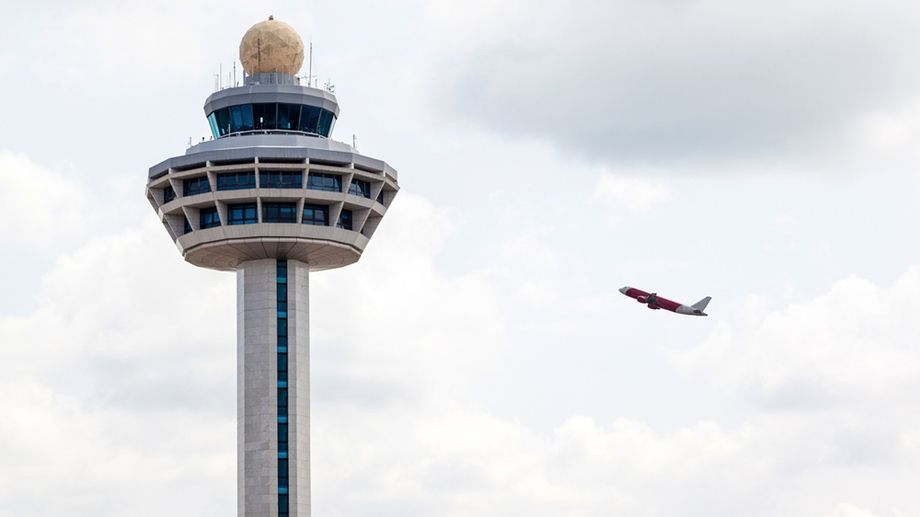
 Passengers will pay levy amounts ranging from S$1 to S$41.60 depending on cabin class and distance. Photo Credit: iStock/ronniechua
Singapore has confirmed the world’s first explicit sustainable aviation fuel (SAF) levy will kick in this year, with new passenger charges expected to help fund greener jet fuel.
When will it kick in?
The mandatory levy will apply for air tickets sold from 1 April 2026 for flights departing Singapore from 1 October 2026 onwards, the Civil Aviation Authority of Singapore (CAAS) announced.
How will it be charged?
The levy will be applied per passenger on flights to and from Singapore.
The amount varies by distance and cabin class, with rates grouped by four geographic bands.
For flights within Southeast Asia (Band I), passengers travelling in economy class will pay S$1 (US$0.79), while those in premium cabins will be charged S$4.
For Band II destinations, which include Northeast Asia, South Asia, Australia and Papua New Guinea, the levy will rise to S$2.80 for economy passengers and S$11.20 for premium cabin travellers.
On longer-haul Band III routes – covering Africa, Central and West Asia, Europe, the Middle East, the Pacific Islands and New Zealand – the levy comes up to S$6.40 in economy and S$25.60 in premium cabins.
The highest levy will apply to Band IV destinations in the Americas, where passengers can expect to pay S$10.40 in economy class and S$41.60 if travelling in a premium cabin.
For flights with multiple stops, the applicable levy is based on the immediate next destination after departing Singapore.
Who pays?
Airlines will collect the SAF Levy from passengers, and are required to display the SAF Levy as a distinct line item on the air ticket sold, according to CAAS.
Only origin-destination passengers will be charged.
Passengers transiting in Singapore are exempt from the levy.
Cargo flights and business/general aviation will face separate SAF levies based on weight and distance.
Why this SAF levy?
Singapore’s Sustainable Air Hub Blueprint sets initial SAF usage targets at 1% of jet fuel by 2026, rising to 3-5% by 2030, with the levy’s revenues earmarked to fund SAF purchases and related environmental attributes.
CAAS says the levy is calibrated around the volume of SAF needed to hit these targets and the expected price premium of SAF over conventional fuel, plus other associated costs, including for certification, blending, and delivery.