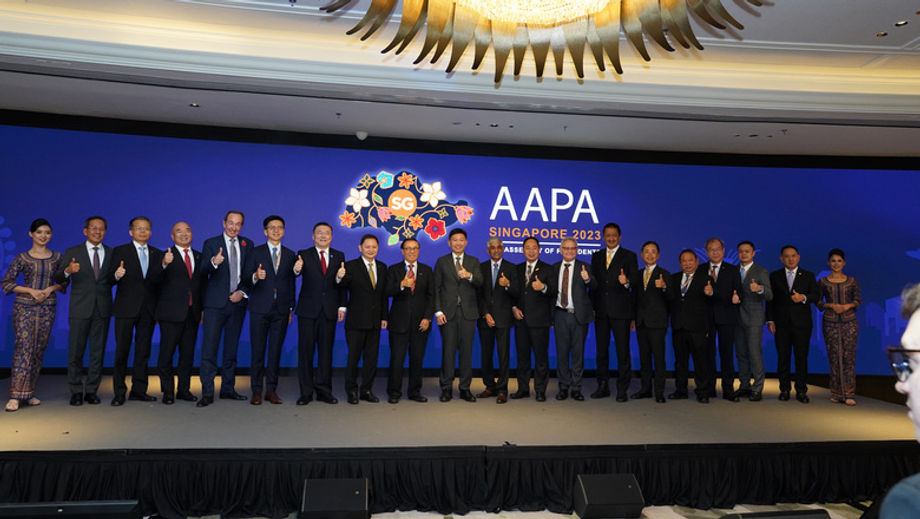
 The 67th Assembly of Presidents of the Association of Asia Pacific Airlines at Mandarin Oriental Singapore. Photo Credit: AAPA
Sustainability was one of the key topics amongst airline leaders at the 67th Assembly of Presidents of the Association of Asia Pacific Airlines (AAPA) in Singapore last week. They also sought for greater dialogue with governments on regulatory initiatives.
“Achieving sustainability goals is critical to the future success of the international air transport sector and its continuing role as an agent for social and economic development,” said Subhas Menon, AAPA director general.
“Extreme weather events and record temperatures in 2023 nearing global warming thresholds set by the United Nations Intergovernmental Panel on Climate Change, are a clarion call for all industry players, especially governments and fuel suppliers, to step up efforts on sustainability, and to ensure that aviation is able to achieve its net zero carbon emissions goal by 2050.”
AAPA leaders pledged to work together to aim for a sustainable aviation fuel (SAF) utilisation target of 5% by 2030. The airlines disclosed their collective ambition, recognising that SAF production is only at its infancy globally. Only an adequate supply of SAF would effectively mitigate CO2 emissions in international aviation.
By embracing the global aspirational goal of net zero CO2 emissions by 2050, the AAPA calls on governments, fuel producers, airports, and other industry organisations to work in unity to accelerate the transition to renewable energy and fuel the industry’s journey towards carbon neutrality.
“A harmonised global framework that enables the cost-effective supply of SAF is crucial for aviation to attain its net zero emissions goal by 2050,” said Menon. “By highlighting their collective ambition on SAF usage, AAPA airlines are indicating the level of SAF demand as an impetus for governments to consider the necessary support initiatives for SAF supply, and for fuel producers to plan SAF production capacity, to meet the needs of the industry.
“At the same time, a globally-agreed accounting framework for airlines to account for their emission reductions, based on a chain of custody approach, should be in place. This will ensure that the relevant carbon abatement credits are properly attributed in the SAF supply chain from feedstock to production and use.”