Last August, Paulo Henrique Machado perused the exhibits and schmoozed with his peers at SIGGRAPH, an annual gathering of computer graphics artists and developers. The show was held at the Vancouver Convention Center in British Columbia, but Machado participated from the confines of a hospital bed in Sao Paolo, Brazil, where he has spent most of his 47 years. Such is the miracle of modern meetings technology.
As an infant, Machado was stricken with an especially virulent form of polio that left him almost completely paralyzed. Although he is prone in bed and tethered to a respirator 24/7, he can use his hands to work a computer. Over time, he taught himself computer animation and recently worked on an animated film series for children. When SIGGRAPH (short for Special Interest Group on Graphics and Interactive Techniques) conference chair Dave Shreiner learned about Machado, he vowed to find a way for the resourceful techie to attend the show.
"My view is that if you do anything related to computer graphics, you should be a part of the SIGGRAPH community," says Shreiner. "I thought that there had to be a way to get this guy to the conference."
.jpg?tr=w-390%2Cfo-auto "Paulo Machado (right) virtually attended the SIGGRAPH
computer graphics show by means of a robot donated
by Double Robotics.") Paulo Machado (right) virtually attended the SIGGRAPH
computer graphics show by means of a robot donated
by Double Robotics.
Paulo Machado (right) virtually attended the SIGGRAPH
computer graphics show by means of a robot donated
by Double Robotics.Shreiner's solution was to have Machado attend via a telepresent robot -- essentially a screen that streams video and audio and is outfitted with a microphone and speakers. The unit is attached to wheels that can be remotely controlled via laptop from anywhere via an Internet connection. The video feed allows the participant to navigate through a space in real time, interact with other attendees and roam the floor independently.
After reaching out to several robotics companies over the course of several weeks, just nine days before the event, Sunnyvale, Calif.-based Double Robotics offered to supply a free model.
During the week before the show, Kristy Barkan, who took over from Shreiner as the project's manager, was in constant communication with Machado, updating him on conference schedules and agendas, discussing his interests and getting him up to speed on the SIGGRAPH community. The robot was shipped to the convention site, at which point Machado was able to perform test drives of the remote-controlled machine.
Despite the limited time to prepare, everything ran smoothly. "The robots do exactly what they're designed for -- it's pretty much plug and play," says Barkan. "Surprisingly, they're not overly complicated."
On the first day of SIGGRAPH, as some 14,045 attendees began arriving at the convention center, Machado rolled in alongside them. Soon he was gliding through the hallways via screen, introducing himself to others, taking part in sessions and meeting colleagues at a networking event for attendees from Brazil.
Two student volunteers were assigned to escort the robot around. ("It's light enough to be picked up, and it uses a removable iPad for the screen, so we didn't necessarily want to leave it unattended," notes Barkan.) They also helped with translation when required, as Machado speaks Portuguese.
Machado -- via an electronic avatar that he called R2-D2 -- became an instant celebrity on the show floor. "Everywhere the robot went, people would stop and talk to him," Barkan says. "We didn't see a single negative reaction."
"Do you know what this means to me?" Machado enthused during the show in a live Q&A. "It gives me the freedom that I physically can't have."
Next year, SIGGRAPH organizers plan to bring Machado back and are optimistic about making the experience even more valuable for him. "Now that Paulo has been able to 'attend' and learn a bit about the conference offerings, we can work with him more ahead of time to plan out what he would like to participate in," says Marc Barr, a professor of electronic media communication at Middle Tennessee State University and SIGGRAPH 2015's conference chair. He adds that he would love to see Machado participate as a presenter or leader of a session.
"The point is, I think we've made the first step in reaching a new audience," Barr says. "Not just for a conference like SIGGRAPH, but to be at a stage in the development of the technology that enables all of this to happen."
Robotic Do's and Don'ts
It's a new technology, and few meeting planners have experience in using telepresent robots. Following are a few best practices to keep in mind.
Take a test drive. A number of companies offer robots, each with varying capabilities, equipment and user interfaces (see "
Where to Get a Robot"). Some models are very complex and hard to control, so test various kinds to find one you can work with.
Check for sufficient Wi-Fi. Adequate Wi-Fi is essential for robot use. For example, technology writer Russell Holly recently "attended" a Big Android BBQ event using a robot. "But every once in a while the Wi-Fi connection would drop out and the thing would veer to the left and crash into a wall," Holly says. The robot required a handler to guide it, who kept a spare portable data connection (like a Verizon Jetpack) on hand in case the Wi-Fi connection was broken.
Keep it powered up. Be sure a robot's handlers have charged it sufficiently. Some robots move around by the use of attached iPads, which have limited battery life.
Take the elevator. Be sure users are aware that stairs, escalators and doors are best avoided unless the robot is assisted by handlers.
A New Kind of 'Attendee'
They don't look anything like the 1950s science-fiction depiction of humanoid robots, but today's remote-controlled mobile electronic entities increasingly are being integrated into the world of meetings, where drones are capturing high-flying event footage and 3-D printers are churning out giveaways at booths.
They've been pressed into service, too. Last August, for example, Aloft Hotels teamed up with robotics company Savioke to pilot a robotic butler program at its Cupertino, Calif., property. The robot, named "Botlr," can navigate the hotel's halls and elevators to perform tasks like delivering a toothbrush or extra towels to a guest room.
"The robots being used today in our industry are very useful tools, and we'll definitely be seeing more of them in the near future," says Bellingham, Wash.-based meetings technology consultant Corbin Ball. "It's just a matter of finding the right applications."
The possibilities for the meeting industry are broad and largely untapped, says Steve Ernst, CEO of Palo Alto, Calif.-based Event Presence Inc., a subsidiary of Suitable Technologies Inc. Among ways his company's own Beam Telepresent Robots could be of service:
• Venues could use them to provide site walk-throughs with planners who are far away and don't have the time or budget to travel.
• Venue operations teams could put them to use as security guards to patrol a space day or night.
• General contractors could "walk" the trade-show floor before the conference begins to check in on the build-out of the show.
• Planners could use them to get more "attendees" into the building without exceeding a venue's capacity.
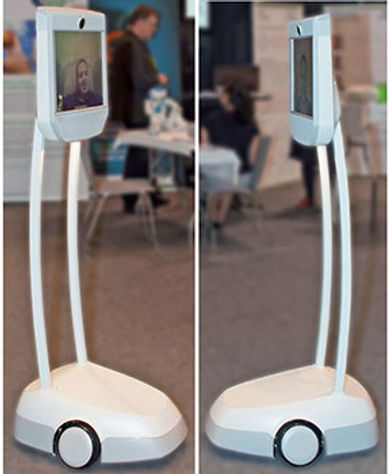 Modern-day R2-D2: Beam Telepresent Robots
from Suitable Technologies
Modern-day R2-D2: Beam Telepresent Robots
from Suitable TechnologiesAs an example, Ernst points to the Consumer Electronics Show, held in Las Vegas this past January, which had some 170,000 attendees. "The building can't handle any more people at this point," he notes, "so how do you grow a show past the walls? One way, he found, was via his Beam robots. "Beams can have only one remote user at a time, and once that user is logged off, another can log on. This means just one Beam can potentially represent dozens of additional attendees that can participate from anywhere in the world."
Suitable Technologies already has pioneered such a concept in real time. In 2013, the company sent 50 Beam Telepresent Robots to the Robobusiness conference at the Santa Clara Convention Center in California. Participants from around the world could rent a robot for $100 per hour by simply clicking a link and reserving a time slot. Users were then logged into Suitable's headquarters, where a technician provided a brief training session before allowing the attendees to "beam in" to a robot on the convention center floor.
Nearly 100 attendees took advantage of the program, accounting for some 127 hours of combined use during the conference.
Where to Get a Robot
Here's a sampling of companies now offering robot technology> Suitable Technologies offers two mobile telepresent solutions: the Beam+, which is geared for home use, and the Beam Pro, which is better for corporate environments and meetings. Unlike Double Robotics' model, the screen, camera and microphone are all attached to the wheels.
> Double Robotics features a telepresent robot that essentially is a removable iPad on wheels that can be controlled via Mac, PC, iPad or iPhone. This past December, the company introduced a new audio kit for $99 that includes an amplified speaker and directional microphone to improve conversation quality in loud environments.
> iRobot, the makers of the Roomba automatic vacuum-cleaning robot, announced in March the advent of the Ava 500. This robot uses sensors to scope out a venue or office, so when users want to remotely attend a meeting in a certain room, they can simply use an iPad app to tap on the desired area, and the Ava 500 will navigate to the location, avoiding walls, obstacle and people.
Remote Eyes and Ears
Every morning, Richard Garriott, founder and CEO of the video game company Portalarium, attends a meeting with his staff to discuss current and future projects as a way to kick off the work day. Garriott lives in New York City, while the rest of his staff is in Austin, Texas. But he's as good as there. Garriott uses a Double Robotics telepresent robot as his representative in the Austin office on a daily basis, which he finds especially useful during meetings.
"When you Skype or use a videoconference program, you show up for the meeting and then you sign off," he notes. "But the power of being 'in the office' means I can be there before the meeting starts and after the meeting ends. I hear the hallway chatter, I can feel the heartbeat of the team. Everyone in the meeting is usually on their best behavior, but if you really want to understand their motivations and rationale, you need to be there before and after the meeting. It's invaluable."
Having a robot in the office also means that "any day I'm working on the road or here in New York, I can still log into the Austin office," Garriott says. In fact, he has interacted with staff via robot from taxis and airplanes.
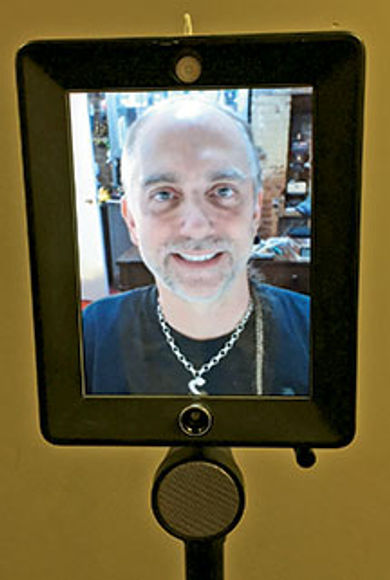 Richard Garriott, via robot
Garriott's direct link back to headquarters is useful while he's with clients, too. "I might be meeting with business partners or product reviewers, and I'll be talking to them about the team," he says. "Instead of showing them a PowerPoint presentation, I can flip open another window on my computer and introduce them to our various team members, then wheel through the halls and give them a tour of the office."
Garriott has even employed the robot to attend two overlapping trade shows simultaneously. "I needed to be at DragonCon and Arcade Expo at the same time," he notes, "so we sent a robot to Arcade, where we had some team members in a booth. If anybody wanted to talk to me specifically, my staff would patch me in via the robot."
A robot also can stand in for a speaker or moderator. Last March, Edward Snowden, the controversial "NSA whistleblower," appeared on the stages of a TED conference in Vancouver, British Columbia, via a Beam Telepresent Robot, since stepping on Canadian soil likely meant extradition to the United States.
The Downside of Novelty
For now, a possible drawback is that the medium can obscure the message. David Haas, director of technology for New York City-based FreemanXP, cites a recent case where a client brought a robot in during coffee breaks to connect attendees with far-flung industry experts. "The goal was to create a lot of buzz, but it may have worked too well," he says. "The machines were so novel that most of the questions were around how cool the robots were."
To avoid this, "Planners should consider that they are probably going to cause a scene," notes Haas, "so if you're counting on them to deliver a critical message or be an integral part of the meeting, let attendees see them earlier so they can get past the wow factor."