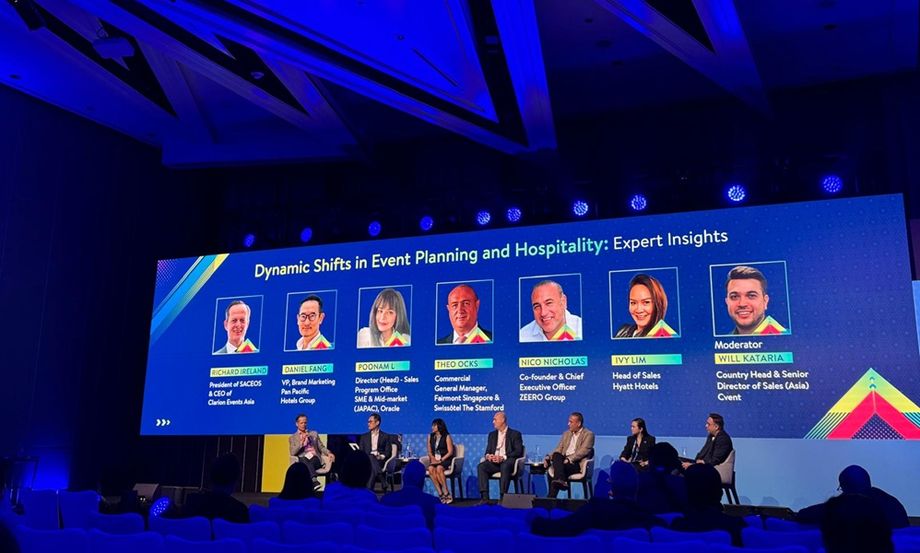
 Cvent Accelerate 2025’s panel discussion: “Dynamic Shifts in Event Planning and Hospitality: Expert Insights” Photo Credit: M&C Asia
Ongoing shifts in the events and hospitality landscape are presenting fresh opportunities for planners and hoteliers willing to adapt to new technologies and customer expectations.
At Cvent Accelerate 2025’s panel discussion, “Dynamic Shifts in Event Planning and Hospitality: Expert Insights”, Richard Ireland, president of SACEOS and CEO of Clarion Events, noted that the recovery of the meetings industry has been far from uniform.
Larger conferences and exhibitions are outpacing smaller shows and the growth is uneven. Hence the industry must remain nimble, relevant, and flexible.
What’s driving change?
Destination appeal remains a crucial differentiator in event planning. Ireland highlighted Singapore’s robust performance, citing its world-class infrastructure and trusted reputation for safety and efficiency. Singapore has outperformed global benchmarks, he said, referencing the Singapore Tourism Board’s statement that 2024 was one of the country's strongest tourism years to date.
Singapore has also become a preferred event hub for Chinese organisers aiming to reach the Southeast Asian market. To meet this rising demand, local planners must focus on efficiency and attracting young talent into the industry, Ireland stressed. “We won’t be able to fulfill that demand unless we have a highly motivated, qualified, and happy workers to fulfill our guests,” he said.
Sustainability is another essential pillar. Global events are increasingly favouring destinations and venues with strong sustainability credentials.
Planning ahead amid uncertainty
Theo Ocks, commercial GM, Fairmont Singapore, observed a shift in booking patterns. “What we’re seeing with those types of events is that once we get through the negotiations and everything, a lot of people are at this point holding (back) on the final confirmation. They know once they sign the contract, they’re on the hook for deposits, cancellation fees, attritions, and at the moment, with all the geopolitical turmoil, people are holding off on making that final decision,” he said.
Despite long lead times, the hotel is also seeing a rise in last-minute bookings, sometimes for groups as large as 500 guests within the same month of the event. Ocks noted that the hotel is exploring more flexible contract terms to accommodate planners’ needs.
From memories to momentum
Customers are focused on having planners understand what they want to achieve, and having the data to support it, said Ireland, noting the importance of aligning events with business objectives.
“We have to be mindful about what role events play in their go-to market strategy. And if we can demonstrate it, long term, we’re going to have fabulous relationships with our customers and have a very strong industry,” he added.
Agreeing with Ireland was Poonam L, director (head) Sales Program Office, SME and mid-market (JAPAC), Oracle. She said: “Customers are not just attending events; they’re actually auditing it. When they are at events, they want to understand for every moment they spend, what is the relevance, the thrust.
“Customers want momentum, not memories. I mean, that’s good, and it’s great if it’s a wedding, but if you’re doing a corporate event, they want momentum. We’re not looking at impressing anymore. We are looking at creating meaningful, measurable value, and if an event is not delivering that, we skip it.”
Key takeaways
Move beyond venue selection - brand and differentiate yourself meaningfully.
Don’t just plan events - design follow-ups that align with client objectives.
Use AI to streamline routine tasks, but maintain personal, human connections. Pick up the phone to talk, or meet face to face.
Embrace sustainability and technology as non-negotiable components of modern event design.
Be intentional at every touchpoint - facilitate real human connections that matter.