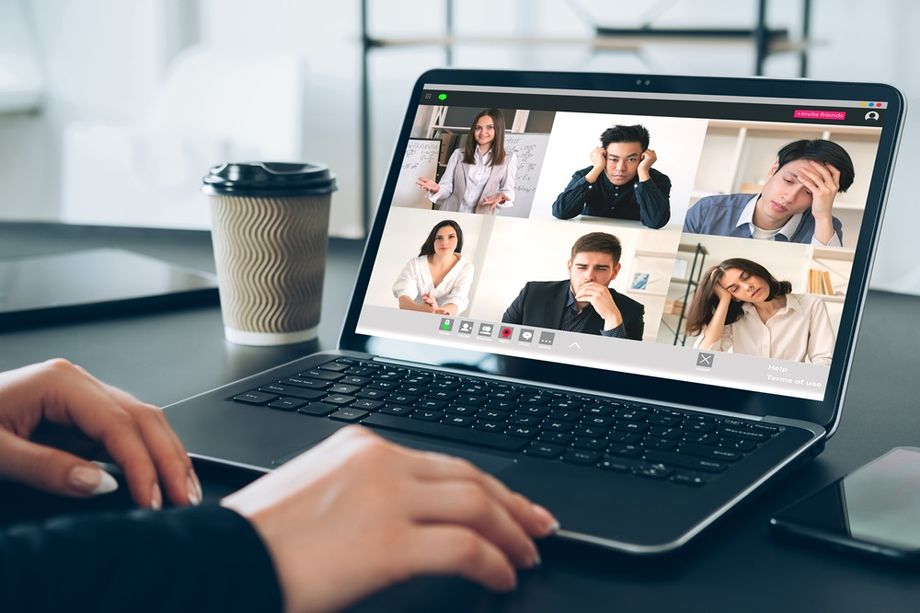
 More employees are choosing to turn off their camera and microphone for zoom calls - which could be indicative of deeper issues at work. Photo Credit: Adobe Stock/golubovy
Virtual meetings remain a staple in today's workplace, even as many
organisations adopt a hybrid approach. However, attendee engagement
during these meetings has not necessarily improved.
Interestingly, the return to the office did not reduce virtual meetings.
A recent Harvard Business Review survey of 40 million meetings from 11
organisations, spanning more than 450,000 unique employees, revealed
that in 2021, employees attended an average of 8.3 meetings per week,
which jumped to 10.32 in 2022. 2023 saw a slight reduction to 10.1,
mostly driven by fewer 1:1s (the easiest to replace when fully
in-person).
This trend reflects evolving employee preferences. Some participants
choose to join via video even when others are in the same office, while
others prefer virtual meetings for their recording, transcription, and
AI note summary capabilities. Many factors are at play as well, but it
appears that in-person collaborative behaviours are unlikely to return
to pre-pandemic norms.
The researchers also found that non-participation in meetings has increased. In 2023, 7.2% of workers stayed muted for entire meetings, up from 4.8% in 2022. Participants are enabling their cameras less often, with a slight drop in camera enablement rates from 2022 to 2023.
Notably, lack of participation during virtual meetings could signal
an impending resignation. Workers who left their company within a year
had their cameras on just 18.4% of the time in small group meetings,
compared to 32.5% for those who remained longer.
Although not a straightforward cause-and-effect relationship, a study
found that employees who felt more engaged at work were less fatigued
from virtual meetings compared to those who were more disengaged.
Shaping and improving the meeting culture
However, the data gleaned from virtual meeting attendance and
behaviour could prove useful to employers and organisations, who now
have a way to analyse what works, what doesn’t, and how they can make
improvements that stick.
Without intentional effort, meeting culture tends to gravitate toward
inefficiency. One suggestion for improvement that the review made was
to treat meeting culture as an important part of the larger company
culture – which encompasses best practices, responsibilities undertaken,
and possible meeting-free days.
Another suggestion is for “power users”, who have an outsized
influence on meeting culture, to set the tone for the majority of
meetings within the company and run effective meetings.