 New way of measuring mobility and openness lends insights into destination power for MICE. Photo Credit: iStock/towfiqu ahamed
In an increasingly fragmented world, the tremors of geopolitical realignment are rippling through global mobility, reshaping passport power, visa policies, and destination openness.
The Henley Passport Index 2026 – which ranks the world’s passports by the number of destinations their holders can access without a prior visa – captures how travel freedom has shifted over the last two decades.
Singapore retains its position as the world’s most powerful passport, with visa-free access to 192 destinations. Japan and South Korea are tied in second place with access to 188 destinations. By contrast, the US and UK – jointly ranked first in 2014 – have slipped to 10th and 7th respectively, reflecting a gradual erosion of passport power.
As the US turns inward, most recently proposing expanded personal data requirements for citizens of 42 allied nations under its Visa Waiver Programme, China has taken the opposite tack. Over the past two years, it has extended visa-free access to more than 40 additional countries, signalling a broader pivot towards openness.

“One door closes, another door opens. As traditional hubs like the US and UK tighten access, the ‘open door’ shifts elsewhere.”
Dee Dee Quah, director at Malaysia-based Medical Conference Partners
Open borders, open business
With Asia holding a commanding position in global mobility, destinations in the region are increasingly favoured for business events – particularly when visa-free access reduces friction for international delegates.
According to Dee Dee Quah, director at Malaysia-based Medical Conference Partners, visa accessibility is now a critical factor for participation across all MICE segments, especially for corporate meetings and incentive travel.
“For global organisations, the primary driver is risk mitigation,” she says. “Planners prioritise destinations where entry is guaranteed, as they cannot afford to have key stakeholders or employees blocked by last-minute visa denials or policy shifts.”
As a result, visa-free access has become a powerful selling point for certain destinations. “In the past year, we have seen destinations with expansive visa-free policies aggressively leveraging this accessibility to outperform competitors when bidding for large-scale international business events.”
In the current geopolitical and economic climate, she adds, a destination’s visa-free policy is a powerful signal. It frames the host country as welcoming, accessible and open to long-term global business partnerships, all hallmarks of a successful business events destination.
Emerging destinations, she notes, are particularly well-positioned. “One door closes, another door opens. As traditional hubs like the US and UK tighten access, the ‘open door’ shifts elsewhere,” she says.
Engagement equals access
For many associations, global engagement is only as strong as the ability of delegates to travel without administrative barriers, says Ferron Gray, president and founder of UK-based Grae Matta Foundation.
“When attendees can access multiple destinations without a prior visa, the likelihood of participation rises sharply – particularly for delegates from regions where visa processing is unpredictable or disproportionately complex,” he says. “Favourable entry policies are becoming a strategic asset for destinations looking to attract international events.”
Gray says host cities across Asia are demonstrating a clear competitive advantage, particularly for delegates from the Middle East and Africa, who often face more restrictive entry pathways elsewhere.
“When associations plan events, they increasingly look for destinations that minimise travel friction, reduce cost, and ensure equitable access. Countries that maintain friendly visa regimes will continue to stand out.”
Looking ahead, Gray believes visa policy will increasingly intersect with wider discussions around global competitiveness, inclusivity and sustainable event strategy. “Equitable mobility is becoming a foundational expectation for international events, and the MICE industry will continue to reward nations that recognise this,” he says.
Planning realities
In parallel, Quah observes that increased global instability has triggered a shift in delegate behaviour, with sponsors and attendees delaying commitment and registering much closer to event dates. Destinations with expansive visa-free access are best placed to capture the growing late-registration trend.
Teguh Heri Basuki, owner of Indonesia-based Samasta Tour & Travel, says planners in countries with less powerful passports, such as Indonesia, evaluate MICE destinations through a different lens. It’s not only about budget, but about practicality and peace of mind.

“Visas aren’t just paperwork, they can affect timelines, attendance, and even the planner’s credibility inside the company.”
Teguh Heri Basuki, owner of Indonesia-based Samasta Tour & Travel
“Choosing a destination also means asking: how predictable is the visa process?,” he says. “Will the group face delays? What if some participants get rejected? Visas aren’t just paperwork, they can affect timelines, attendance, and even the planner’s credibility inside the company. That’s why planners tend to favour destinations that feel accessible: countries with clear requirements, smoother approval patterns and a reputation for welcoming corporate groups.”
That said, Basuki is clear that visa-free access alone does not drive destination selection. The starting point is always the client’s objective and the experience they want to create. “If the decision-maker has a specific country in mind, our role is to assess the feasibility and work strategically to make it happen, including managing the visa process properly,” he says. “Beyond visa complexity, participant safety and event stability remain our top priorities.”
For travellers who require visas, Catherine Chaulet, president and CEO of Global DMC Partners, says visa procurement has become a genuine planning consideration, particularly for multinational programmes.
“Processing times have lengthened in many countries since the pandemic, and some destinations that were previously straightforward have become more complex,” she says. ‘We advise clients to factor visa timelines into their destination selection process from the very beginning.”
She adds that DMCs are often the first to know when visa processing changes or becomes problematic in their destination. The agency’s partners regularly advise on which nationalities face longer processing times, which consulates are backlogged, and even which visa categories work best for different event types.
“This intelligence allows planners to communicate proactively with attendees and build appropriate lead times into their planning,” she says.
Measuring global mobility
The gap between how freely a country’s citizens can travel (passport power) and how openly that country welcomes foreign visitors (openness rank) reveals a striking imbalance.
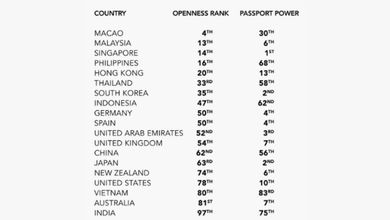 Photo Credit: Source: Henley Openness Index, Henley Passport Index