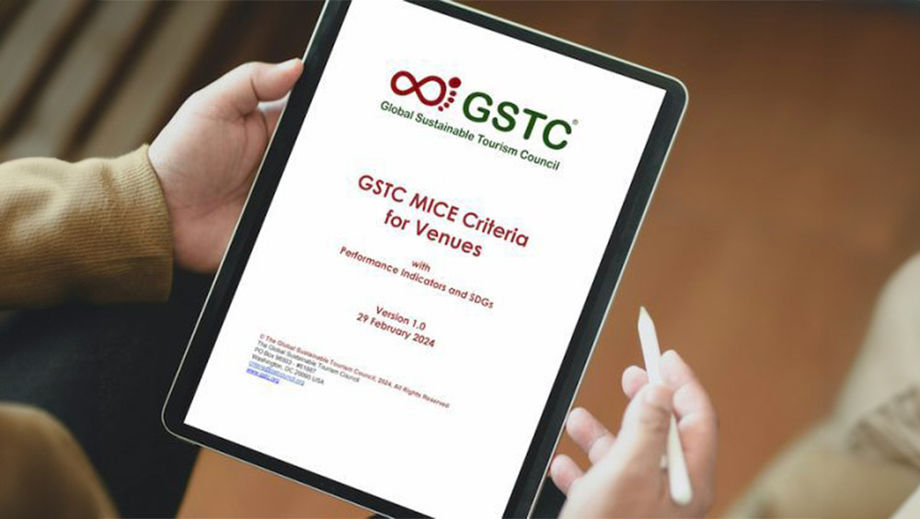
 The GSTC MICE Criteria will help define sustainability in a holistic manner.
A global effort to develop a common language about sustainability in
tourism has resulted in the formation of the new GSTC MICE Criteria
published by the Global Sustainable Tourism Council (GSTC).
The Criteria are used for education and awareness-raising,
policy-making for businesses, organisations and government agencies,
measurement and evaluation, and as a basis for certification. They are
arranged in four pillars: sustainable management; socioeconomic
impacts; cultural impacts; environmental impacts.
As the third GSTC Criteria set, it follows after GSTC Industry
Criteria (for hotels and tour operators) and the GSTC Destination
Criteria. Still under development is the GSTC Attraction Criteria.
Strong support from industry players
A MICE Criteria Development Advisory Group was involved in the GSTC
MICE Criteria development which included Green Key Global; Osaka
Convention Bureau; SACEOS, Sustainable Hospitality Alliance (SHA); Suwon
Convention Center; Visit Berlin; and Visit Oslo.
“After a year of dedicated work and effort, we announce the formal
release of the GSTC MICE Criteria for venues, event organisers, and
events & exhibitions. We thank the Singapore Tourism Board (STB),
who has been a key contributor to its development. Let's seize this
opportunity together to significantly advance the MICE industry's
journey towards sustainability,” said Randy Durband, CEO of GSTC.
Yap Chin Siang, deputy chief executive, STB, said: “Our collaboration
with the GSTC and Singapore Association of Convention & Exhibition
Organisers & Suppliers (SACEOS) to develop the GSTC MICE Criteria
underscores Singapore’s unwavering commitment to sustainable tourism and
solidifies our position as a leading MICE destination. The MICE
Criteria represents a major milestone on this journey, empowering
industry players with the relevant tools to contribute to and thrive in a
sustainable tourism landscape. I strongly urge all stakeholders in the
MICE ecosystem to embrace the criteria and play a pivotal role in
forging a greener future for global tourism.”
The Criteria development process was an 18-month-long journey from
September 2022 to February 2024. The GSTC will launch an Early Adopter
Programme for the MICE Criteria. It will run for two years, giving
industry players the opportunity to apply the Criteria in the field and
form a network for knowledge and experience sharing. Information on the
Program will soon be announced.
Key features of the Criteria:
· Help define sustainability in a holistic manner
· Raise awareness of the breadth and nature of sustainability
· Serve as the basis for certification for sustainability
· Offer both public and private sectors a starting point by
providing basic guidelines for MICE businesses to become more
sustainable, including guidance for identifying more sustainable
suppliers and service providers
· Help consumers identify sustainable MICE businesses
· Serve as a common denominator for recognising sustainable
MICE businesses, helping businesses in choosing sustainable suppliers
and partners
· Serve as basic guidelines for education and training on sustainable MICE practices
· Demonstrate leadership that inspires others to act
Greenhouse gas emissions
Among its features are criteria for venues regarding greenhouse gas emissions:
· The venue should measure greenhouse gas emissions in Scope 1,
Scope 2, and areas of significant influence in Scope 3 and have
specific greenhouse gas emissions reduction targets
· These should be aligned with recent Intergovernmental Panel on Climate Change (IPCC) guidance
· The venue would also have a written plan to avoid and reduce
greenhouse gas emissions from its operations and areas of influence
· This plan is being actively implemented
· The venue encourages and collaborates with suppliers to avoid and reduce significant greenhouse gas emissions
· The venue offsets some or all of its greenhouse gas emissions that remain after avoidance and reduction efforts
· The venue has a policy to prefer offsets that remove carbon
rather than offsets that avoid emissions and to select carbon offsets
that are additional, permanent, and verified by a credible organisation.