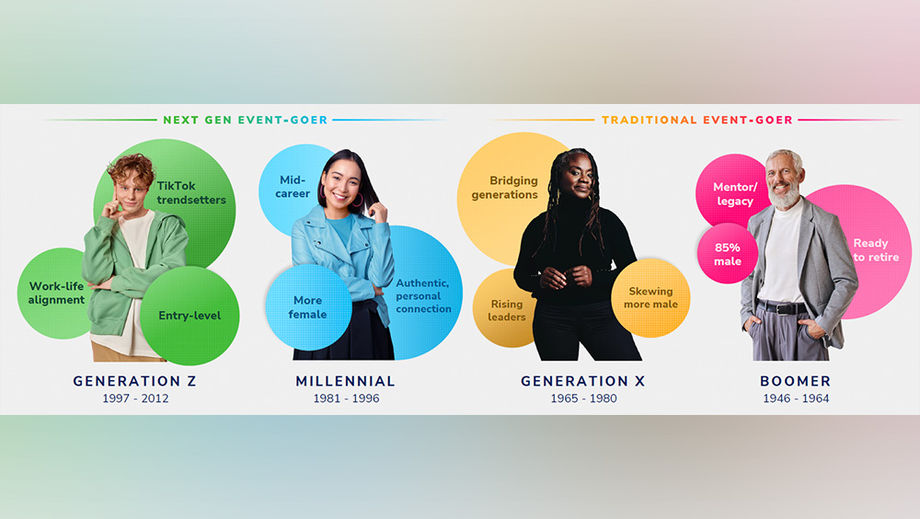
 The Freeman Trends Report 2024: view event attendees as consumers first. Photo Credit: Freeman
Based on decades of extensive research that seeks to uncover why
people attend events, Freeman has narrowed it down to four main reasons:
to have fun, to learn, to network, and to do business. More insights
are found in The Freeman Trends Report 2024 which reveals how budgets,
priorities and technology have evolved. This story forms part one of
several in a series under the Industry Reports section of M&C Asia.
Act on commonalities
A new wave of event-goers is taking the spotlight, as evident from
the increased number of Next Gen Event-Goers (NGEGs) in this year’s
sample.
They tend to care more about authentic connection and social causes
than other generations. It is imperative to recognise and act upon such
generational commonalities.
Yet, the report advises that planners cannot over-rotate to one side
of the generational spectrum and focus solely on NGEGs, nor can planners
put each generation into neat little boxes.
There are four generations of individuals to attend to – each on a
personalised level. With AI available for mainstream adoption,
AI-powered personalisation is possible at scale.
Hence, planners must personalise by knowing exactly what matters to
each attendee. This is why it is crucial to study attendees on a matrix
consisting of age, gender, role, and event preferences. These motivators
allow planners to understand exactly who attends events and what type
of experience they seek.
Location, environment, sentiment
Food, seating, and social events are relatively important to some
attendees, but despite what some post-event surveys report, most
attendees do not value games, natural lighting, and wellness. However,
many event organisers focus on orchestrating and promoting these less
impactful activities.
It is tempting to lean into low-effort elements, but it comes at the
expense of delivering what attendees value most. A yoga class or a fun
run may be an easy addition, but it is low-hanging fruit, said the
report.
The data shows that by focusing first on high-effort event components
like customisation and immersion, event planners and attendees will
gain better returns.
When asked which were the most important experience elements,
games/competitions, more natural lighting, and wellness opportunities
were ranked 6%, 6% and 3% respectively, whilst immersive experience was
ranked the highest at 64%. This was followed by customised agenda plans
at 45%, and technology that makes consuming the event easier at 44%. An
immersive, visually appealing atmosphere was next at 43%, followed by
quality F&B offerings at 28%. Most comfortable seating was 22%.
Education, inspiration, training
Attendees want substance, not celebrities, in keynotes, plenary and
general sessions. Innovation and industry experts prevail as the
preferred keynote topic and speaker types.
Attendees want to hear about topics such as innovation and from
people like industry leaders and experts. Celebrity speakers do not
drive behaviour or outweigh what really matters.
Hence, a relevant topic will outweigh even the most prominent
speaker, it reported. To attendees, the most important factors for
attending such sessions start with topic, followed by type of speaker,
session format, duration, and award or recognition.