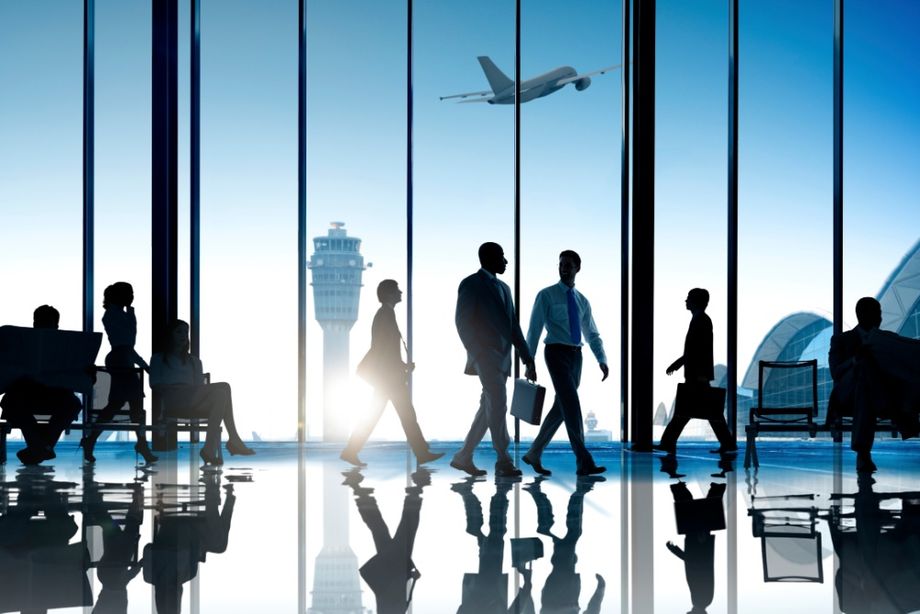
 More business travellers are planning trips in 2024 to connect with clients and colleagues. Photo Credit: Adobe stock/Rawpixel.com
The annual travel capacity for corporate and leisure clients is set to surpass figures in 2018 and 2019, according to FCM Consulting’s Q4-2023 Quarterly Global Trends Report, citing data from Cirium.
A key trend that is set to continue for 2024: more seats with fewer flights. H1 2024 is forecast to offer 97.9 million (rise of 3.5%) more seats, and 2.1 million (drop of 5.6%) fewer flights than H1 2019.
“This is a result of fleet configuration changes and shifts in schedules to meet the demand. When carefully planned, this will be favourable to airline operating costs, staffing, airport slots and airport costs,” said Bertrand Saillet, MD of FCM Travel Asia.
“Q4 2023 closed a milestone year, seeing corporate travel the busiest and least interrupted in over four years. Business travellers became more confident than in previous years and are planning trips in 2024 to both grow their business and connect with clients and colleagues,” Saillet said.
“Across the top global corporate airlines, we forecast that the seats offered in 2024 will be 2% above 2019 and the number of flights offered will be down 6%.”
“American Airlines, Delta Airlines, United Airlines, China Southern Airlines, China Eastern Airlines, LATAM Airlines Group, Qatar Airways, Cathay Pacific, Singapore Airlines, and Virgin Atlantic Airways are all forecast to be back over 100% in terms of seats offered when compared to five years ago.”
Airlines in the home markets of China and India lead Asia’s growth. The top Chinese airlines are forecasted to offer 21% more seats in 2024 than in 2019.
As Singapore is the number one international destination from Shanghai, economy class fares remain strong at an increase of 9% from both Shanghai Hongqiao International Airport and Shanghai Pudong International Airport. Business class fares, however, saw a respective increase of 22% and 21% respectively from these two airports.
Mumbai to London saw a 25% increase in economy class fares and a 24% increase in economy class fares from Mumbai to Delhi. Business class fares from Mumbai to London increased by 13%.
Hotel rates
The average hotel room rates increased across all regions for 2023, when compared to 2022, with Asia seeing a rise of US$39, the highest globally.
In Q4 2023, Singapore commanded the highest average room rate paid by corporate travellers per night at US$$296, followed by Hanoi at US$$201, Bangkok at US$$184, Manila at US$$174, Jakarta at US$$155, and Kuala Lumpur at US$$145.
“Kuala Lumpur witnessed the sharpest increase of 38% in Q4-2023 as compared to Q3-2023, followed by Singapore at 11%. Jakarta was up by just 1% and Manila remained flat.
“Despite the increased cost, all regions also saw a lift in occupancy levels year-on-year, with Mainland China – the last major nation to reopen its borders – leaping 34% to have an occupancy rate of 65%, Asia excluding China saw an increase of 17%, and India saw an increase of 1.8 to 70% occupancy level in 2023,” concluded Saillet.