 Business Events Council Malaysia chairman, Alan Pryor, said that lockdowns have not allowed the MICE industry to reset and gradually recover.
Less than a month after MICE events were given the go-ahead to resume
in Malaysia, the government's latest lockdown measures — a two-week
Movement Control Order (MCO) from 13 January — have dealt the industry
yet another blow.
MICE is considered a non-essential sector, so when the two-week MCO
was announced last week, all events in Melaka, Johor, Penang, Selangor
and Sabah, as well as in the federal territories of Kuala Lumpur, Labuan
and Putrajaya, were banned.
Alan Pryor, the Business Events Council Malaysia chairman, pointed
this out and said this led to immediate closure and loss of events with
postponements being the best-case scenario. He noted that the long
period of lockdown had already impacted the industry in a very negative
way with thousands of job losses and businesses shutting down due to
loss of revenue.
According to a recent survey by the Malaysian Association of
Convention and Exhibition Organisers and Suppliers (MACEOS), business
events industry players had experienced revenue losses of RM2.25 billion
(US$560 million), a drop of 90% since the first MCO in Malaysia
started.
“Venues in Malaysia have had to survive since March 2020 with almost
zero revenue, and a total of 5,610 employees from the overall supply
chain had been laid off since then, equivalent to 17% of the total
industry workforce,” said Pryor who is also Kuala Lumpur Convention
Centre's general manager.
With record daily cases of Covid-19 infections breaching the 4,000
mark at one point, the two-week Movement Control Order began on 13
January for eight states and territories, including Kuala Lumpur and the
states of Selangor and Penang and will remain in force until 26
January.
Malaysian Prime Minister Muhyiddin Yassin has also declared a state
of emergency that will remain in force until 1 August, but Pryor noted
that it wouldn’t have any direct impact on the industry.
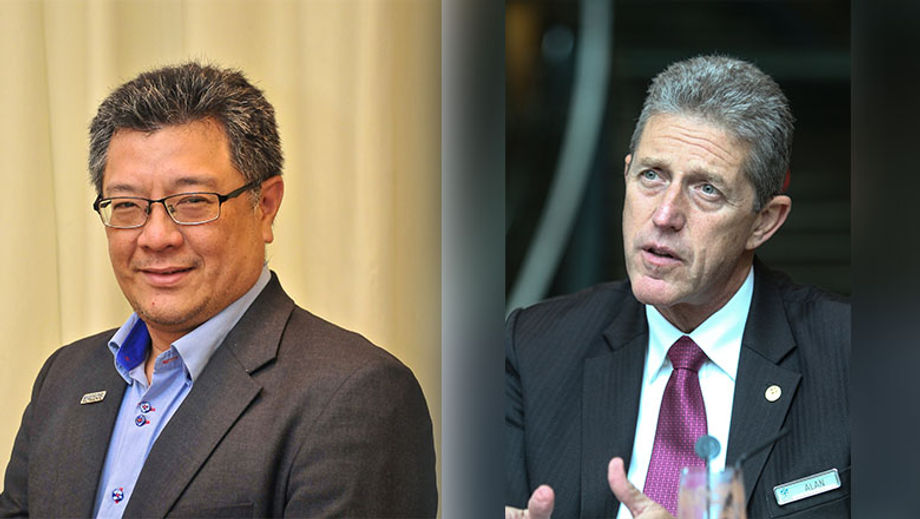 17% of the total industry workforce has been laid off, said Alan Pryor, chairman at Business Events Council Malaysia (right). MACEOS president Francis Teo (left) is lobbying the government to support the virtual push.
“The industry has barely had time to get back on its feet and every
time we are ready to reset and start a gradual recovery, we are faced
with yet another lockdown. Malaysia’s business events industry will
suffer throughout the first half of the year and possibly right into the
second half of 2021 if we continue to be restricted to operate,” he
said.
Pyror added that even if events are allowed to resume, they could
only work towards rehabilitating the industry before any form of
recovery is seen throughout the local supply chain.
Is going fully virtual the answer?
Pyror shared with M&C Asia that he's unsure if virtual events are
allowed during the lockdown and while moving forward it offers
advantages, by itself it cannot save the industry and its supply chain.
MACEOS president Francis Teo urged the government to allow production
crew in a studio to work and provide technical support for virtual
events, which is well noted by the Malaysia Convention & Exhibition
Bureau (MyCEB).
Teo noted that the lockdown could be extended beyond the two-week
duration and that industry players needed help to sustain themselves. He
hoped the government would extend the wage subsidy structure to 50% and
for those earning RM6,000 and below even though they were considered
non-essential.
Pyor agrees.
MICE venues though currently considered not as tourism enterprises
under the purview of the Tourism, Arts and Culture Ministry, should
still be allowed subsidies and incentives. The government needs to
recognise the worth and value of the industry and should have
communication channels in place to ensure that, said the Business Events
Council Malaysia chairman.
MyCEB says that they are in the midst of planning a strategic
marketing plan for the years 2021-2030, which should be launched in Q1
2021.