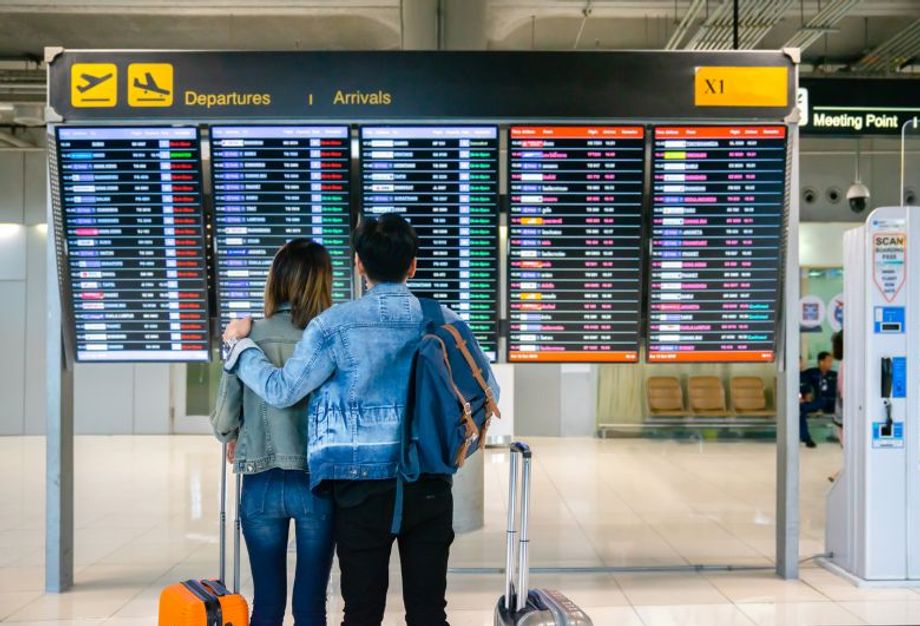
 "Complete harmonisation is unlikely. But some simple best practices that travellers can comprehend should be achievable," said IATA Director General, Willie Walsh. Photo Credit: Getty Images/tool51
After two years of travel restrictions and its "confusing web of
rules", a new survey shows "little evidence to support ongoing border
restrictions and the economic havoc they create," said Willie Walsh,
Director General, The International Air Transport Association (IATA).
The association is resounding its call for governments to simplify
"wildly inconsistent" border rules, especially since major key markets
which were previously closed are now re-opening, such as Europe, Canada,
the UK, the US, Singapore, and even the draconian-ruled Australia.
Willie Walsh, IATA’s Director General said: “Covid-19 is present in
all parts of the world. Travel restrictions are a complex and confusing
web of rules with very little consistency among them. And there is
little evidence to support ongoing border restrictions and the economic
havoc they create."
He pointed to the testing results of UK arriving passengers, where
out of the three million recorded between February and August, only
42,000 tested positive — or fewer than 250 a day. That is in contrast to
the daily case count of 35,000 in the UK.
"The UK economy — apart from international travel — is wide open. People should be just as free to travel,” said Walsh.
Are destinations truly open?
 Only four states — Germany (pictured), France, Switzerland, and Austria — recognise immunity resulting from previous Covid-19 infection as equivalent to vaccination. Photo Credit: Getty Images/f11photo
However, a recent survey across 50 travel markets, accounting for 92%
of global traffic, show a disconnect in government's border reopening
measures and being "truly open".
For instance, 38 states still have some form of Covid-19 restriction
on who can enter. Only seven states have no entry restrictions or
quarantine requirements upon arrival. A further five have no additional
restriction on who can enter but maintain quarantine measures for some
after arrival.
As for the 38 states which mandate pandemic restrictions, 20 exempt
or foresee exemptions from restrictions in various forms for vaccinated
travellers, yet, nine states do not recognise the full WHO list of
vaccines — another case of vaccine inequality.
Furthermore, there is no agreement on the duration of the validity
period for a traveller to be considered vaccinated, and there is no
consistency on what is needed to prove prior infection.
As for minors, there is no consistency on the age definition of
minors, with less than 10 states exempting minors when they travel with
vaccinated adults.
- IATA has recommended this five-step framework for governments:
- Vaccines should be made available to all as quickly as possible
- Vaccinated travellers should not face any barriers to travel
- Testing should enable those without access to vaccines to travel without quarantine
- Antigen tests are the key to cost-effective and convenient testing regimes, and
- Governments should pay for testing, so it does not become an economic barrier to travel
As
with all safety regulations, review periods should also be defined for
Covid-19 measures, "otherwise, as we said in the aftermath of 9.11,
well-intentioned measures could remain in place long after they are
necessary, or have become technologically or scientifically obsolete,”
said Walsh.
Walsh also stressed the importance of digital tools again, including
the IATA-backed EU Digital COVID Certificate (EU DCC), and the IATA
Travel Pass which recently entered regular operations.
"Experience even at today’s low levels of travel tells us that there will be chaos in airports if we rely on paper processes."
Source: Travel Weekly Asia