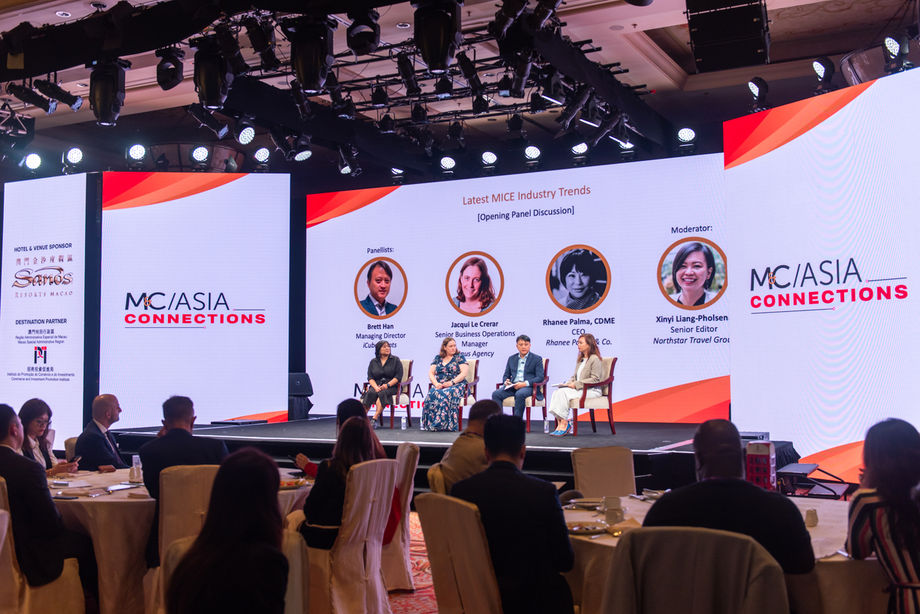
 Speaking at the recent M&C Asia Connections, industry experts touched upon topics ranging from Asia’s appeal to event planners, the significance of hybrid events, and AI’s role in the planning process. Photo Credit: Meetings & Conventions Asia
Asia is steadily becoming the global destination of choice for
meetings and events amidst increasing budget constraints and political
tensions, according to event professionals at the recently concluded M&C Asia Connections 2024 in Macao.
Moderated by M&C Asia senior editor Xinyi Liang-Pholsena, the
panel brought together Brett Han, managing director at iCube Events;
Jacqui Le Crerar, senior business operations manager at Opus Agency; and
Rhanee Palma, CEO of Rhanee Palma and Co. to discuss the latest trends
and challenges in the MICE industry.
Surge in interest in Asia
While post-pandemic travel has picked up, event budgets have
tightened significantly. Brett Han explained, “We have to be extra
careful to propose exactly what the client wants, because with tighter
budgets, there’s now a higher chance that the client may postpone their
event instead if we don’t meet their exact expectations.”
Jacqui Le Crerar echoed similar sentiments from the UK. “Clients are
very much looking forward to getting back into events and doing a lot
more events than we’ve previously seen but they’re very cautious in
terms of budgets, and the timeline has become much shorter. More often
than not, clients want something now.”
This belt-tightening across the industry is prompting more planners
to consider Asia for events, where competitive rates, meeting packages,
and warm hospitality proved to be drawcards for longhaul MICE buyers.
“European buyers are shying away from expensive cities like London and
Paris – even Barcelona is becoming costly. We’ve seen a lot more people
wanting to come to Asia – it’s a great opportunity for us to explore the
region,” said Le Crerar.
Beyond budgetary advantages, the region’s political stability has
also drawn attention. Rhanee Palma emphasised, “Many clients (in the US)
are avoiding the US due to its political climate. It’s become a
concern, so we’re actually having a lot more conferences outside of the
US, and we’re definitely looking at Asia.”
European buyers are shying away from expensive cities like London and Paris – even Barcelona is becoming costly.
Jacqui Le Crerar, senior business operations manager, Opus Agency
Hybrid events a lasting trend
The rise of hybrid events during the Covid-19 pandemic has proven to
be more than a temporary solution. Despite budgetary constraints,
clients still value in-person networking and connection.
“Even with smaller budgets, clients want customised experiences that
allow them to connect with peers,” said Han, explaining how hybrid
formats help maintain these connections while cutting costs.
Le Crerar agreed: “A hybrid event allows for networking, where
clients can get together and see and talk to each other. Being able to
have that face-to-face connection and have their personal conversations
is really important for clients, and it’s so much easier than when
you’re doing a purely virtual event.”
AI really helps me in creating agendas or a programme schedule with all these different prompts.
Rhanee Palma, CEO, Rhanee Palma and Co.
AI, the event planner’s new assistant
With technology becoming increasingly necessary for events, it’s no
surprise that planners have been turning to AI as a potential tool in
their arsenal.
“It’s still early days with AI right now,” said Han. “But in terms of
using platforms like ChatGPT, it’s quite useful for planners because it
helps with coming up with ideas or designs that they can then leverage
on.”
Palma added, “We use AI across all my programmes. AI really helps me
in creating agendas or a programme schedule with all these different
prompts, and I can then show it to these scientists, and they can just
add in the schedule for the conference based on the draft that I’ve made
with AI.”