 Resilience may be a key skill in a demanding events industry, but event professionals must learn to recognise burnout. Photo Credit: AdobeStock/mitay20
Behind the scenes of every seamless event is a well-hidden pressure cooker of deadlines, decisions and chaos. While resilience is easily taken for granted in the business events industry, this high-stress, results-oriented workforce especially calls for mental health awareness and management skills.
Speaking at the recent BE @ Penang conference, associate professor Prem Kumar Chandrasekaran challenged event professionals to rethink how ambition, workload, and expectations are managed within their organisations.
Resilience a must
Prem, a consultant neuropsychiatrist at Penang Adventist Hospital and Head of Neurobehavioural Services, made it clear that resilience is a core professional competency for the business events sector.
The industry’s pace and performance-driven culture, he noted, place professionals at heightened risk of burnout if mental health skills are not actively developed.
According to Prem, many mental health challenges in the workplace stem from overambition and unrealistically high benchmarks for success. When these targets are repeatedly missed, individuals experience a cycle of frustration, diminished self-worth, and eventually depression and burnout – outcomes that directly undermine productivity and organisational effectiveness.
Problematising the perfection pursuit
Compounding the issue is the pervasive influence of social media. Prem cautioned against uncritical comparisons with highly curated portrayals of success. “What is often invisible are the struggles, failures, and sacrifices behind those achievements,” he noted. The result, particularly among younger professionals, is a growing sense of inadequacy and disengagement when similar outcomes prove elusive.
One of the most damaging patterns identified was what Prem described as the perfectionism trap – the belief that one must do everything, and do it perfectly.
In the business events environment, this mindset often leads to decision paralysis, chronic procrastination, and eventual emotional exhaustion.
“The ‘I have to do it all’ mentality is not a strength,” Prem asserted. “It is a direct pathway to burnout.” His prescription was clear: delegation, mentoring, and teamwork are not signs of weakness but proven operational and mental health strategies.
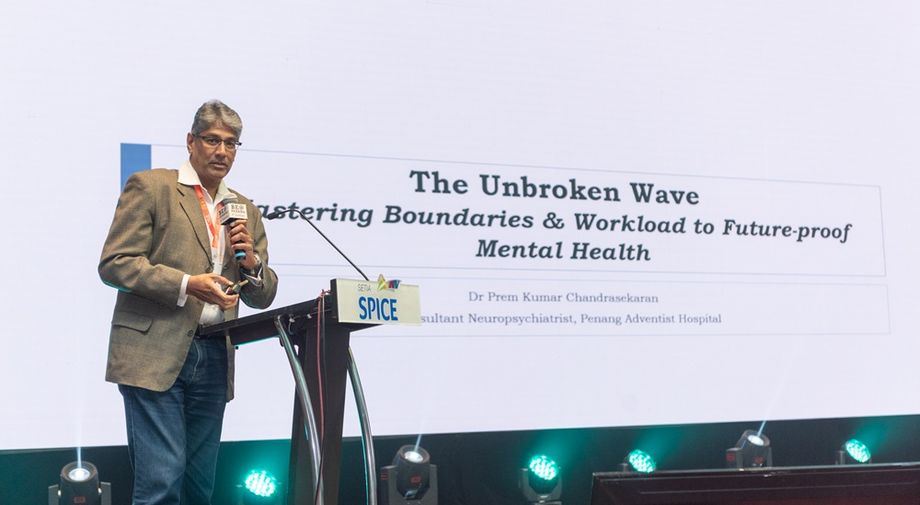 Prem: good mental health care is not about infinite toughness – but awareness of limits, ability to introduce structure, and willingness to seek help.
Research consistently shows that effective task delegation and structured mentoring not only prevent burnout but also improve performance, particularly in industries where professionals are managing multiple projects, clients, and live events simultaneously.
Recognising burnout
Early identification, Prem emphasised, is critical. He outlined three key indicators – often referred to as the three pillars of exhaustion – that leaders and managers should watch for: emotional exhaustion (persistent fatigue and low energy), inefficacy (declining productivity and morale), and detachment (withdrawal and negative attitudes towards colleagues and family).
These indicators are also useful in distinguishing burnout from routine work stress. Typical work-related stress, he explained, tends to ease by the weekend and resurface before the workweek begins. Burnout, by contrast, is persistent and progressive.
Stress is not the enemy – denial is
Importantly, Prem rejected the idea that all stress is harmful. “Manageable stress can be motivating, sharpen focus, and enhance productivity,” he said. Problems arise only when stress becomes chronic, unmanaged, and embedded in workplace culture. At that point, it increases the risk of anxiety, depression, and a range of physical health conditions.
The solution, he argued, lies in building mental endurance – starting with clear boundaries between work and personal life. After-hours communication protocols, for example, are a practical leadership tool that signals respect for employees’ personal time and reduces the corrosive sense of being constantly ‘on call’.
Prem concluded by outlining a holistic framework for stress management built around four pillars: mental (positive thinking and spirituality), physical (nutrition, exercise, sleep), social (support networks and relationships), and biological (professional intervention and medication where necessary).
“Good mental health is not about denial or toughness,” he said. “It’s about awareness, structure, and having the courage to seek help when needed.”