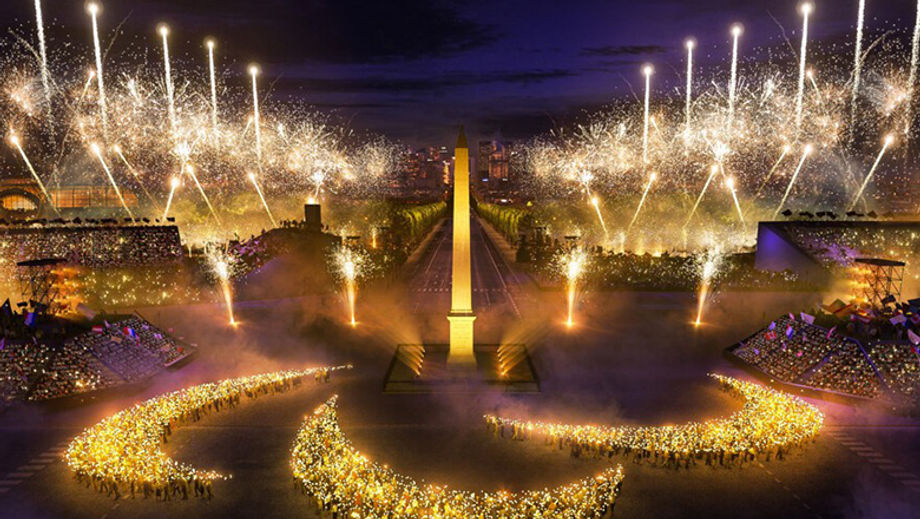
 The opening ceremony of the Olympic and Paralympic Games Paris 2024 will be on the Seine River. Photo Credit: Paris 2024
For the first time in history, the opening ceremony of the Olympic
and Paralympic Games Paris 2024 will not be taking place in a stadium.
It will be held in the heart of the city, on the Seine River, on 26 July
2024.
The Games’ exclusive official hospitality provider, On Location, is
the official partner to over 150 of the most significant brands in
sports and entertainment.
During the opening ceremony, corporate guests taking the Bridge
360 Package costing €9,500 per pax (US$10,405) will celebrate in style
in premium seats offering unparalleled views and access. This will
include views of the parade and the Eiffel Tower from the famous Alma
bridge, access to hospitality before, during, and after the ceremony,
cocktail dining with a selection of beverages, live music and
entertainment, guest appearances and photo ops, grandstand seating
(Category A), and open seating on the bridge.
Sustainable Paris 2024
According to PCMA’s Convene, 95% of the venues for the Games will use
existing or temporary buildings, the highest figure of any previous
Olympic Games. This covers historic sites that have been refurbished
such as Yves-du-Manoir Stadium, which was the main venue for the 1924
Games and will host the field hockey competitions for Paris 2024.
Temporary facilities include an outdoor arena that will host the Olympic
and Paralympic equestrian jumping and dressage competitions on the
Etoile Royale esplanade at Château de Versailles.
The Olympic and Paralympic Village comprises neighbourhoods of
Seine-Saint-Denis, Ile Saint-Denis, and Saint-Ouen, and will house
14,500 athletes and their staff during the Olympic Games followed by
9,000 athletes and their staff during the subsequent Paralympic Games.
The Village’s carbon footprint is also 30% less than that of a modern
construction project due to the use of wood and recycled materials, also
creating climate-resilient infrastructure.
Legacy for Paris 2024
The geothermal-powered Olympic Village will be a first for the Games,
a departure from diesel generators as a primary source of energy. A
newly created grid operated by French partner Enedis and EDF will supply
Paris 2024 venues with energy produced via off-site wind and solar
farms, saving 14,000 tons of carbon emissions. This is also permanent,
helping to further the legacy of Paris 2024 by allowing future events to
harness renewable energy too.
 The Aquatics Centre: the only permanent sports facility to be built for the Paris 2024 Games. Photo Credit: Paris 2024
The design of the new Aquatics Centre, the only permanent sports
facility built for Paris 2024, has been built primarily with wood rather
than concrete or steel, and will require less cooling and heating,
aided by the rooftop solar panels, qualifying as one of France’s largest
urban solar farms.
Similar installations will be added to the Olympic Village, the
Transport Mall, and on the Seine, where a floating solar power plant
with 7,750 sqm will supply energy to the Games and will be repurposed
elsewhere later. The backup generators will run on biofuels.
Venues for the Games have been selected for their nearness to public
transport even beyond Paris. Lyon, Saint-Etienne, Nice, Bordeaux,
Nantes, and Marseille will all serve as Olympic host sites in 2024, with
France’s high-speed TGV rail network connecting spectators to those
cities and other Olympic sites around France. Within Paris, spectators
will have the Paris metro to rely on, which has expanded routes for the
Games.
Extra bicycles will be available for spectator use via Vélib, a
public bike-sharing program. Toyota will provide a fleet of electric-
and hydrogen-fuelled transportation options on hand for athletes, staff,
and spectators.