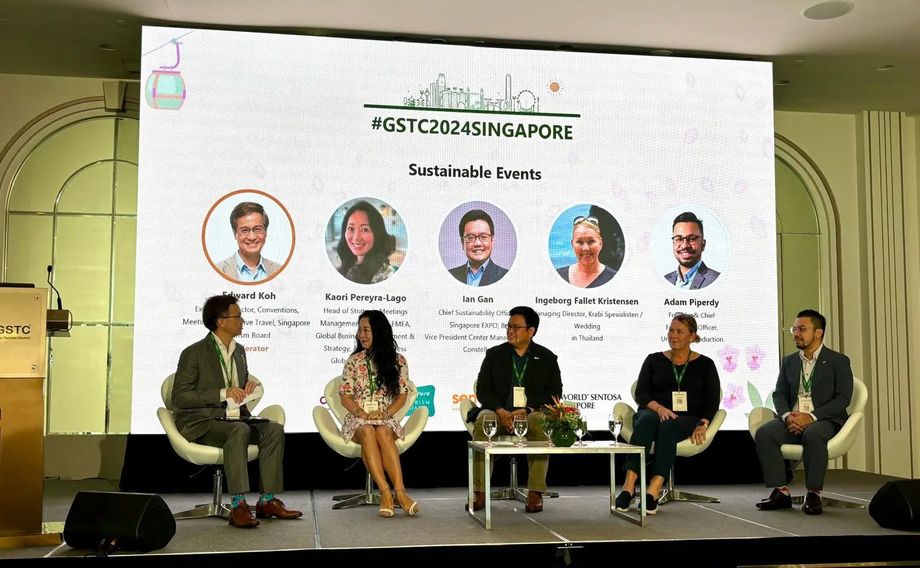
 The panel at GSTC Conference in Singapore discussed key ways to reduce waste. Photo Credit: Patricia Wee
At the recent Global Sustainable Tourism Conference 2024, held in Singapore at Resorts World Sentosa, a panel of experts shared their insights on implementing sustainable practices throughout the event lifecycle.
The panel discussion, moderated by Edward Koh, executive director, conventions, meetings & incentive travel at Singapore Tourism Board, featured contributions from Ian Gan, chief sustainability officer, Singapore EXPO and VP Center Management, Constellar; Adam Piperdy, founder and chief experience officer, Unearthed Productions; Kaori Pereyra-Lago, head of strategic meetings management, APAC & EMEA, Global Business Development & Strategy, American Express Global Business Travel (Amex GBT), and Ingeborg Fallet Kristensen, managing director, Krabi Spesialisten.
Understand the impact of food waste
Amex GBT’s Pereyra-Lago highlighted a rising commitment to sustainability among MICE professionals. She identified reducing food waste as a growing priority in this area, as it represents 8-10% of global greenhouse gas emissions when compared with aviation (3%).
“If we tackle the food waste, we can make double or triple the impact for the same action and decision we are making, as meetings and events are notorious for food waste,” she said.
Pereyra-Lago recommended building a policy around education, talking to customers to reduce waste from the beginning. “Communicate with them and ask them if they are not going to show up for a meal, to make sure you are as close as possible to having the exact number [of attendees],” she said.
Collaboration is key
Singapore Expo’s Gan highlighted how to achieve a reduction in carbon emissions. Referencing a study carried out in July this year, Gan shared how the venue has achieved carbon emissions per sqm that are 45% lower than the industry effort.
The venue focuses on four pillars in its sustainability efforts: renewable energy; efficient building operations; waste management operations with on-site food waste recycling; and responsible F&B with farm-to-table experiences.
For Gan, key drivers to succeed as a sustainable MICE destination include open collaboration and reciprocal engagement across the entire MICE ecosystem. He said this is a shared responsibility; whilst governments determine policies, regulations and incentives to shape behaviour and outcomes, associations can set industry standards, establish certification programmes and encourage training and sharing of information.
Get creative with your materials
Unearthed Productions’ Piperdy shared how his company reduces waste through the creative re-use of pallets and industrial crates. Materials that were used to transport heavy and fragile event equipment are transformed into event props, creating a circular economy in the production and consumption of such products. Choosing a suitable venue and destination could also negate the need to build an event backdrop. Piperdy also suggested eliminating the use of carpets at events. “You might be able to recycle them [carpets], but why start in the first place?” he said.
Successful work with local communities
Krabi Spesialisten’s Kristensen said her company has stressed the importance of supporting local communities and protecting natural resources in a developing tourism destination. Among the challenges of implementing sustainable practices are the cost implications and the lack of awareness in waste management.
Some successful initiatives with communities include beach cleanups and carbon-friendly activities such as kayaking. Kristensen highlighted how such physical activities not only boost health and well-being, but also connect participants to culturally significant sites and nature.